


Page 1802 - Hall et al (2015) Principles of Critical Care-McGraw-Hill
P. 1802
CHAPTER 128: Anaphylactic and Anaphylactoid Reactions  1271


                    ETIOLOGY                                              life-threatening reactions occur with a frequency of less than 0.1%
                                                                          with conventional high-osmolality RCM. 26,27  With the development of
                    The various triggers of anaphylaxis are grouped according to the mecha-  lower-osmolality RCM, the overall risk of anaphylactoid reactions has
                    nism by which they cause anaphylaxis (Table 128-2). Overall drugs and   decreased. 28
                    foods are the most frequent causes of anaphylaxis. 16  Systemic allergic reactions to insect stings are reported by up to 3%
                     Foods are arguably the most common cause of anaphylaxis in the   of adults, and almost 1% of children who have been stung. 29,30  At least
                    outpatient setting. Food allergens account for 30% of fatal cases. 17,18  The   50 fatal reactions to an insect sting occur each year in the United States.
                    prevalence of food-induced anaphylaxis is increasing. The most fre-  Half of these occur in individuals who had no history of a previous reac-
                    quently incriminated foods are peanuts, tree nuts, fish, and shellfish, but   tion to an insect sting. 31
                    other foods, such as sesame seeds, have become increasingly important   It has  been  estimated that  the  overall  incidence  of latex allergy  in
                    as causes of food-induced anaphylaxis. 18,19          the United States ranges between 2.7 million and 16 million. Although
                     Medications are the second most common overall cause of anaphy-  the incidence of latex allergy has risen markedly over the last 15 years,
                    laxis, and perhaps the primary cause of anaphylaxis in adults.  They   with the reduction of the use of powdered gloves and the substitution
                                                                  20
                    are also the most common cause of anaphylaxis in the hospital setting.   of nonlatex gloves in hospitals, the incidence of latex allergy appears
                    The most common classes of drugs producing anaphylaxis are antibiot-  to have stabilized and perhaps declined.  Populations at risk are those
                                                                                                       32
                    ics, especially β-lactam antibiotics, and nonsteroidal anti-inflammatory   experiencing multiple mucosal exposures to latex such as subjects who
                    drugs (NSAIDs). β-Lactam antibiotics account for as many as 22% of all   have had multiple catheterizations, multiple surgeries, and of course
                    drug-related episodes.  NSAIDs are the second most common medica-  health care workers.
                                    2
                    tion offender.  Depending on the country, anaphylactic reactions dur-  Exercise-induced anaphylaxis (EIA) is a rare disorder. One study
                             21
                    ing the perioperative procedure represent 9% to 19% of complications   estimated  the  prevalence  of  EIA  among  Japanese  adolescents  to  be
                    occurring during anesthesia. The fatality rate approximates 5% to 7%.   approximately 0.03%, with no clear gender preference.  Exercise-
                                                                                                                    33
                    Muscle relaxants account for 62%, latex approximately 16%, and the   induced anaphylaxis exists in two forms. In one form the act of
                    remainder of reactions are due to hypnotics, antibiotics, plasma sub-  exercise alone is sufficient to produce an event, and in another form
                    stitutes, and opioids.  Other agents like antilymphocyte globulin and   exercise  plus  a  cofactor  such  as  the  ingestion  of  a  food  or  drug  is
                                   22
                    antivenom antisera have been mentioned as causes of anaphylaxis.  required. The prevalence of patients with purely exercise-triggered
                     Anaphylaxis to anticancer chemotherapy drugs is increasing in inci-  anaphylaxis, relative to those who require exercise plus a cofactor,
                    dence with the increasing use of these drugs. In particular, reactions to   is not known.  Foods are the most frequently reported cofactor.
                                                                                                                            35
                                                                                    34
                    the platinum-containing drugs, such as cisplatinum and carboplatinum,   NSAIDs  and  aspirin  are  the  most  frequently  reported  drug  cofac-
                    are increasing in incidence.  Anaphylactic events to biologic modifiers   tor. 36,37  Other cofactors include alcoholic beverages, menstruation, and
                                       23
                    are also growing in importance. These include omalizumab (anti-IgE),   exposure to pollen during exercise. 36,38
                    an agent used to treat asthma,  and cetuximab, a chimeric mouse/  The cause of anaphylactic events remains unidentified in as many as
                                           24
                    human IgG1 monoclonal antibody to epidermal growth factor receptor   two-thirds of adults presenting to an allergist/immunologist for evalua-
                    used in the treatment of colorectal cancer and squamous cell cancer of   tion of anaphylaxis. A survey of 75 allergists in the United States found
                    the head and neck. 25                                 that these physicians had encountered 633 cases. The authors extrapo-
                     Radiographic contrast material (RCM) is used in more than 10   lated these data to the population of the USA and estimated there are as
                    million radiologic examinations annually in the United States. The   many as 20,592 to 47,024 cases. 14
                    overall frequency of adverse reactions is 5% to 8%. Moderate reactions,
                    such as severe vomiting, diffuse urticaria, or angioedema, that require   CAUSES OF ANAPHYLAXIS IN THE CRITICAL
                    therapy occur in about 1% of patients who receive RCM. However,
                                                                          CARE UNIT OR OPERATING ROOM
                                                                          The  incidence  of anaphylaxis  during  anesthesia  has been  reported to
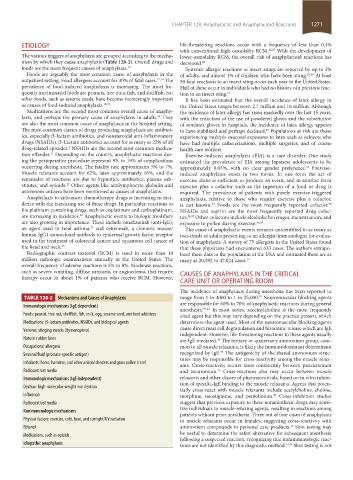
                      TABLE 128-2    Mechanisms and Causes of Anaphylaxis  range from 1 in 4000 to 1 in 25,000.  Neuromuscular blocking agents
                                                                                                    20
                                                                          are responsible for 60% to 70% of anaphylactic reactions during general
                    Immunologic mechanisms (IgE dependent)
                                                                          anesthesia. 39-41  In most series, succinylcholine is the most frequently
                    Foods: peanut, tree nut, shellfish, fish, milk, egg, sesame seed, and food additives  cited agent but this may vary depending on the practice pattern, which
                    Medications: β-lactam antibiotics, NSAIDs, and biological agents  determines the agent used. Most of the neuromuscular blocking agents
                    Venoms: stinging insects (Hymenoptera)                cause direct mast cell degranulation and histamine release which are IgE
                                                                          independent. However, life-threatening reactions to these agents usually
                    Natural rubber latex                                  are IgE mediated.  The tertiary or quaternary ammonium group, com-
                                                                                      42
                    Occupational allergens                                mon to all muscle relaxants, is likely the immunodominant determinant
                                                                                       43
                    Seminal fluid (prostate-specific antigen)             recognized by IgE.  The antigenicity of the shared ammonium struc-
                    Inhalants: horse, hamster, and other animal danders and grass pollen (rare)  tures may be responsible for cross-reactivity among the muscle relax-
                                                                          ants. Cross-reactivity occurs most consistently between pancuronium
                    Radiocontrast media                                   and vecuronium.  Cross-reactions also may occur between muscle
                                                                                      44
                    Immunologic mechanisms (IgE independent)              relaxants and other classes of pharmaceuticals, based on in vitro inhibi-
                                                                          tion of specific-IgE binding to the muscle relaxants. Agents that poten-
                    Dextran: high-molecular-weight iron dextran           tially cross-react with muscle relaxants include acetylcholine, choline,
                    Infliximab                                            morphine, neostigmine, and pentolinium.  Cross-inhibition studies
                                                                                                         45
                    Radiocontrast media                                   suggest that previous exposure to these nonanesthetic drugs may sensi-
                                                                          tize individuals to muscle-relaxing agents, resulting in reactions among
                    Nonimmunologic mechanisms
                                                                          patients without prior anesthesia. Three out of four cases of anaphylaxis
                    Physical factors: exercise, cold, heat, and sunlight/UV radiation  to  muscle  relaxants  occur  in  females,  suggesting  cross-reactivity  with
                    Ethanol                                               ammonium compounds in personal care products.  Skin testing may
                                                                                                               46
                    Medications, such as opioids                          be useful to determine the safest alternative for subsequent anesthesia
                                                                          following a suspected reaction, recognizing that nonimmunologic reac-
                    Idiopathic anaphylaxis                                tions are not identified by this diagnostic method. 47,48  Skin testing is not


            section11.indd   1271                                                                                      1/19/2015   10:52:25 AM

