


Page 1804 - Hall et al (2015) Principles of Critical Care-McGraw-Hill
P. 1804
CHAPTER 128: Anaphylactic and Anaphylactoid Reactions  1273


                     TABLE 128-3    Anaphylactic Mediators and the Resultant Pathophysiologic Activities  Pathway activation during anaphylaxis
                    Mediator      Pathophysiologic Event  Clinical Correlate
                    Histamine and products  Smooth muscle spasm, mucus   Wheeze, urticaria,
                    of arachidonic acid   secretion, vasodilatation, increased  angioedema, flush, itch,   Clotting  Factor  Contact
                                                                                                                    system
                                                                                             XII
                    metabolism (leukot-  vascular permeability, activation   diarrhea and abdominal pain,
                    rienes, thromboxane,   of nociceptive neurons, platelet   hypotension, rhinorrhea, and   Kallikrein
                    prostaglandins, and   adherence, eosinophil activation,   bronchorrhea
                    platelet-activating factor) eosinophil chemotaxis               Plasmin
                    Neutral proteases:    Cleavage of complement   May recruit complement by                Mast
                                                                                                            cell
                    tryptase, chymase,     components, chemoattractants   cleaving C3, may ameliorate   Trypsin
                    carboxypeptidase,   for eosinophils and neutrophils,   symptoms by invoking a   Complement
                    cathepsin G   further activation and degranu-  hypertensive response through
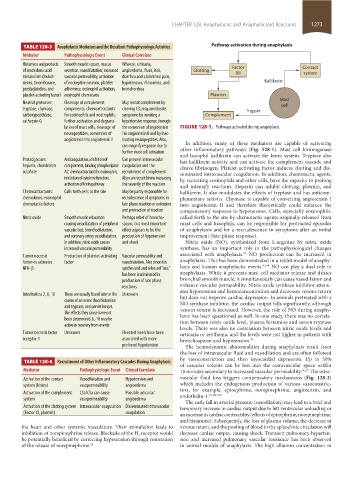
                                  lation of mast cells, cleavage of   the conversion of angiotensin   FIGURE 128-1.  Pathways activated during anaphylaxis.
                                  neuropeptides, conversion of   I to angiotensin II and by inac-
                                  angiotensin I to angiotensin II  tivating neuropeptides. Also,   In addition, many of these mediators are capable of activating
                                                      can magnify response due to
                                                      further mast cell activation  other inflammatory pathways (Fig. 128-1). Mast cell kininogenase
                                                                          and basophil kallikrein can activate the kinin system. Tryptase also
                    Proteoglycans:   Anticoagulation, inhibition of   Can prevent intravascular    has kallikrein activity and can activate the complement cascade and
                    heparin, chondroitin   complement, binding phospholipase  coagulation and the   cleave fibrinogen. Platelet-activating factor induces clotting and dis-
                    sulphate      A2, chemoattractant for eosinophils,   recruitment of complement.   seminated intravascular coagulation. In addition, chemotactic agents,
                                  inhibition of cytokine function,   Also can recruit kinins increasing   by recruiting eosinophils and other cells, have the capacity to prolong
                                  activation of kinin pathway   the severity of the reaction  and intensify reactions. Heparin can inhibit clotting, plasmin, and
                    Chemoattractants:   Calls forth cells to the site  May be partly responsible for   kallikrein. It also modulates the effects of tryptase and has anticom-
                    chemokines, eosinophil            recrudescence of symptoms in   plementary activity. Chymase is capable of converting angiotensin I
                    chemotactic factors               late phase reaction or extension   into angiotensin II and therefore theoretically could enhance the
                                                      and protraction of reaction  compensatory response to hypotension. Cells, especially eosinophils,
                    Nitric oxide  Smooth muscle relaxation    Perhaps relief of broncho-  called forth to the site by chemotactic agents originally released from
                                  causing vasodilatation of peripheral  spasm, but most important   mast cells and basophils, can be responsible for protracted episodes
                                  vascular bed, bronchodilatation,   effect appears to be the   of anaphylaxis and for a recrudescence in symptoms after an initial
                                  and coronary artery vasodilatation.  production of hypotension   improvement (late-phase response).
                                  In addition, nitric oxide causes   and shock  Nitric oxide (NO), synthesized from L-arginine by nitric oxide
                                  increased vascular permeability         synthase, has an important role in the pathophysiological changes
                                                                                               93
                    Tumor necrosis   Production of platelet- activating  Vascular permeability and   associated with anaphylaxis.  NO production can be increased in
                    factor-α activates   factor       vasodilatation. Also since it is   anaphylaxis. This has been demonstrated in a rabbit model of anaphy-
                    NFK-β                             synthesized and released “late,”   laxis and human anaphylactic events. 93,94  NO can play a dual role in
                                                      has been incriminated in    anaphylaxis. While it prevents mast cell mediator release and dilates
                                                      production of late phase   bronchial smooth muscle, it simultaneously can cause vasodilation and
                                                      reactions           enhance vascular permeability. Nitric oxide synthase inhibitor attenu-
                    Interleukins 2, 6, 10  These are usually found later in the  Unknown  ates hypotension and hemoconcentration and decreases venous return
                                                                          but does not improve cardiac depression. In animals pretreated with a
                                  course of an event than histamine       NO synthase inhibitor, the cardiac output falls significantly, although
                                  and tryptase, and persist longer.       venous return is increased. However, the role of NO during anaphy-
                                  The effects they cause have not         laxis has been questioned as well. In one study, there was no correla-
                                  been determined. IL-10 may be           tion between nitric oxide level, plasma histamine and serum tryptase
                                  active in recovery from events          levels. There was also no correlation between nitric oxide levels and
                    Tumor necrosis factor   Unknown   Elevated levels have been   urticaria or erythema, and the levels were not higher in patients with
                    receptor-1                        associated with more    bronchospasm and hypotension. 95
                                                      profound hypotension  The hemodynamic abnormalities during anaphylaxis result from
                                                                          the loss of intravascular fluid and vasodilation and are often followed
                                                                          by vasoconstriction and then myocardial depression. Up to 50%
                      TABLE 128-4    Recruitment of Other Inflammatory Cascades During Anaphylaxis
                                                                          of vascular volume can be lost into the extravascular space within
                    Mediator           Pathophysiologic Event Clinical Correlate  10 minutes secondary to increased vascular permeability. 96,97  The intra-
                    Activation of the contact    Vasodilatation and    Hypotension and   vascular fluid loss triggers compensatory mechanisms (Fig. 128-2)
                    system (kinins)    vasopermeability    angioedema     which includes the endogenous production of various vasoconstric-
                    Activation of the complement   C3a/C5a can cause    Possible urticaria/   tors, for example, epinephrine, norepinephrine, angiotensin, and
                                                                          endothelin-1.
                                                                                    61,98-100
                    system             vasopermeability  angioedema        The early fall in arterial pressure (vasodilation) may lead to a brief and
                    Activation of the clotting system  Intravascular coagulation Disseminated intravascular   temporary increase in cardiac output due to left ventricular unloading or
                    (Factor XI, plasmin)               coagulation        an increase in cardiac contractility (effects of epinephrine, norepinephrine,
                                                                          and histamine). Subsequently, the loss of plasma volume, the decrease in
                    the heart and other systemic vasculature. Their stimulation leads to   venous return, and the pooling of blood in the splanchnic circulation will
                    inhibition of norepinephrine release. Blockade of the H  receptor would   decrease cardiac output, causing shock. Transient  pulmonary hyperten-
                                                           3
                    be potentially beneficial by correcting hypotension through restoration   sion and increased pulmonary vascular resistance has been observed
                    of the release of norepinephrine. 92                  in animal models of anaphylaxis. The high albumin concentration in


            section11.indd   1273                                                                                      1/19/2015   10:52:27 AM

