


Page 1806 - Hall et al (2015) Principles of Critical Care-McGraw-Hill
P. 1806
CHAPTER 128: Anaphylactic and Anaphylactoid Reactions  1275


                    DIFFERENTIAL DIAGNOSIS                                organs dysfunction. The absence of cutaneous features may help distin-
                                                                          guish these forms of shock from the majority of episodes of anaphylaxis.
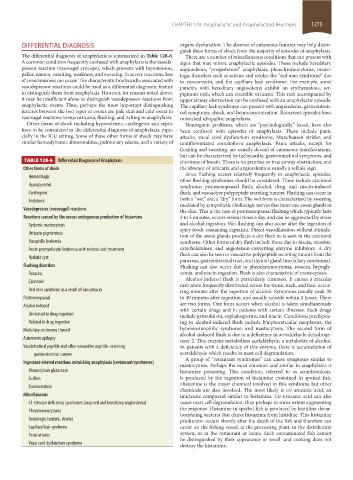
                    The differential diagnosis of anaphylaxis is summarized in Table 128-6.   There are a number of miscellaneous conditions that can present with
                    A common condition frequently confused with anaphylaxis is the vasode-  signs that may mimic anaphylactic episodes. These include hereditary
                    pressor reaction (vasovagal syncope), which presents with hypotension,   angioedema, “progesterone” anaphylaxis, pheochromocytoma, neuro-
                    pallor, nausea, vomiting, weakness, and sweating. In severe reactions, loss   logic disorders such as seizure and stroke, the “red man syndrome” due
                    of consciousness can occur. The characteristic bradycardia associated with   to vancomycin, and the capillary leak syndrome. For example, some
                    vasodepressor reactions could be used as a differential diagnostic feature   patients with hereditary angioedema exhibit an erythematous, ser-
                    to distinguish them from anaphylaxis. However, for reasons noted above,   piginous rash, which can resemble urticaria. This rash accompanied by
                    it may be insufficient alone to distinguish vasodepressor reactions from   upper airway obstruction can be confused with an anaphylactic episode.
                    anaphylactic  events.  Thus,  perhaps  the  most  important  distinguishing   The capillary leak syndrome can present with angioedema, gastrointesti-
                    features between the two types of events are pale skin and cold sweat in   nal symptoms, shock, and hemoconcentration. Recurrent episodes have
                    vasovagal reactions versus urticaria, flushing, and itching in anaphylaxis.  mimicked idiopathic anaphylaxis.
                     Other forms of shock including hypovolemic, cardiogenic and septic   Nonorganic problems, which are “psychologically” based, have also
                    have to be considered in the differential diagnosis of anaphylaxis, espe-  been confused with episodes of anaphylaxis. These include panic
                    cially in the ICU setting. Some of these other forms of shock may have   attacks, vocal cord dysfunction syndrome, Munchausen stridor, and
                    similar hemodynamic abnormalities, pulmonary edema, and a variety of   undifferentiated somatoform anaphylaxis. Panic attacks, except for
                                                                          flushing and sweating, are usually devoid of cutaneous manifestations,
                                                                          but can be characterized by tachycardia, gastrointestinal symptoms, and
                      TABLE 128-6    Differential Diagnosis of Anaphylaxis  shortness of breath. There is no pruritus or true airway obstruction, and
                    Other forms of shock                                  the absence of urticaria and angioedema is usually a telltale sign.
                                                                           Since flushing occurs relatively frequently in anaphylactic episodes,
                      Hemorrhagic
                                                                          other flushing syndromes should be considered. These include carcinoid
                      Hypoglycemic                                        syndrome; postmenopausal  flush;  alcohol,  drug, and  niacin-induced
                      Cardiogenic                                         flush; and vasoactive polypeptide secreting tumors. Flushing can occur in
                      Endotoxic                                           both a “wet” and a “dry” form. The wet form is characterized by sweating
                                                                          mediated by sympathetic cholinergic nerves that innervate sweat glands in
                    Vasodepressor (vasovagal) reactions                   the skin. This is the case of postmenopausal flushing which typically lasts
                    Reactions caused by the excess endogenous production of histamine  3 to 5 minutes, occurs several times a day, and can be aggravated by stress
                      Systemic mastocytosis                               and alcohol ingestion. Wet flushing can also occur after the ingestion of
                                                                          spicy foods containing capsaicin. Direct vasodilatation without stimula-
                      Urticaria pigmentosa
                                                                          tion of the sweat glands produces a dry flush as is seen in the carcinoid
                      Basophilic leukemia                                 syndrome. Other forms of dry flush include those due to niacin, nicotine,
                      Acute promyelocytic leukemia with retinoic acid treatment  catecholamines,  and  angiotensin-converting  enzyme  inhibitors.  A  dry
                      Hydatid cyst                                        flush can also be seen in vasoactive polypeptide secreting tumors from the
                                                                          pancreas, gastrointestinal tract, and thyroid gland (medullary carcinoma).
                    Flushing disorders                                    Flushing can also occur due to pheochromocytoma, rosacea, hypogly-
                      Rosacea                                             cemia, and niacin ingestion. Flush is also characteristic of mastocytosis.
                                                                           Alcohol-induced flush is particularly common. It causes a macular
                      Carcinoid                                           rash more frequently distributed across the trunk, neck, and face, occur-
                      Red man syndrome as a result of vancomycin          ring minutes after the ingestion of alcohol. Symptoms usually peak 30
                    Postmenopausal                                        to 40 minutes after ingestion, and usually subside within 2 hours. There
                    Alcohol induced                                       are two forms. One form occurs when alcohol is taken simultaneously
                                                                          with certain drugs and in patients with certain illnesses. Such drugs
                      Unrelated to drug ingestion                         include griseofulvin, cephalosporins, and niacin. Conditions predispos-
                      Related to drug ingestion                           ing to alcohol-induced flush include lymphoreticular neoplasms, the
                    Medullary carcinoma thyroid                           hypereosinophilic syndrome, and mastocytosis. The second form of
                                                                          alcohol-induced flush is due to a deficiency in acetaldehyde dehydroge-
                    Autonomic epilepsy                                    nase-2. This enzyme metabolizes acetaldehyde, a metabolite of alcohol.
                    Vasointestinal peptide and other vasoactive peptide–secreting  In patients with a deficiency of this enzyme, there is accumulation of
                       gastrointestinal tumors                            acetaldehyde which results in mast cell degranulation.
                                                                           A group of “restaurant syndromes” can cause symptoms similar to
                    Ingestant-related reactions mimicking anaphylaxis (restaurant syndromes)
                                                                          mastocytosis. Perhaps the most common and similar to anaphylaxis is
                      Monosodium glutamate                                histamine poisoning. This condition, referred to as scombroidosis,
                      Sulfites                                            is produced by the ingestion of histamine contained in spoiled fish.
                      Scombroidosis                                       Histamine is the major chemical involved in this syndrome but other
                                                                          chemicals are also involved. The most likely is  cis-urocanic acid, an
                    Miscellaneous                                         imidazole compound similar to histamine. Cis-urocanic acid can also
                      C1 esterase deficiency syndromes (acquired and hereditary angioedema)  cause mast cell degranulation, thus perhaps to some extent augmenting
                                                                          the response. Histamine in spoiled fish is produced by histidine-decar-
                      Pheochromocytoma                                    boxylating bacteria that cleave histamine from histidine. This histamine
                      Neurologic (seizure, stroke)                        production occurs shortly after the death of the fish and therefore can
                      Capillary leak syndrome                             occur on the fishing vessel, at the processing plant, in the distribution
                      Panic attacks                                       system, or in the restaurant or home. Such contaminated fish cannot
                                                                          be distinguished by their appearance or smell, and cooking does not
                      Vocal cord dysfunction syndrome                     destroy the histamine.


            section11.indd   1275                                                                                      1/19/2015   10:52:28 AM

