


Page 1830 - Hall et al (2015) Principles of Critical Care-McGraw-Hill
P. 1830
CHAPTER 129: Dermatologic Conditions  1299


                                                                           The purpura seen in meningococcemia result from two mechanisms.
                                                                          The first is thrombosis precipitated by meningococcus, fibrin, and leu-
                                                                          kocytes with a corresponding leukocytoclastic vasculitis. Thrombi are
                                                                          concentrated in the lung, skin, spleen, heart, and liver. The second is
                                                                          DIC precipitated by meningococcal endotoxin.  Fibrin thrombi within
                                                                                                           110
                                                                          a vessel and a corresponding vasculitis are seen on histology.
                                                                           Mortality rates are high and fewer than 30% with septic shock survive,
                                                                          making an early diagnosis crucial. The Gram stain from a skin biopsy is
                                                                          significantly more sensitive (72%) than the Gram stain from CSF (22%)
                                                                          for detecting meningococci. Cultures should be sent from both blood and
                                                                          skin biopsies. Mortality rates increase with extensive skin hemorrhage
                                                                          (purpura fulminans, Fig. 129-24). Prompt antibiotic treatment is essen-
                                                                          tial and improves outcomes. Third-generation cephalosporins should be
                                                                          used empirically until culture results are available. Although antibiotic
                                                                          therapy may decrease the yield of CSF cultures, it will not affect cultures
                                                                          from the skin biopsies. Chloramphenicol is an acceptable alternative in
                                                                          penicillin-allergic patients, although resistance has been reported. 111
                                                                              ■  INFECTIVE ENDOCARDITIS


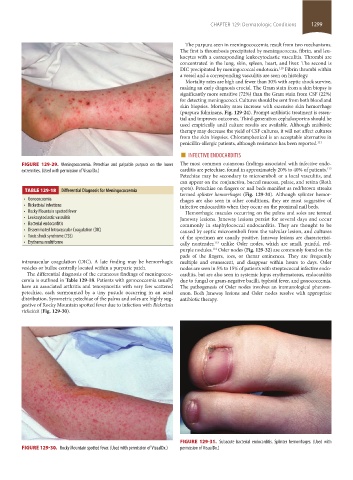
                    FIGURE  129-29.  Meningococcemia. Petechiae and palpable purpura on the lower   The most common cutaneous findings associated with infective endo-
                                                                                                                            112
                    extremities. (Used with permission of VisualDx.)      carditis are petechiae, found in approximately 20% to 40% of patients.
                                                                          Petechiae may be secondary to microemboli or a local vasculitis, and
                                                                          can appear on the conjunctiva, buccal mucosa, palate, and retina (Roth
                                                                          spots). Petechiae on fingers or nail beds manifest as red/brown streaks
                      TABLE 129-18    Differential Diagnosis for Meningococcemia
                                                                          termed  splinter  hemorrhages (Fig.  129-31). Although splinter hemor-
                    •  Gonococcemia                                       rhages are also seen in other conditions, they are most suggestive of
                    •  Rickettsial infections                             infective endocarditis when they occur on the proximal nail beds.
                    •  Rocky Mountain spotted fever                        Hemorrhagic macules occurring on the palms and soles are termed
                    •  Leukocytoclastic vasculitis                        Janeway lesions. Janeway lesions persist for several days and occur
                    •  Bacterial endocarditis                             commonly in staphylococcal endocarditis. They are thought to be
                    •  Disseminated Intravascular Coagulation (DIC)       caused by septic microemboli from the valvular lesion, and cultures
                    •  Toxic shock syndrome (TSS)                         of  the specimen are usually positive. Janeway lesions are characteristi-
                    •  Erythema multiforme                                cally nontender,  unlike Osler nodes, which are small, painful, red-
                                                                                     113
                                                                          purple nodules.  Osler nodes (Fig. 129-32) are commonly found on the
                                                                                     114
                                                                          pads of the fingers, toes, or thenar eminences. They are frequently
                    intravascular coagulation (DIC). A late finding may be hemorrhagic   multiple and evanescent, and disappear within hours to days. Osler
                    vesicles or bullae centrally located within a purpuric patch.  nodes are seen in 5% to 15% of patients with streptococcal infective endo-
                     The differential diagnosis of the cutaneous findings of meningococ-  carditis, but are also seen in systemic lupus erythematosus, endocarditis
                    cemia is outlined in Table 129-18. Patients with gonococcemia usually   due to fungal or gram-negative bacilli, typhoid fever, and gonococcemia.
                    have an associated arthritis and tenosynovitis with very few scattered   The pathogenesis of Osler nodes involves an immunological phenom-
                    petechiae, each surmounted by a tiny pustule occurring in an acral   enon. Both Janeway lesions and Osler nodes resolve with appropriate
                    distribution. Symmetric petechiae of the palms and soles are highly sug-  antibiotic therapy.
                    gestive of Rocky Mountain spotted fever due to infection with Rickettsia
                    rickettsii (Fig. 129-30).


                                                                          FIGURE 129-31.  Subacute bacterial endocarditis. Splinter hemorrhages. (Used with
                    FIGURE 129-30.  Rocky Mountain spotted fever. (Used with permission of VisualDx.)  permission of VisualDx.)


            section11.indd   1299                                                                                      1/19/2015   10:55:32 AM

