


Page 1831 - Hall et al (2015) Principles of Critical Care-McGraw-Hill
P. 1831
1300     PART 11: Special Problems in Critical Care


                                                                         TABLE 129-19    Diagnostic Modalities for Diagnosing Cutaneous Herpes Simplex
                                                                        Diagnostic test  Advantages       Disadvantages
                                                                        Direct fluorescent anti-  •  Rapid diagnosis (30min to   •  Sample must contain
                                                                        body (DFA) testing   2 hours)      epithelial cells to avoid
                                                                                       •  Can distinguish between   false-negative results
                                                                                         HSV1 and HSV2
                                                                        Tzanck smear   •  Can be performed at   •  Sample must contain
                                                                                         bedside           epithelial cells to avoid
                                                                                       •  Inexpensive      false-negative results
                                                                                       •  Reliable        •  Does not differentiate
                                                                                                           between HSV and VZV
                                                                        Viral cultures  •  Used in conjunction with other  •  Delayed diagnosis
                                                                                         tests to confirm diagnosis  (48+ hours)
                                                                                       •  Can distinguish between
                                                                                         HSV1 and HSV2
                                                                        Skin biopsy    •  Provides more reliable tissue  •  Expensive

                                                                                         material for histological   •  Delayed diagnosis
                 FIGURE 129-32.  Subacute bacterial endocarditis (Osler nodes). (Used with permission   examination
                 of VisualDx.)                                          Serologic antibodies              •  Nonspecific
                                                                                                          •  Small, primary lesion may
                                                                                                           not generate detectable
                 VIRAL INFECTIONS                                                                          antibody response
                     ■  HERPES SIMPLEX


                 Cutaneous herpes infection is associated with herpes simplex virus   famciclovir, or valacyclovir. For acyclovir-resistant strains, foscarnet is the
                                                                       preferred second-line agent for treatment of HSV and VZV.
                 (HSV) types 1 and 2. In general, HSV-1 causes orofacial infection and   Local care consists of 0.5% silver nitrate or Burrow compresses
                 HSV-2 causes anogenital infection, although crossover is possible due to   applied for 20 minutes three to four times daily to alleviate swelling,
                 oral-genital contact. The classic appearance of recurrent HSV infection   inflammation, maceration, and crusting of extensive erosions. Topical
                 is a cluster of vesicles or shallow erosions over the lips, genitals, and   acyclovir is generally not useful but may speed the healing of erosive
                 lumbosacral region (Fig. 129-33). In the ICU, recurrent HSV infections   HSV in immunosuppressed individuals. Topical penciclovir applied
                 are extremely common and related to the stress of illness or the degree of   every 2 hours for 4 days has been shown to decrease clinical healing time
                 immunosuppression. If early lesions go undetected in an immunocom-  by about 1 day in primary infections.
                 promised patient, large, erosive areas of ulceration may occur. Chronic   An important complication of HSV infection is eczema herpeticum
                 perianal HSV ulcers are sometimes mistaken for decubitus ulcers.   (Fig. 129-34), which is a disseminated cutaneous HSV infection that
                 Scalloped borders and small circular ulcerations at the periphery of the   occurs in patients with an underlying dermatitis such as atopic dermati-
                 ulcer may be helpful distinguishing signs. Transplant and HIV patients   tis, seborrheic dermatitis, contact dermatitis, or Darier disease. Patients
                 are at increased risk of developing chronic perianal HSV ulcers.  present with diffuse crusting that may or may not be preceded by typical
                   Several diagnostic modalities are available, as outlined in    herpetic lesions. Intact vesicles are rarely seen. Diffuse eczema herpeti-
                 Table 129-19. 115,116   All HSV and VZV infections encountered in the   cum is a severe and potentially life-threatening condition that usually
                 ICU should be treated promptly with an antiviral agent such as acyclovir,   requires therapy with intravenous acyclovir. 117
                                                                           ■  VARICELLA ZOSTER


                                                                       Infection with the varicella zoster virus leads to two distinct conditions:
                                                                       varicella (chicken pox, Fig. 129-35) as the primary disease, and herpes
                                                                       zoster (shingles,  Fig. 129-36A) as a reactivation of the latent form.
                                                                       Primary infection occurs via aerosolized respiratory droplets or direct
                                                                       contact with vesicle fluid. After primary infection, the virus lies dormant
                                                                       in the dorsal root ganglion until reactivation occurs. Reactivation results
                                                                       in spread of the virus down the nerve root, causing pain, erythema, and
                                                                       vesicles in a dermatomal distribution.
                                                                         The classic cutaneous finding in varicella is a generalized eruption of
                                                                       discrete vesicles, each on an erythematous base (“dew-drop on a rose
                                                                       petal”). These appear after an average incubation period of 14 days
                                                                       (range = 9-21 days) and are usually seen in association with prodromal
                                                                       symptoms of fever and malaise. The cutaneous lesions progress from an
                                                                       erythematous papule to a vesicle to hemorrhagic crusting. The lesions
                                                                       first appear on the trunk, then spread to the extremities. There may be
                                                                       lesions at various stages of development at any one time. The patient is
                                                                       contagious from 2 days before the eruption until all lesions have crusted.
                                                                         Herpes zoster presents with a prodrome of intense pain affecting a
                                                                       dermatome followed by the eruption of a cluster of vesicles on an ery-
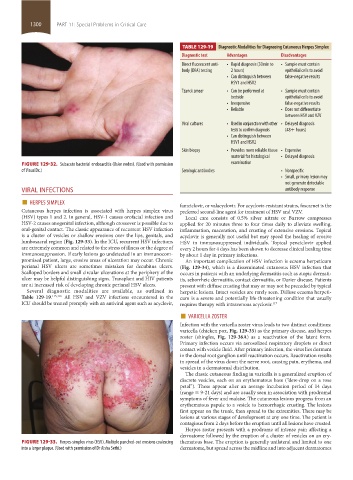
                 FIGURE 129-33.  Herpes-simplex virus (HSV). Multiple punched-out erosions coalescing   thematous base. The eruption is generally unilateral and limited to one
                 into a larger plaque. (Used with permission of Dr Aisha Sethi.)  dermatome, but spread across the midline and into adjacent dermatomes


            section11.indd   1300                                                                                      1/19/2015   10:55:41 AM

