


Page 608 - Clinical Hematology_ Theory _ Procedures ( PDFDrive )
P. 608
592            PART 8  ■  Fundamentals of Hematological Analysis


                                                                                                                           Pleural Fluid
                  NOTE: This is a good time to complete Review Questions

                  related to preceding content.                                                                            Anatomy of the Pleura


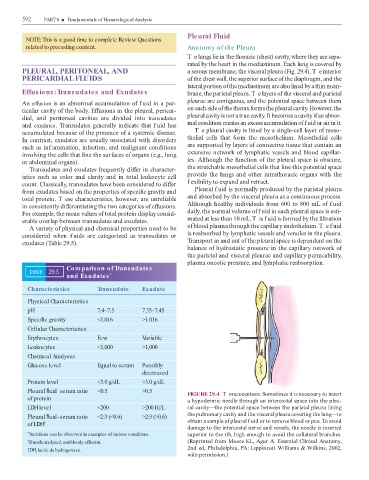
                                                                                                                           Te lungs lie in the thoracic (chest) cavity, where they are sepa-

                                                                                                                           rated by the heart in the mediastinum. Each lung is covered by
               PLEURAL, PERITONEAL, AND                                                                                    a serous membrane, the visceral pleura (Fig. 29.4). T e interior

               PERICARDIAL FLUIDS                                                                                          o  the chest wall, the superior sur ace o  the diaphragm, and the


                                                                                                                           lateral portion o  the mediastinum are also lined by a thin mem-
               Effusions: Transudates and Exudates                                                                         brane, the parietal pleura. T e layers o  the visceral and parietal


               An effusion is an abnormal accumulation o  f uid in a par-                                                  pleurae are contiguous, and the potential space between them

               ticular cavity o  the body. E  usions in the pleural, pericar-                                              on each side o  the thorax  orms the pleural cavity. However, the

               dial,  and  peritoneal  cavities  are  divided  into  transudates                                           pleural cavity is not a true cavity. It becomes a cavity i  an abnor-

               and exudates.   ransudates generally indicate that f uid has                                                mal condition creates an excess accumulation o  f uid or air in it.

               accumulated because o  the presence o  a systemic disease.                                                       T e pleural cavity is lined by a single-cell layer o  meso-

               In contrast, exudates are usually associated with disorders                                                 thelial  cells  that   orm  the  mesothelium.  Mesothelial  cells

               such as inf ammation, in ection, and malignant conditions                                                   are supported by layers o  connective tissue that contain an

               involving the cells that line the sur aces o  organs (e.g., lung                                            extensive network o  lymphatic vessels and blood capillar-

               or abdominal organs).                                                                                       ies. Although the  unction o  the pleural space is obscure,

                     ransudates and exudates  requently di  er in character-                                               the stretchable mesothelial cells that line this potential space

               istics such as color and clarity  and in total leukocyte cell                                               provide the lungs and other intrathoracic organs with the

               count. Classically, transudates have been considered to di  er                                              fexibility to expand and retract.

                rom exudates based on the properties o  speci  c gravity and                                                    Pleural f uid is normally produced by the parietal pleura

               total protein. T ese characteristics, however, are unreliable                                               and absorbed by the visceral pleura as a continuous process.

               in consistently di  erentiating the two categories o  e  usions.                                            Although healthy individuals  rom 600 to 800 mL o  f uid

               For example, the mean values o  total protein display consid-                                               daily, the normal volume o  f uid in each pleural space is esti-

               erable overlap between transudates and exudates.                                                            mated at less than 10 mL. T is f uid is  ormed by the   ltration

                    A variety o  physical and chemical properties need to be                                               o  blood plasma through the capillary endothelium. T e f uid

               considered  when  f uids  are  categorized  as  transudates  or                                             is reabsorbed by lymphatic vessels and venules in the pleura.

               exudates (  able 29.5).                                                                                       ransport in and out o  the pleural space is dependent on the
                                                                                                                           balance o  hydrostatic pressure in the capillary network o

                                                                                                                           the parietal and visceral pleurae and capillary permeability,

                                                                                                                           plasma oncotic pressure, and lymphatic reabsorption.
                                             Comparison of Transudates
                    TABLE        29.5
                                             and Exudates                *


                   Characteristics                               Transudate                   Exudate


                   Physical Characteristics


                   pH                                            7.4–7.5                      7.35–7.45


                   Speci  c gravity                              <1.016                       >1.016


                   Cellular Characteristics

                   Erythrocytes                                  Few                          Variable


                   Leukocytes                                    <1,000                       >1,000


                   Chemical Analyses


                   Glucose level                                 Equal to serum               Possibly

                                                                                              decreased

                   Protein level                                 <3.0 g/dL                    >3.0 g/dL


                   Pleural   uid–serum ratio                     <0.5                         >0.5                         FIGURE 29.4  T oracocentesis. Sometimes it is necessary to insert

                   of protein                                                                                              a hypodermic needle through an intercostal space into the pleu-


                   LDH level                                     <200                         >200 IU/L                    ral cavity—the potential space between the parietal pleura lining

                   Pleural   uid–serum ratio                     <2:3 (<0.6)                  >2:3 (>0.6)                  the pulmonary cavity and the visceral pleura covering the lung—to


                   of LDH     †                                                                                            obtain a sample o  pleural f uid or to remove blood or pus.   o avoid
                                                                                                                           damage to the intercostal nerve and vessels, the needle is inserted

                   * Variations can be observed in examples of various conditions.                                         superior to the rib, high enough to avoid the collateral branches.

                   † If nonhemolyzed, nonbloody effusion.                                                                  (Reprinted  rom Moore KL, Agur A. Essential Clinical Anatomy,
                                                                                                                           2nd ed, Philadelphia, PA: Lippincott Williams & Wilkins, 2002,
                   LDH, lactic dehydrogenase.
                                                                                                                           with permission.)

