


Page 635 - Clinical Hematology_ Theory _ Procedures ( PDFDrive )
P. 635
Digital microscopy                                                                                          Case studies


                     Describe the function of arti  cial neural networks.                                                        Analyze and discuss the signi  cance of the erythrocyte and leuko-

                     Explain the bene  ts and advantages of digital microscopy.                                                    cyte histograms and the nomogram presented in the six case stud-

                                                                                                                                   ies,  answer the critical thinking group discussion questions, and
                   Instruments in coagulation studies                                                                              conclude a diagnosis.


                   ■   Describe the two most common types of instruments used in the
                       clinical laboratory for the detection of   brin clots.                                                     NOTE:


                   ■   Explain the principles of electromechanical and optical detection                                          ■   indicates MLT and MLS core content
                       systems.                                                                                                     indicates MLT (optional) and MLS advanced content

                     Describe the methodological principle of platelet aggregation.


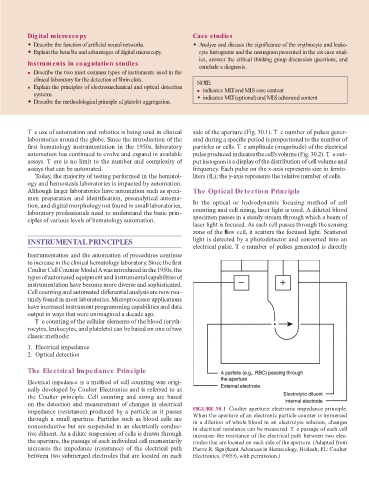
                   T e use o  automation and robotics is being used in clinical                                                side o  the aperture (Fig. 30.1). T e number o  pulses gener-

                   laboratories around the globe. Since the introduction o  the                                                ated during a speci  c period is proportional to the number o

                     rst  hematology  instrumentation  in  the  1950s,  laboratory                                             particles or cells. T e amplitude (magnitude) o  the electrical

                   automation has continued to evolve and expand in available                                                  pulse produced indicates the cell’s volume (Fig. 30.2). T e out-

                   assays. T ere is no limit to the number and complexity o                                                    put histogram is a display o  the distribution o  cell volume and

                   assays that can be automated.                                                                                requency. Each pulse on the x-axis represents size in  emto-

                          oday, the majority o  testing per ormed in the hematol-                                              liters ( L); the y-axis represents the relative number o  cells.

                   ogy and hemostasis laboratories is impacted by automation.

                   Although larger laboratories have automation such as speci-                                                 The Optical Detection Principle

                   men  preparation  and  identi  cation, preanalytical  automa-

                   tion, and digital morphology not  ound in small laboratories,                                               In  the  optical  or  hydrodynamic   ocusing  method  o   cell

                   laboratory pro essionals need to understand the basic prin-                                                 counting and cell sizing, laser light is used. A diluted blood

                   ciples o  various levels o  hematology automation.                                                          specimen passes in a steady stream through which a beam o
                                                                                                                               laser light is  ocused. As each cell passes through the sensing

                                                                                                                               zone o  the   ow cell, it scatters the  ocused light. Scattered


                   INSTRUMENTAL PRINCIPLES                                                                                     light is detected by a photodetector and converted into an
                                                                                                                               electrical pulse. T e number o  pulses generated is directly


                   Instrumentation and the automation o  procedures continue

                   to increase in the clinical hematology laboratory. Since the   rst

                   Coulter Cell Counter Model A was introduced in the 1950s, the

                   types o  automated equipment and instrumental capabilities o

                   instrumentation have become more diverse and sophisticated.

                   Cell counting and automated di  erential analysis are now rou-

                   tinely  ound in most laboratories. Microprocessor applications

                   have increased instrument programming capabilities and data

                   output in ways that were unimagined a decade ago.

                        T e counting o  the cellular elements o  the blood (eryth-

                   rocytes, leukocytes, and platelets) can be based on one o  two

                   classic methods:


                   1.  Electrical impedance

                   2.  Optical detection


                   The Electrical Impedance Principle


                   Electrical impedance is a method o  cell counting was origi-

                   nally developed by Coulter Electronics and is re erred to as

                   the  Coulter  principle.  Cell  counting  and  sizing  are  based

                   on the detection and measurement o  changes in electrical

                   impedance  (resistance)  produced  by  a  particle  as  it  passes                                          FIGURE 30.1  Coulter aperture: electronic impedance principle.
                                                                                                                               When the aperture o  an electronic particle counter is immersed
                   through  a  small  aperture.  Particles  such  as  blood  cells  are                                        in a dilution o  whole blood in an electrolyte solution, changes

                   nonconductive but are suspended in an electrically conduc-                                                  in electrical resistance can be measured. T e passage o  each cell

                   tive diluent. As a dilute suspension o  cells is drawn through                                              increases the resistance o  the electrical path between two elec-

                   the aperture, the passage o  each individual cell momentarily                                               trodes that are located on each side o  the aperture. (Adapted  rom

                   increases  the  impedance  (resistance)  o   the  electrical  path                                          Pierre R. Signi  cant Advances in Hematology, Hialeah, FL: Coulter

                   between two submerged electrodes that are located on each                                                   Electronics, 1985:6, with permission.)

