


Page 639 - Clinical Hematology_ Theory _ Procedures ( PDFDrive )
P. 639
CHAPTER 30  ■  Instrumentation in Hematology                             623


                                                                                                                               Data Analysis


                                                                                                                               Data are plotted on a histogram. Populations o  similar cells

                                                                                                                                orm discrete and characteristic two-dimensional “clusters”

                                                                                                                               o   scatter  when  the   orward  and  side  scatters  are  plotted

                                                                                                                               against each other.

                                                                                                                                    Most hematological samples contain multiple cell popula-

                                                                                                                               tions. It is necessary to   rst identi y the population o  interest

                                                                                                                                or  urther analysis. Whole blood is commonly used  or plate-

                                                                                                                               let and erythrocyte assays. Data collected by the f ow cytometer

                                                                                                                               can be displayed as a 1-parameter histogram or as 2-parameter

                                                                                                                               plots. A 1-parameter histogram is described as either the per-

                                                                                                                               centage o  cells within a set o  markers or as the mean f uores-

                                                                                                                               cent intensity o  a population. A 2-parameter plot is usually

                                                                                                                               divided into  our quadrants, each containing a percentage o

                                                                                                                               the total population. T is is used to distinguish between f uo-

                                                                                                                               rescent and nonf uorescent cells. It also de  nes the expression

                                                                                                                               and nonexpression o  a cell molecule marked by a f uorescent

                                                                                                                               antibody or other f uorochrome. It is o  en necessary to ana-

                                                                                                                               lyze a single population within several populations and debris.

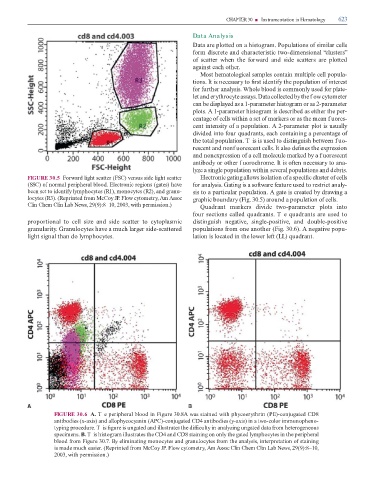
                   FIGURE 30.5  Forward light scatter (FSC) versus side light scatter                                               Electronic gating allows isolation o  a speci  c cluster o  cells

                   (SSC) o  normal peripheral blood. Electronic regions (gates) have                                            or analysis. Gating is a so  ware  eature used to restrict analy-

                   been set to identi y lymphocytes (R1), monocytes (R2), and granu-                                           sis to a particular population. A gate is created by drawing a
                   locytes (R3). (Reprinted  rom McCoy JP. Flow cytometry, Am Assoc                                            graphic boundary (Fig. 30.5) around a population o  cells.

                   Clin Chem Clin Lab News, 29(9):8–10, 2003, with permission.)                                                     Quadrant  markers  divide  two-parameter  plots  into


                                                                                                                                our sections called quadrants. T e quadrants are used to

                     proportional  to  cell  size  and  side  scatter  to  cytoplasmic                                           distinguish  negative,  single-positive,  and  double-positive

                   granularity. Granulocytes have a much larger side-scattered                                                 populations  rom one another (Fig. 30.6). A negative popu-

                   light signal than do lymphocytes.                                                                           lation is located in the lower le   (LL) quadrant.


                                    FIGURE 30.6  A. T e peripheral blood in Figure 30.8A was stained with phycoerythrin (PE)-conjugated CD8
                                    antibodies (x-axis) and allophycocyanin (APC)-conjugated CD4 antibodies (y-axis) in a two-color immunopheno-

                                    typing procedure. T is   gure is ungated and illustrates the di  culty in analyzing ungated data  rom heterogeneous

                                    specimens. B. T is histogram illustrates the CD4 and CD8 staining on only the gated lymphocytes in the peripheral
                                    blood  rom Figure 30.7. By eliminating monocytes and granulocytes  rom the analysis, interpretation o  staining

                                    is made much easier. (Reprinted  rom McCoy JP. Flow cytometry, Am Assoc Clin Chem Clin Lab News, 29(9):8–10,

                                    2003, with permission.)

