


Page 638 - Clinical Hematology_ Theory _ Procedures ( PDFDrive )
P. 638
622            PART 8  ■  Fundamentals of Hematological Analysis


               react speci  cally  with  the  cellular  component  being stud-                                                  T e stained cells next pass through the laser beam. T e

               ies such as reticulocytes, peroxidase enzyme, or DNA con-                                                   laser activates the dye and the cell f uoresces. T e interaction

               tent. Fluorescent dyes include acridine orange, thiof avin   ,                                              between each cell and the laser beam provides the  ollowing

               pyronin Y, f uorescein isothiocyanate (FI  C), and phycoery-                                                two types o  in ormation:

               thrin (PE). FI  C and PE are used when dual color analysis                                                  1.  T e amount o  light scattered by each cell hit by the laser

               is desired.                                                                                                       beam

                    Many f ow cytometric assays use direct immunof uores-

               cence  staining  with  f uorochrome-conjugated  monoclonal                                                  2.  T e intensity o  the f uorescence emitted by labeled anti-
                                                                                                                                 bodies bound to antigens on the di  erent types o  sus-
               antibodies to identi y cellular characteristics. Fluorochromes                                                    pended cells

               are molecules that absorb light o  one wavelength and emit

               light o  a higher wavelength. Fluorochromes are covalently                                                       Although  the  f uorescence  is  emitted  throughout  a

               bonded  to  monoclonal  antibody  molecules.  T is  provides                                                360-degree circle, it is usually collected via optical sensors

               a mechanism that allows  or the determination by the f ow                                                   located at 90 degrees relative to the laser beam. T e f uores-

               cytometer i  a labeled antibody has bound to the cell sur ace.                                              cence in ormation is then transmitted to a computer. Flow

                    Each f uorochrome has a maximal excitation wavelength                                                  cytometry per orms f uorescence analysis on single cells at

               at or near the wavelength o  the laser and has a characteris-                                               rates up to 50,000 cells/minute. T e computer is the heart o

               tic emission spectrum. T e f uorochrome, excited by the laser                                               the instrument; it controls all decisions regarding data col-

               light, will f uoresce at a longer wavelength. Fluorescein emits                                             lection, analysis, and cell sorting.

               a green f uorescence, PE emits orange, and peridinin chloro-

               phyll protein or PE coupled to cyanin 5 emits a red f uores-                                                The Basis of Cellular Identi  cation

               cence. An argon laser, which produces blue light, is the most

               commonly used laser. Some instruments add a red helium-                                                     One o  the major advantages o  f ow cytometry is that more

               neon laser, and occasionally, a mercury arc lamp is substituted.                                            than one measurement can be made on every cell during

                    Some f ow cytometers have a second laser that can excite                                               the  ew milliseconds that the cell spends passing through

               other f uorochromes. Like the side-scattered blue light, all                                                the laser beam. Each cell can be optically measured  or the

               o  these f uorescent signals pass through the objective set at                                              intensity o  scattered light.

               90 degrees to the incident laser light. T e number o  colors                                                     Te cellular light scatter patterns can be used to iden-

               in f ow cytometry output re ers to the number o  individual                                                 ti y  cells.  Both  intrinsic  and  extrinsic  properties  o   cells

               f uorochrome-labeled  antibodies  used  simultaneously  in  a                                               can  be  analyzed  by  f ow  cytometry.  Intrinsic  properties

               given reaction tube. For example, mixing a cell suspension                                                  include  orward- and right-angle light scatter, which cor-

               with a combination o  antibodies labeled with two f uoro-                                                   relate with size and granularity o  a cell, respectively. T is

               chromes is re erred to two-color f ow cytometry.                                                            data output does not require addition o  dyes or stains  or

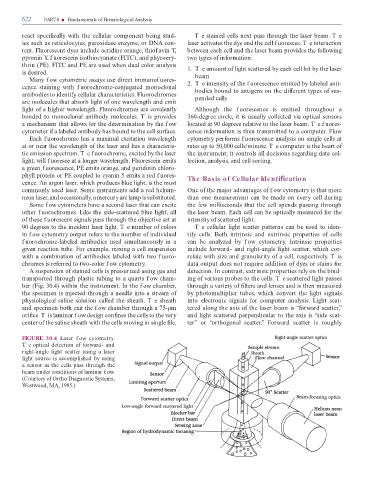
                    A suspension o  stained cells is pressurized using gas and                                             detection. In contrast, extrinsic properties rely on the bind-

               transported through plastic tubing to a quarts f ow cham-                                                   ing o  various probes to the cells. T e scattered light passes

               ber (Fig. 30.4) within the instrument. In the f ow chamber,                                                 through a  variety o    lters and lenses and is then measured

               the specimen is injected through a needle into a stream o                                                   by  photomultiplier  tubes,  which  convert  the  light  signals

               physiological saline solution called the sheath. T e sheath                                                 into  electronic  signals   or  computer  analysis.  Light  scat-

               and specimen both exit the f ow chamber through a 75-µm                                                     tered along the axis o  the laser beam is “ orward scatter,”

               ori  ce. T is laminar f ow design con  nes the cells to the very                                            and light scattered perpendicular to the axis is “side scat-

               center o  the saline sheath with the cells moving in single   le.                                           ter”  or  “orthogonal  scatter.”  Forward  scatter  is  roughly


               FIGURE  30.4  Laser  f ow  cytometry.

               Te optical detection o   orward- and

               right-angle  light  scatter  using  a  laser

               light source is accomplished by using

               a sensor as the cells pass through the
               beam under conditions o  laminar f ow.

               (Courtesy o  Ortho Diagnostic Systems,

               Westwood, MA, 1985.)

