


Page 637 - Clinical Hematology_ Theory _ Procedures ( PDFDrive )
P. 637
CHAPTER 30  ■  Instrumentation in Hematology                             621


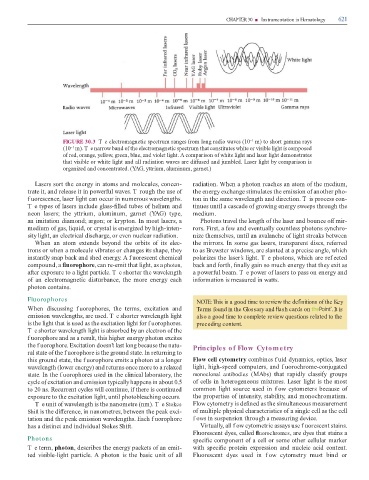
                                          FIGURE 30.3  T e electromagnetic spectrum ranges  rom long radio waves (10  m) to short gamma rays
                                                                                                                                                                    −1
                                          (10  m). T e narrow band o  the electromagnetic spectrum that constitutes white or visible light is composed
                                               −1
                                          o  red, orange, yellow, green, blue, and violet light. A comparison o  white light and laser light demonstrates

                                          that visible or white light and all radiation waves are di  used and jumbled. Laser light by comparison is
                                          organized and concentrated. (YAG, yttrium, aluminum, garnet.)


                        Lasers sort the energy in atoms and molecules, concen-                                                   radiation. When a photon reaches an atom o  the medium,
                   trate it, and release it in power ul waves. T rough the use o                                               the energy exchange stimulates the emission o  another pho-


                   f uorescence, laser light can occur in numerous wavelengths.                                                ton in the same wavelength and direction. T is process con-
                   T e types o  lasers include glass-  lled tubes o  helium and                                                tinues until a cascade o  growing energy sweeps through the


                   neon  lasers;  the  yttrium,  aluminum,  garnet  (YAG)  type,                                               medium.
                   an imitation diamond; argon; or krypton. In most lasers, a                                                       Photons travel the length o  the laser and bounce o   mir-


                   medium o  gas, liquid, or crystal is energized by high-inten-                                               rors. First, a  ew and eventually countless photons synchro-
                   sity light, an electrical discharge, or even nuclear radiation.                                             nize themselves, until an avalanche o  light streaks between


                        When  an  atom  extends  beyond  the  orbits  o   its  elec-                                           the mirrors. In some gas lasers, transparent discs, re erred
                   trons or when a molecule vibrates or changes its shape, they                                                to as Brewster windows, are slanted at a precise angle, which


                   instantly snap back and shed energy. A f uorescent chemical                                                 polarizes the laser’s light. T e photons, which are ref ected
                   compound, a  uorophore, can re-emit that light, as a photon,                                                back and  orth,   nally gain so much energy that they exit as


                   a  er exposure to a light particle. T e shorter the wavelength                                              a power ul beam. T e power o  lasers to pass on energy and
                   o   an  electromagnetic  disturbance,  the  more  energy  each                                              in ormation is measured in watts.


                   photon contains.


                   Fluorophores                                                                                                  NOTE: This is a good time to review the de  nitions of the Key


                   When  discussing  f uorophores,  the  terms,  excitation  and                                                 Terms found in the Glossary and   ash cards on                                           . It is

                   emission wavelengths, are used. T e shorter wavelength light                                                  also a good time to complete review questions related to the

                   is the light that is used as the excitation light  or f uorophores.                                           preceding content.

                   T e shorter wavelength light is absorbed by an electron o  the

                   fuorophore and as a result, this higher energy photon excites

                   the f uorophore. Excitation doesn’t last long because the natu-                                             Principles of Flow  Cytometry

                   ral state o  the f uorophore is the ground state. In returning to

                   this ground state, the f uorophore emits a photon at a longer                                               Flow cell cytometry combines f uid dynamics, optics, laser

                   wavelength (lower energy) and returns once more to a relaxed                                                light, high-speed computers, and f uorochrome-conjugated

                   state. In the f uorophores used in the clinical laboratory, the                                             monoclonal  antibodies (MAbs)  that rapidly classi y groups

                   cycle o  excitation and emission typically happens in about 0.5                                             o  cells in heterogeneous mixtures. Laser light is the most

                   to 20 ns. Recurrent cycles will continue, i  there is continued                                             common  light  source  used  in  f ow  cytometers  because  o

                   exposure to the excitation light, until photobleaching occurs.                                              the properties o  intensity, stability, and monochromatism.


                        Te unit o  wavelength is the nanometre (nm). Te Stokes                                                 Flow cytometry is de  ned as the simultaneous measurement
                   Shift is the di  erence, in nanometres, between the peak exci-                                              o  multiple physical characteristics o  a single cell as the cell

                   tation and the peak emission wavelengths. Each f uorophore                                                  f ows in suspension through a measuring device.

                   has a distinct and individual Stokes Shi  .                                                                      Virtually, all f ow cytometric assays use f uorescent stains.

                                                                                                                               Fluorescent dyes, called   uorochromes, are dyes that stains a
                   Photons                                                                                                     speci  c component o  a cell or some other cellular marker


                   Te term, photon, describes the energy packets o  an emit-                                                   with  speci  c  protein  expression  and  nucleic  acid  content.

                   ted visible-light particle. A photon is the basic unit o  all                                               Fluorescent  dyes  used  in  f ow  cytometry  must  bind  or

