


Page 636 - Clinical Hematology_ Theory _ Procedures ( PDFDrive )
P. 636
620            PART 8  ■  Fundamentals of Hematological Analysis


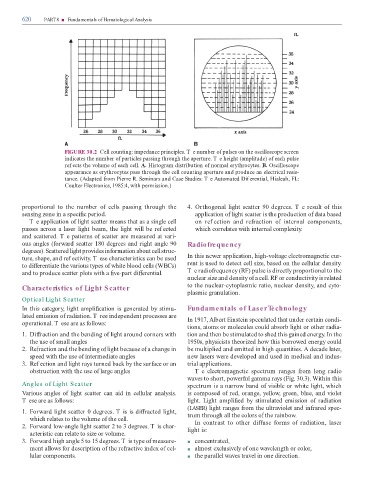
                                           FIGURE 30.2  Cell counting: impedance principles. T e number o  pulses on the oscilloscope screen

                                           indicates the number o  particles passing through the aperture. T e height (amplitude) o  each pulse

                                           ref ects the volume o  each cell. A. Histogram distribution o  normal erythrocytes. B. Oscilloscope

                                           appearance as erythrocytes pass through the cell counting aperture and produce an electrical resis-

                                           tance. (Adapted  rom Pierre R. Seminars and Case Studies: T e Automated Dif erential, Hialeah, FL:
                                           Coulter Electronics, 1985:4, with permission.)


               proportional  to  the  number  o   cells  passing  through  the                                             4.  Orthogonal light scatter 90 degrees. T e result o  this

               sensing zone in a speci  c period.                                                                                application o  light scatter is the production o  data based

                    Te application o  light scatter means that as a single cell                                                  on  ref ection  and  re raction  o   internal  components,

               passes across a laser light beam, the light will be ref ected                                                     which correlates with internal complexity.

               and scattered. T e patterns o  scatter are measured at vari-

               ous angles ( orward scatter 180 degrees and right angle 90                                                  Radiofrequency

               degrees). Scattered light provides in ormation about cell struc-

               ture, shape, and ref ectivity. T ese characteristics can be used                                            In this newer application, high-voltage electromagnetic cur-

               to di  erentiate the various types o  white blood cells (WBCs)                                              rent is used to detect cell size, based on the cellular density.

               and to produce scatter plots with a   ve-part di  erential.                                                 T e radio requency (RF) pulse is directly proportional to the
                                                                                                                           nuclear size and density o  a cell. RF or conductivity is related


               Characteristics of Light Scatter                                                                            to the nuclear-cytoplasmic ratio, nuclear density, and cyto-
                                                                                                                           plasmic granulation.

               Optical Light Scatter

               In this category, light ampli  cation is generated by stimu-                                                Fundamentals of Laser Technology

               lated emission o  radiation. T ree independent processes are                                                In 1917, Albert Einstein speculated that under certain condi-

               operational. T ese are as  ollows:
                                                                                                                           tions, atoms or molecules could absorb light or other radia-

               1.  Di  raction and the bending o  light around corners with                                                tion and then be stimulated to shed this gained energy. In the

                     the use o  small angles                                                                               1950s, physicists theorized how this borrowed energy could

               2.  Re raction and the bending o  light because o  a change in                                              be multiplied and emitted in high quantities. A decade later,

                     speed with the use o  intermediate angles                                                             new lasers were developed and used in medical and indus-

               3.  Ref ection and light rays turned back by the sur ace or an                                              trial applications.

                     obstruction with the use o  large angles                                                                   T e  electromagnetic  spectrum  ranges   rom  long  radio

                                                                                                                           waves to short, power ul gamma rays (Fig. 30.3). Within this
               Angles of Light Scatter                                                                                     spectrum is a narrow band o  visible or white light, which


               Various angles o  light scatter can aid in cellular analysis.                                               is composed o  red, orange, yellow, green, blue, and violet

               Tese are as  ollows:                                                                                        light.  Light  ampli  ed  by  stimulated  emission  o   radiation

                                                                                                                           (LASER) light ranges  rom the ultraviolet and in rared spec-
               1.  Forward light scatter 0 degrees. T is is di  racted light,                                              trum through all the colors o  the rainbow.

                     which relates to the volume o  the cell.
                                                                                                                                In  contrast  to  other  di  use   orms  o   radiation,  laser
               2.  Forward low-angle light scatter 2 to 3 degrees. T is char-                                              light is:

                     acteristic can relate to size or volume.

               3.  Forward high angle 5 to 15 degrees. T is type o  measure-                                               ■    concentrated,

                     ment allows  or description o  the re ractive index o  cel-                                           ■    almost exclusively o  one wavelength or color,

                     lular components.                                                                                     ■    the parallel waves travel in one direction.

