


Page 691 - Clinical Hematology_ Theory _ Procedures ( PDFDrive )
P. 691
CHAPTER 32  ■  Laboratory Manual: Manual Procedures in Hematology                                         675


                             HEMATOLOGY PROCEDURES (continued)


                   Note: When taking rea  ings, be sure that the bottom o  the                                                 2.  Conventional microscope an   lens paper

                   packe   cell column is line   up correctly to the zero mark. Do                                             3.    ra  itional hemocytometer an   coverslip or   isposable

                   not inclu  e the bu  y coat in rea  ing the packe   erythrocyte                                                  hemocytometer*

                   column. Do not allow the tubes to remain in the centri uge                                                  Note: T e improve   Neubauer hemocytometer consists o  two

                    or more than 10 minutes because the inter ace between the                                                  raise   counting chambers. A specif cally weighe    coverslip  or

                   plasma an   the cells will become slante   an   an inaccurate                                               the hemocytometer is place   over the chambers  or cell count-

                   rea  ing will result.
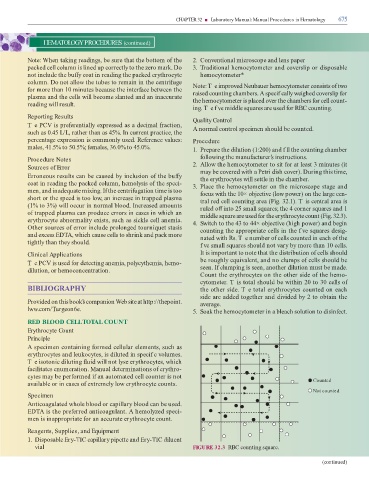
                                                                                                                               ing. T e f ve mi    le squares are use    or RBC counting.


                   Reporting Results                                                                                           Quality Control


                   Te PCV is pre erentially expresse   as a   ecimal  raction,                                                 A normal control specimen shoul   be counte  .
                   such as 0.45 L/L, rather than as 45%. In current practice, the


                   percentage expression is commonly use  . Re erence values:                                                  Procedure
                   males, 41.5% to 50.5%;  emales, 36.0% to 45.0%.                                                             1.  Prepare the   ilution (1:200) an   f ll the counting chamber


                   Procedure Notes                                                                                                   ollowing the manu acturer’s instructions.

                   Sources of Error                                                                                            2.  Allow the hemocytometer to sit  or at least 3 minutes (it
                                                                                                                                    may be covere   with a Petri   ish cover). During this time,
                   Erroneous results can be cause   by inclusion o  the bu  y                                                       the erythrocytes will settle in the chamber.

                   coat in rea  ing the packe   column, hemolysis o  the speci-                                                3.  Place the hemocytometer on the microscope stage an

                   men, an   ina  equate mixing. I  the centri ugation time is too                                                   ocus with the 10× objective (low power) on the large cen-

                   short or the spee   is too low, an increase in trappe   plasma                                                   tral re   cell counting area (Fig. 32.1). T is central area is

                   (1% to 3%) will occur in normal bloo  . Increase   amounts                                                       rule   o   into 25 small squares; the 4 corner squares an   1

                   o  trappe   plasma can pro  uce errors in cases in which an                                                      mi    le square are use    or the erythrocyte count (Fig. 32.3).

                   erythrocyte abnormality exists, such as sickle cell anemia.                                                 4.  Switch to the 43 to 44× objective (high power) an   begin

                   Other sources o  error inclu  e prolonge   tourniquet stasis                                                     counting the appropriate cells in the f ve squares   esig-

                   an   excess ED  A, which cause cells to shrink an   pack more                                                    nate   with Rs. T e number o  cells counte   in each o  the

                   tightly than they shoul  .
                                                                                                                                    f ve small squares shoul   not vary by more than 10 cells.


                   Clinical Applications                                                                                            It is important to note that the   istribution o  cells shoul


                   Te PCV is use    or   etecting anemia, polycythemia, hemo-                                                       be roughly equivalent, an   no clumps o  cells shoul   be

                     ilution, or hemoconcentration.                                                                                 seen. I  clumping is seen, another   ilution must be ma  e.
                                                                                                                                    Count the erythrocytes on the other si  e o  the hemo-


                                                                                                                                    cytometer. T is total shoul   be within 20 to 30 cells o
                   BIBLIOGRAPHY                                                                                                     the other si  e. T e total erythrocytes counte   on each


                                                                                                                                    si  e are a    e   together an     ivi  e   by 2 to obtain the
                   Provi  e   on this book’s companion Web site at http://thepoint.                                                 average.
                   lww.com/  urgeon6e.                                                                                         5.  Soak the hemocytometer in a bleach solution to   isin ect.


                   RED BLOOD CELL TOTAL COUNT

                   Erythrocyte Count

                   Principle


                   A specimen containing  orme   cellular elements, such as

                   erythrocytes an   leukocytes, is   ilute   in specif c volumes.

                   Te isotonic   iluting   ui   will not lyse erythrocytes, which

                    acilitates enumeration. Manual   eterminations o  erythro-

                   cytes may be per orme   i  an automate   cell counter is not

                   available or in cases o  extremely low erythrocyte counts.                                                                                                                                 Counted

                                                                                                                                                                                                              Not counted
                   Specimen

                   Anticoagulate   whole bloo   or capillary bloo   can be use  .

                   ED  A is the pre erre   anticoagulant. A hemolyze   speci-

                   men is inappropriate  or an accurate erythrocyte count.


                   Reagents, Supplies, and Equipment


                   1.  Disposable Ery-  IC capillary pipette an   Ery-  IC   iluent

                        vial                                                                                                   FIGURE 32.3  RBC counting square.


                                                                                                                                                                                                                    (continued)

