


Page 696 - Clinical Hematology_ Theory _ Procedures ( PDFDrive )
P. 696
680            PART 8  ■  Fundamentals of Hematological Analysis


                       SPECIAL HEMATOLOGY PROCEDURES


               ACIDIFIED SERUM LYSIS TEST: HAM METHOD


               Principle

               Erythrocytes are incubate   with  resh an   heate   serum to test

                or hemolysis. Weak aci   is use   in specif c serum cell mix-

               tures to maximize hemolytic activity. T e presence o  hemo-

               lysis,   epen  ing on the test con  itions, may be observe   in

               cases o  antibo  y-sensitize   coate   erythrocytes, spherocytes,

               or paroxysmal nocturnal hemoglobinuria (PNH).

                    T is proce  ure, in CLSI  ormat, is provi  e   on this book’s

               companion Web site at http://thepoint.lww.com/  urgeon6e.


               BONE MARROW EXAMINATION


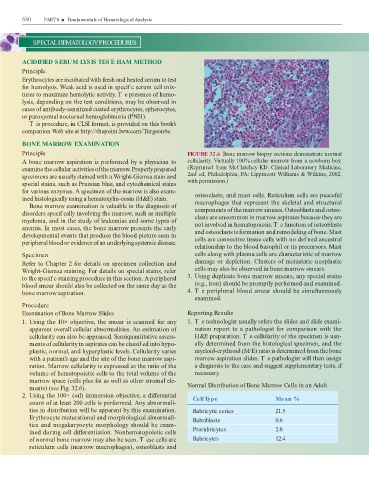
               Principle                                                                                                   FIGURE 32.6  Bone marrow biopsy sections   emonstrate normal

               A bone marrow aspiration is per orme   by a physician to                                                    cellularity. Virtually 100% cellular marrow  rom a newborn boy.


               examine the cellular activities o  the marrow. Properly prepare                                             (Reprinte    rom McClatchey KD. Clinical Laboratory Medicine,
               specimens are usually staine   with a Wright-Giemsa stain an                                                2n   e  , Phila  elphia, PA: Lippincott Williams & Wilkins, 2002,


               special stains, such as Prussian blue, an   cytochemical stains                                             with permission.)
                or various enzymes. A specimen o  the marrow is also exam-                                                      osteoclasts, an   mast cells. Reticulum cells are peace ul


               ine   histologically using a hematoxylin-eosin (H&E) stain.                                                      macrophages that represent the skeletal an   structural
                    Bone marrow examination is valuable in the   iagnosis o


                 isor  ers specif cally involving the marrow, such as multiple                                                  components o  the marrow sinuses. Osteoblasts an   osteo-
                                                                                                                                clasts are uncommon in marrow aspirates because they are
               myeloma, an   in the stu  y o  leukemias an   some types o                                                       not involve   in hematopoiesis. T e  unction o  osteoblasts


               anemia. In most cases, the bone marrow presents the early                                                        an   osteoclasts is  ormation an   remo  eling o  bone. Mast
                 evelopmental events that pro  uce the bloo   picture seen in                                                   cells are connective tissue cells with no   ef ne   ancestral


               peripheral bloo   or evi  ence o  an un  erlying systemic   isease.
                                                                                                                                relationship to the bloo   basophil or its precursors. Mast

               Specimen                                                                                                         cells along with plasma cells are characteristic o  marrow


               Re er to Chapter 2  or   etails on specimen collection an                                                         amage or  epletion. Clusters o  metastatic neoplastic

               Wright-Giemsa staining. For   etails on special stains, re er                                                    cells may also be observe   in bone marrow smears.

               to the specif c staining proce  ure in this section. A peripheral                                           3.  Using   uplicate bone marrow smears, any special stains

               bloo   smear shoul   also be collecte   on the same   ay as the                                                  (e.g., iron) shoul   be promptly per orme   an   examine  .

               bone marrow aspiration.                                                                                     4.  T e peripheral bloo   smear shoul   be simultaneously
                                                                                                                                examine  .

               Procedure

               Examination of Bone Marrow Slides                                                                           Reporting Results


               1.  Using the 10× objective, the smear is scanne    or any                                                  1.  T e technologist usually re ers the sli  es an   sli  e exami-

                    apparent overall cellular abnormalities. An estimation o                                                    nation report to a pathologist  or comparison with the

                    cellularity can also be appraise  . Semiquantitative assess-                                                H&E preparation. T e cellularity o  the specimen is usu-

                    ments o  cellularity in aspirates can be classif e   into hypo-                                             ally   etermine    rom the histological specimen, an   the

                    plastic, normal, an   hyperplastic levels. Cellularity varies                                               myeloi  -erythroi   (M/E) ratio is   etermine    rom the bone

                    with a patient’s age an   the site o  the bone marrow aspi-                                                 marrow aspiration sli  es. T e pathologist will then assign

                    ration. Marrow cellularity is expresse   as the ratio o  the                                                a   iagnosis to the case an   suggest supplementary tests, i

                    volume o  hematopoietic cells to the total volume o  the                                                    necessary.

                    marrow space (cells plus  at as well as other stromal ele-

                    ments) (see Fig. 32.6).                                                                                Normal Distribution of Bone Marrow Cells in an Adult

               2.  Using the 100× (oil) immersion objective, a   i  erential                                                   Cell Type                                             Mean %

                    count o  at least 200 cells is per orme  . Any abnormali-

                    ties in   istribution will be apparent by this examination.                                                Rubricytic series                                     21.5

                    Erythrocyte maturational an   morphological abnormali-                                                     Rubriblasts                                           0.6

                    ties an   megakaryocyte morphology shoul   be exam-

                    ine     uring cell   i  erentiation. Nonhematopoietic cells                                                Prorubricytes                                         2.0

                    o  normal bone marrow may also be seen. T ese cells are                                                    Rubricytes                                            12.4

                    reticulum cells (marrow macrophages), osteoblasts an

