


Page 374 - Review of Medical Microbiology and Immunology ( PDFDrive )
P. 374
mebooksfree.com
mebooksfree.com
mebooksfree.com
mebooksfree.com
mebooksfree.com mebooksfree.com mebooksfree.com mebooksfree.com mebooksfree.com mebooksfree.com
mebooksfree.com
mebooksfree.com
363
CHAPTER 43 Tumor Viruses
In the revertants studied, the viral genetic material remains
Growth
factor
integrated in cellular DNA, but changes in the quality and
quantity of the virus-specific RNA occur.
Regulator
of apoptosis
Growth
factor
PROVIRUSES & ONCOGENES
receptor
The two major concepts of the way viral tumorigenesis
regulator
occurs are expressed in the terms provirus and oncogene.
These contrasting ideas address the fundamental question Cell cycle G protein
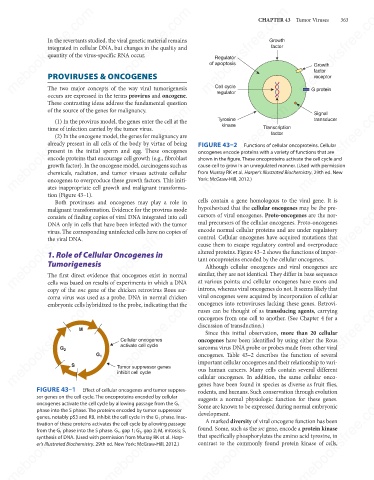
mebooksfree.com mebooksfree.com mebooksfree.com FIGURE 43–2 Functions of cellular oncoproteins. Cellular mebooksfree.com
mebooksfree.com
mebooksfree.com
of the source of the genes for malignancy.
Signal
transducer
Tyrosine
(1) In the provirus model, the genes enter the cell at the
kinase
Transcription
time of infection carried by the tumor virus.
factor
(2) In the oncogene model, the genes for malignancy are
already present in all cells of the body by virtue of being
present in the initial sperm and egg. These oncogenes
oncogenes encode proteins with a variety of functions that are
encode proteins that encourage cell growth (e.g., fibroblast
shown in the figure. These oncoproteins activate the cell cycle and
growth factor). In the oncogene model, carcinogens such as
cause cell to grow in an unregulated manner. (Used with permission
chemicals, radiation, and tumor viruses activate cellular
York: McGraw-Hill, 2012.)
oncogenes to overproduce these growth factors. This initi-
ates inappropriate cell growth and malignant transforma-
tion (Figure 43–1). from Murray RK et al. Harper’s Illustrated Biochemistry. 29th ed. New
cells contain a gene homologous to the viral gene. It is
Both proviruses and oncogenes may play a role in
mebooksfree.com
mebooksfree.com mebooksfree.com mebooksfree.com mal precursors of the cellular oncogenes. Proto-oncogenes mebooksfree.com
mebooksfree.com
hypothesized that the cellular oncogenes may be the pre-
malignant transformation. Evidence for the provirus mode
cursors of viral oncogenes. Proto-oncogenes are the nor-
consists of finding copies of viral DNA integrated into cell
DNA only in cells that have been infected with the tumor
encode normal cellular proteins and are under regulatory
virus. The corresponding uninfected cells have no copies of
control. Cellular oncogenes have acquired mutations that
the viral DNA.
cause them to escape regulatory control and overproduce
altered proteins. Figure 43–2 shows the functions of impor-
1. Role of Cellular Oncogenes in
tant oncoproteins encoded by the cellular oncogenes.
Tumorigenesis
Although cellular oncogenes and viral oncogenes are
The first direct evidence that oncogenes exist in normal
at various points; and cellular oncogenes have exons and
cells was based on results of experiments in which a DNA
introns, whereas viral oncogenes do not. It seems likely that
copy of the onc gene of the chicken retrovirus Rous sar-
viral oncogenes were acquired by incorporation of cellular
coma virus was used as a probe. DNA in normal chicken similar, they are not identical. They differ in base sequence
mebooksfree.com
mebooksfree.com mebooksfree.com G 1 mebooksfree.com discussion of transduction.) mebooksfree.com mebooksfree.com
oncogenes into retroviruses lacking these genes. Retrovi-
embryonic cells hybridized to the probe, indicating that the
ruses can be thought of as transducing agents, carrying
oncogenes from one cell to another. (See Chapter 4 for a
M
Since this initial observation, more than 20 cellular
oncogenes have been identified by using either the Rous
Cellular oncogenes
activate cell cycle
sarcoma virus DNA probe or probes made from other viral
G 2
oncogenes. Table 43–2 describes the function of several
important cellular oncogenes and their relationship to vari-
S
Tumor suppressor genes
inhibit cell cycle
cellular oncogenes. In addition, the same cellular onco-
genes have been found in species as diverse as fruit flies,
FIGURE 43–1 Effect of cellular oncogenes and tumor suppres- ous human cancers. Many cells contain several different
rodents, and humans. Such conservation through evolution
sor genes on the cell cycle. The oncoproteins encoded by cellular
mebooksfree.com mebooksfree.com mebooksfree.com found. Some, such as the src gene, encode a protein kinase mebooksfree.com
mebooksfree.com
suggests a normal physiologic function for these genes.
mebooksfree.com
oncogenes activate the cell cycle by allowing passage from the G 1
Some are known to be expressed during normal embryonic
phase into the S phase. The proteins encoded by tumor suppressor
development.
genes, notably p53 and RB, inhibit the cell cycle in the G 1 phase. Inac-
A marked diversity of viral oncogene function has been
tivation of these proteins activates the cell cycle by allowing passage
from the G 1 phase into the S phase. G 1 , gap 1; G 2 , gap 2; M, mitosis; S,
that specifically phosphorylates the amino acid tyrosine, in
synthesis of DNA. (Used with permission from Murray RK et al. Harp-
contrast to the commonly found protein kinase of cells,
er’s Illustrated Biochemistry. 29th ed. New York: McGraw-Hill, 2012.)
mebooksfree.com mebooksfree.com mebooksfree.com mebooksfree.com mebooksfree.com mebooksfree.com

