


Page 375 - Review of Medical Microbiology and Immunology ( PDFDrive )
P. 375
mebooksfree.com
mebooksfree.com
mebooksfree.com
mebooksfree.com
mebooksfree.com
mebooksfree.com mebooksfree.com Important Human Cancer TABLE 43–3 Evidence That Cellular Oncogenes mebooksfree.com
mebooksfree.com
mebooksfree.com
mebooksfree.com
mebooksfree.com
364
PART IV Clinical Virology
TABLE 43–2 Examples of Cellular Oncogenes
(c-onc) Can Cause Tumors
Involved in Human Cancer
Description
Evidence
Cellular
Function of
Oncogene
Oncogene
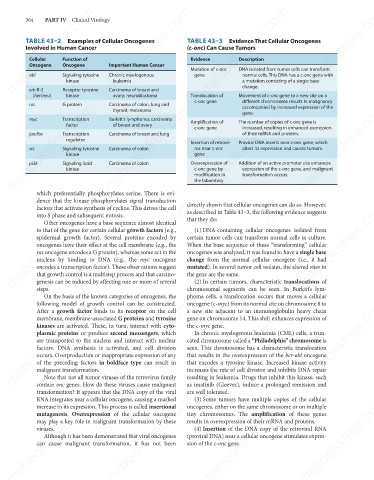
Mutation of c-onc
DNA isolated from tumor cells can transform
normal cells. This DNA has a c-onc gene with
abl
gene
Signaling tyrosine
Chronic myelogenous
leukemia
a mutation consisting of a single base
kinase
change.
Carcinoma of breast and
Receptor tyrosine
erb B-2
Translocation of
ovary; neuroblastoma
(her/neu)
kinase
different chromosome results in malignancy
c-onc gene Movement of c-onc gene to a new site on a
Carcinoma of colon, lung and
ras
G protein
mebooksfree.com
mebooksfree.com
mebooksfree.com mebooksfree.com Carcinoma of breast and lung Insertion of retrovi- Proviral DNA inserts near c-onc gene, which mebooksfree.com
mebooksfree.com
accompanied by increased expression of the
thyroid; melanoma
gene.
Transcription
myc
Burkitt’s lymphoma; carcinoma
Amplification of
The number of copies of c-onc gene is
of breast and ovary
factor
increased, resulting in enhanced expression
c-onc gene
jun/fos
Transcription
of their mRNA and proteins.
regulator
alters its expression and causes tumors.
rus near c-onc
Carcinoma of colon
src
Signaling tyrosine
gene
kinase
Addition of an active promoter site enhances
pi3k
Carcinoma of colon
Signaling lipid
Overexpression of
expression of the c-onc gene, and malignant
c-onc gene by
kinase
modification in
transformation occurs.
the laboratory
which preferentially phosphorylates serine. There is evi-
dence that the kinase phosphorylates signal transduction
mebooksfree.com
mebooksfree.com
mebooksfree.com mebooksfree.com mebooksfree.com directly shown that cellular oncogenes can do so. However, mebooksfree.com
factors that activate synthesis of cyclins. This drives the cell
as described in Table 43–3, the following evidence suggests
into S phase and subsequent mitosis.
that they do:
Other oncogenes have a base sequence almost identical
to that of the gene for certain cellular growth factors (e.g.,
(1) DNA-containing cellular oncogenes isolated from
certain tumor cells can transform normal cells in culture.
epidermal growth factor). Several proteins encoded by
When the base sequence of these “transforming” cellular
oncogenes have their effect at the cell membrane (e.g., the
oncogenes was analyzed, it was found to have a single base
ras oncogene encodes a G protein), whereas some act in the
nucleus by binding to DNA (e.g., the myc oncogene
change from the normal cellular oncogene (i.e., it had
encodes a transcription factor). These observations suggest
mutated). In several tumor cell isolates, the altered sites in
that growth control is a multistep process and that carcino-
genesis can be induced by affecting one or more of several
(2) In certain tumors, characteristic translocations of
chromosomal segments can be seen. In Burkitt’s lym-
steps.
On the basis of the known categories of oncogenes, the the gene are the same.
phoma cells, a translocation occurs that moves a cellular
mebooksfree.com mebooksfree.com mebooksfree.com the c-myc gene. mebooksfree.com mebooksfree.com
mebooksfree.com
following model of growth control can be constructed.
oncogene (c-myc) from its normal site on chromosome 8 to
a new site adjacent to an immunoglobulin heavy chain
After a growth factor binds to its receptor on the cell
membrane, membrane-associated G proteins and tyrosine
gene on chromosome 14. This shift enhances expression of
kinases are activated. These, in turn, interact with cyto-
plasmic proteins or produce second messengers, which
In chronic myelogenous leukemia (CML) cells, a trun-
are transported to the nucleus and interact with nuclear
cated chromosome called a “Philadelphia” chromosome is
seen. This chromosome has a characteristic translocation
factors. DNA synthesis is activated, and cell division
that results in the overexpression of the bcr-abl oncogene
occurs. Overproduction or inappropriate expression of any
that encodes a tyrosine kinase. Increased kinase activity
of the preceding factors in boldface type can result in
malignant transformation.
resulting in leukemia. Drugs that inhibit this kinase, such
Note that not all tumor viruses of the retrovirus family
contain onc genes. How do these viruses cause malignant
as imatinib (Gleevec), induce a prolonged remission and
transformation? It appears that the DNA copy of the viral increases the rate of cell division and inhibits DNA repair
are well tolerated.
mebooksfree.com
mebooksfree.com
mebooksfree.com mebooksfree.com mebooksfree.com results in overexpression of their mRNA and proteins. mebooksfree.com
RNA integrates near a cellular oncogene, causing a marked
(3) Some tumors have multiple copies of the cellular
increase in its expression. This process is called insertional
oncogenes, either on the same chromosome or on multiple
mutagenesis. Overexpression of the cellular oncogene
tiny chromosomes. The amplification of these genes
may play a key role in malignant transformation by these
viruses.
(4) Insertion of the DNA copy of the retroviral RNA
(proviral DNA) near a cellular oncogene stimulates expres-
Although it has been demonstrated that viral oncogenes
sion of the c-onc gene.
can cause malignant transformation, it has not been
mebooksfree.com mebooksfree.com mebooksfree.com mebooksfree.com mebooksfree.com mebooksfree.com

