Page 376 - Review of Medical Microbiology and Immunology ( PDFDrive )
P. 376
mebooksfree.com
                                                                            mebooksfree.com
 mebooksfree.com

                                            mebooksfree.com
                                                                            mebooksfree.com
                                                                                                            mebooksfree.com
                                                                                                                                           mebooksfree.com
            mebooksfree.com
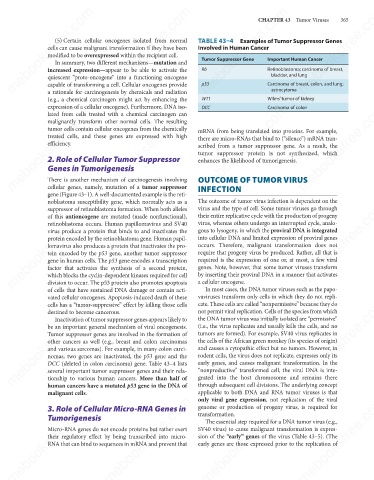
 mebooksfree.com  mebooksfree.com           mebooksfree.com              TABLE 43–4  Examples of Tumor Suppressor Genes                    mebooksfree.com
                                                                                                                        365
                                                                                             CHAPTER 43  Tumor Viruses
                          (5) Certain cellular oncogenes isolated from normal
                                                                         Involved in Human Cancer
                        cells can cause malignant transformation if they have been
                        modified to be overexpressed within the recipient cell.
                                                                                                Important Human Cancer
                                                                          Tumor Suppressor Gene
                          In summary, two different mechanisms—mutation and
                        increased expression—appear to be able to activate the
                                                                                                Retinoblastoma; carcinoma of breast,
                                                                          Rb
                                                                                                 bladder, and lung
                        quiescent “proto-oncogene” into a functioning oncogene
                        capable of transforming a cell. Cellular oncogenes provide
                                                                                                 astrocytoma
                        a rationale for carcinogenesis by chemicals and radiation
                        (e.g., a chemical carcinogen might act by enhancing the   p53           Carcinoma of breast, colon, and lung;
                                                                          WT1
                                                                                                Wilms’ tumor of kidney
 mebooksfree.com  mebooksfree.com           mebooksfree.com              mRNA from being translated into proteins. For example,            mebooksfree.com
                                                                            mebooksfree.com
                                                                                                            mebooksfree.com
                        expression of a cellular oncogene). Furthermore, DNA iso-
                                                                          DCC
                                                                                                Carcinoma of colon
                        lated from cells treated with a chemical carcinogen can
                        malignantly transform other normal cells. The resulting
                        tumor cells contain cellular oncogenes from the chemically
                        treated cells, and these genes are expressed with high
                                                                         there are micro-RNAs that bind to (“silence”) mRNA tran-
                        efficiency.
                                                                         scribed from a tumor suppressor gene. As a result, the
                                                                         tumor suppressor protein is not synthesized, which
                        2. Role of Cellular Tumor Suppressor
                                                                         enhances the likelihood of tumorigenesis.
                        Genes in Tumorigenesis
                        There is another mechanism of carcinogenesis involving
                        cellular  genes,  namely,  mutation  of  a  tumor suppressor
                                                                         INFECTION
                        gene (Figure 43–1). A well-documented example is the reti-  OUTCOME OF TUMOR VIRUS
                                                                         The outcome of tumor virus infection is dependent on the
                        noblastoma susceptibility gene, which normally acts as a
                                                                                                            mebooksfree.com
 mebooksfree.com  mebooksfree.com           mebooksfree.com              virus, whereas others undergo an interrupted cycle, analo-        mebooksfree.com
                                                                            mebooksfree.com
                                                                         virus and the type of cell. Some tumor viruses go through
                        suppressor of retinoblastoma formation. When both alleles
                                                                         their entire replicative cycle with the production of progeny
                        of this antioncogene are mutated (made nonfunctional),
                        retinoblastoma  occurs.  Human  papillomavirus  and  SV40
                                                                         gous to lysogeny, in which the proviral DNA is integrated
                        virus produce a protein that binds to and inactivates the
                                                                         into cellular DNA and limited expression of proviral genes
                        protein encoded by the retinoblastoma gene. Human papil-
                                                                         occurs. Therefore, malignant transformation does not
                        lomavirus also produces a protein that inactivates the pro-
                                                                         require that progeny virus be produced. Rather, all that is
                        tein encoded by the p53 gene, another tumor suppressor
                                                                         required is the expression of one or, at most, a few viral
                        gene in human cells. The p53 gene encodes a transcription
                                                                         genes. Note, however, that some tumor viruses transform
                        factor that activates the synthesis of a second protein,
                        which blocks the cyclin-dependent kinases required for cell
                                                                         a cellular oncogene.
                        division to occur. The p53 protein also promotes apoptosis
                                                                           In most cases, the DNA tumor viruses such as the papo-
                        of cells that have sustained DNA damage or contain acti-
                                                                         vaviruses transform only cells in which they do not repli-
                        vated cellular oncogenes. Apoptosis-induced death of these   by inserting their proviral DNA in a manner that activates
                                                                                                            mebooksfree.com
 mebooksfree.com  mebooksfree.com           mebooksfree.com              (i.e., the virus replicates and usually kills the cells, and no   mebooksfree.com
                                                                            mebooksfree.com
                                                                         cate. These cells are called “nonpermissive” because they do
                        cells has a “tumor-suppressive” effect by killing those cells
                                                                         not permit viral replication. Cells of the species from which
                        destined to become cancerous.
                                                                         the DNA tumor virus was initially isolated are “permissive”
                          Inactivation of tumor suppressor genes appears likely to
                        be an important general mechanism of viral oncogenesis.
                                                                         tumors are formed). For example, SV40 virus replicates in
                        Tumor suppressor genes are involved in the formation of
                                                                         the cells of the African green monkey (its species of origin)
                        other cancers as well (e.g., breast and colon carcinomas
                                                                         and causes a cytopathic effect but no tumors. However, in
                        and various sarcomas). For example, in many colon carci-
                                                                         rodent cells, the virus does not replicate, expresses only its
                        nomas, two genes are inactivated, the  p53 gene and the
                                                                         early genes, and causes malignant transformation. In the
                        DCC (deleted in colon carcinoma) gene. Table 43–4 lists
                        several important tumor suppressor genes and their rela-
                                                                         grated into the host chromosome and remains there
                        tionship to various human cancers.  More than half of
                                                                         through subsequent cell divisions. The underlying concept
                        human cancers have a mutated p53 gene in the DNA of
                                                                         applicable to both DNA and RNA tumor viruses is that
                        malignant cells.                                 “nonproductive” transformed cell, the viral DNA is inte-
                                                                                                            mebooksfree.com
                                                                            mebooksfree.com
 mebooksfree.com  mebooksfree.com           mebooksfree.com              SV40 virus) to cause malignant transformation is expres-          mebooksfree.com
                                                                         only viral gene expression, not replication of the viral
                                                                         genome or production of progeny virus, is required for
                        3. Role of Cellular Micro-RNA Genes in
                                                                         transformation.
                        Tumorigenesis
                                                                           The essential step required for a DNA tumor virus (e.g.,
                        Micro-RNA genes do not encode proteins but rather exert
                                                                         sion of the “early” genes of the virus (Table 43–5). (The
                        their regulatory effect by being transcribed into micro-
                        RNA that can bind to sequences in mRNA and prevent that
                                                                         early genes are those expressed prior to the replication of
 mebooksfree.com  mebooksfree.com           mebooksfree.com                 mebooksfree.com                 mebooksfree.com                mebooksfree.com
   371   372   373   374   375   376   377   378   379   380   381