Page 505 - Review of Medical Microbiology and Immunology ( PDFDrive )
P. 505
mebooksfree.com
 mebooksfree.com


            mebooksfree.com
                                                                            mebooksfree.com
                                            mebooksfree.com
                                                                                                            mebooksfree.com
                                                                                                                                           mebooksfree.com
 mebooksfree.com  mebooksfree.com           mebooksfree.com               Mode of Action                    mebooksfree.com                mebooksfree.com
                       PART VII  Immunology
                 494
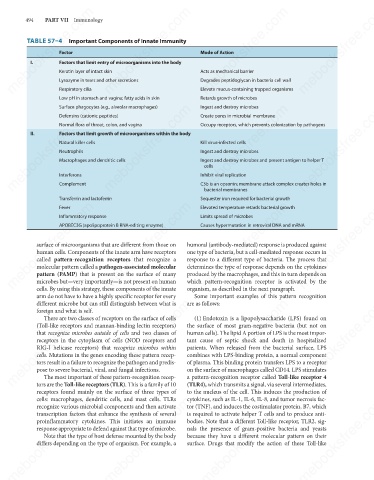
                 TABLE 57–4  Important Components of Innate Immunity
                            Factor
                            Factors that limit entry of microorganisms into the body
                  I.
                            Keratin layer of intact skin
                                                                          Acts as mechanical barrier
                            Lysozyme in tears and other secretions
                                                                          Elevate mucus-containing trapped organisms
                            Respiratory cilia
                                                                          Retards growth of microbes
                            Low pH in stomach and vagina; fatty acids in skin  Degrades peptidoglycan in bacteria cell wall
                                                                            mebooksfree.com
 mebooksfree.com  mebooksfree.com           mebooksfree.com               Occupy receptors, which prevents colonization by pathogens       mebooksfree.com
                                                                                                            mebooksfree.com
                            Surface phagocytes (e.g., alveolar macrophages)
                                                                          Ingest and destroy microbes
                            Defensins (cationic peptides)
                                                                          Create pores in microbial membrane
                            Normal flora of throat, colon, and vagina
                  II.
                            Factors that limit growth of microorganisms within the body
                                                                          Kill virus-infected cells
                            Natural killer cells
                                                                          Ingest and destroy microbes
                            Neutrophils
                                                                          Ingest and destroy microbes and present antigen to helper T
                            Macrophages and dendritic cells
                                                                           cells
                            Interferons
                                                                          C3b is an opsonin; membrane attack complex creates holes in
                            Complement
                                                                           bacterial membranes
                            Transferrin and lactoferrin                   Inhibit viral replication
                                                                          Sequester iron required for bacterial growth
                                                                            mebooksfree.com
 mebooksfree.com  mebooksfree.com           mebooksfree.com          organism, as described in the next paragraph. mebooksfree.com         mebooksfree.com
                                                                          Elevated temperature retards bacterial growth
                            Fever
                            Inflammatory response
                                                                          Limits spread of microbes
                            APOBEC3G (apolipoprotein B RNA-editing enzyme)
                                                                          Causes hypermutation in retroviral DNA and mRNA
                    surface of microorganisms that are different from those on
                                                                     humoral (antibody-mediated) response is produced against
                    human cells. Components of the innate arm have receptors
                                                                     one type of bacteria, but a cell-mediated response occurs in
                                                                     response to a different type of bacteria. The process that
                    called  pattern-recognition receptors that recognize a
                                                                     determines the type of response depends on the cytokines
                    molecular pattern called a pathogen-associated molecular
                    pattern  (PAMP) that is present on the surface of many
                    microbes but—very importantly—is not present on human
                                                                     which pattern-recognition receptor is activated by the
                    cells. By using this strategy, these components of the innate
                                                                        Some important examples of this pattern recognition
                    arm do not have to have a highly specific receptor for every   produced by the macrophages, and this in turn depends on
 mebooksfree.com  mebooksfree.com           mebooksfree.com          the surface of most gram-negative bacteria (but not on                mebooksfree.com
                                                                            mebooksfree.com
                                                                                                            mebooksfree.com
                                                                     are as follows:
                    different microbe but can still distinguish between what is
                    foreign and what is self.
                       There are two classes of receptors on the surface of cells
                                                                        (1) Endotoxin is a lipopolysaccharide (LPS) found on
                    (Toll-like receptors and mannan-binding lectin receptors)
                    that recognize microbes outside of cells and two classes of
                                                                     human cells). The lipid A portion of LPS is the most impor-
                    receptors in the cytoplasm of cells (NOD receptors and
                                                                     tant cause of septic shock and death in hospitalized
                    RIG-I helicase receptors) that  recognize microbes within
                                                                     patients. When released from the bacterial surface, LPS
                                                                     combines with LPS-binding protein, a normal component
                    cells. Mutations in the genes encoding these pattern recep-
                    tors result in a failure to recognize the pathogen and predis-
                                                                     of plasma. This binding protein transfers LPS to a receptor
                    pose to severe bacterial, viral, and fungal infections.
                                                                     a pattern-recognition receptor called Toll-like receptor 4
                       The most important of these pattern-recognition recep-
                    tors are the Toll-like receptors (TLR). This is a family of 10
                                                                     (TLR4), which transmits a signal, via several intermediates,
                    receptors  found  mainly  on  the  surface  of three  types  of   on the surface of macrophages called CD14. LPS stimulates
                                                                     to the nucleus of the cell. This induces the production of
 mebooksfree.com  mebooksfree.com           mebooksfree.com          bodies. Note that a different Toll-like receptor, TLR2, sig-          mebooksfree.com
                                                                                                            mebooksfree.com
                    cells: macrophages, dendritic cells, and mast cells. TLRs
                                                                            mebooksfree.com
                                                                     cytokines, such as IL-1, IL-6, IL-8, and tumor necrosis fac-
                    recognize various microbial components and then activate
                                                                     tor (TNF), and induces the costimulator protein, B7, which
                    transcription factors that enhance the synthesis of several
                                                                     is required to activate helper T cells and to produce anti-
                    proinflammatory cytokines. This initiates an immune
                    response appropriate to defend against that type of microbe.
                                                                     nals the presence of gram-positive bacteria and yeasts
                       Note that the type of host defense mounted by the body
                                                                     because they have a  different molecular  pattern  on their
                                                                     surface. Drugs that modify the action of these Toll-like
                    differs depending on the type of organism. For example, a
 mebooksfree.com  mebooksfree.com           mebooksfree.com                 mebooksfree.com                 mebooksfree.com                mebooksfree.com
   500   501   502   503   504   505   506   507   508   509   510