


Page 504 - Review of Medical Microbiology and Immunology ( PDFDrive )
P. 504
mebooksfree.com


                                                                            mebooksfree.com
                                                                                                            mebooksfree.com
            mebooksfree.com
 mebooksfree.com  mebooksfree.com       Virus mebooksfree.com               mebooksfree.com                 mebooksfree.com                mebooksfree.com
                                            mebooksfree.com
                                                                                                                                           mebooksfree.com
                                                                                                                        493
                                                                                                CHAPTER 57  Immunity
                                                             Virus-infected cell

                                                      Class I MHC
                                                        protein
                                                                         Perforins
                                                                                          Virus
                                                      Viral epitope
                                                           TCR

                                                                  CD8   IL-2                  Macrophage
 mebooksfree.com  mebooksfree.com          Antibody B cell Class II  TCR  CD4 mebooksfree.com               mebooksfree.com                mebooksfree.com
                                            mebooksfree.com
                                                                  cell
                                          IgM
                                                         IL-4, IL-5
                                                                                    Class II MHC protein
                                                                                 Viral epitope
                                                                              TCR
                                                                    cell
                                                   MHC protein
                                                                             IL-2
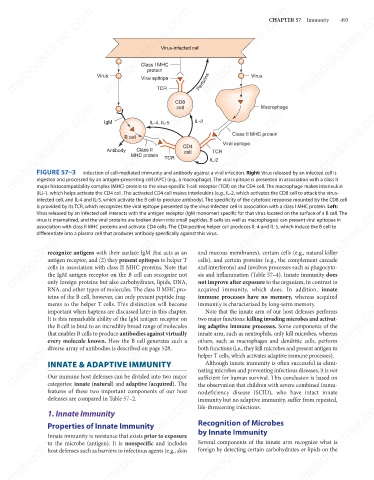
                    FIGURE 57–3
                                   Induction of cell-mediated immunity and antibody against a viral infection. Right: Virus released by an infected cell is
                    ingested and processed by an antigen-presenting cell (APC) (e.g., a macrophage). The viral epitope is presented in association with a class II
                    major histocompatibility complex (MHC) protein to the virus-specific T-cell receptor (TCR) on the CD4 cell. The macrophage makes interleukin
                    (IL)-1, which helps activate the CD4 cell. The activated CD4 cell makes interleukins (e.g., IL-2, which activates the CD8 cell to attack the virus-
                    infected cell, and IL-4 and IL-5, which activate the B cell to produce antibody). The specificity of the cytotoxic response mounted by the CD8 cell
                                                                            mebooksfree.com
 mebooksfree.com  mebooksfree.com           mebooksfree.com              and mucous membranes), certain cells (e.g., natural killer        mebooksfree.com
                                                                                                            mebooksfree.com
                    is provided by its TCR, which recognizes the viral epitope presented by the virus-infected cell in association with a class I MHC protein. Left:
                    Virus released by an infected cell interacts with the antigen receptor (IgM monomer) specific for that virus located on the surface of a B cell. The
                    virus is internalized, and the viral proteins are broken down into small peptides. B cells (as well as macrophages) can present viral epitopes in
                    association with class II MHC proteins and activate CD4 cells. The CD4-positive helper cell produces IL-4 and IL-5, which induce the B cell to
                    differentiate into a plasma cell that produces antibody specifically against this virus.

                        recognize antigens with their surface IgM that acts as an
                        antigen receptor, and (2) they present epitopes to helper T
                                                                         cells), and certain proteins (e.g., the complement cascade
                        cells in association with class II MHC proteins. Note that
                                                                         and interferons) and involves processes such as phagocyto-
                        the IgM antigen receptor on the B cell can recognize not
                                                                         not improve after exposure to the organism, in contrast to
                        only foreign proteins but also carbohydrates, lipids, DNA,
                                                                         acquired immunity, which does. In addition,  innate
                        RNA, and other types of molecules. The class II MHC pro-
                                                                         immune processes have no memory, whereas acquired
                        teins of the B cell, however, can only present peptide frag-  sis and inflammation (Table 57–4). Innate immunity does
 mebooksfree.com  mebooksfree.com           mebooksfree.com              ing adaptive immune processes. Some components of the             mebooksfree.com
                                                                                                            mebooksfree.com
                                                                            mebooksfree.com
                                                                         immunity is characterized by long-term memory.
                        ments to the helper T cells. This distinction will become
                                                                           Note that the innate arm of our host defenses performs
                        important when haptens are discussed later in this chapter.
                                                                         two major functions: killing invading microbes and activat-
                        It is this remarkable ability of the IgM antigen receptor on
                        the B cell to bind to an incredibly broad range of molecules
                        that enables B cells to produce antibodies against virtually
                                                                         innate arm, such as neutrophils, only kill microbes, whereas
                        every molecule known. How the B cell generates such a
                                                                         others, such as macrophages and dendritic cells, perform
                                                                         both functions (i.e., they kill microbes and present antigen to
                        diverse array of antibodies is described on page 528.
                                                                         helper T cells, which activates adaptive immune processes).
                                                                           Although innate immunity is often successful in elimi-
                        INNATE & ADAPTIVE IMMUNITY
                        Our immune host defenses can be divided into two major
                                                                         sufficient for human survival. This conclusion is based on
                        categories: innate (natural) and adaptive (acquired). The
                                                                         the observation that children with severe combined immu-
                        features of these two important components of our host   nating microbes and preventing infectious diseases, it is not
                                                                         nodeficiency disease (SCID), who have intact innate
                        defenses are compared in Table 57–2.
                                                                            mebooksfree.com
 mebooksfree.com  mebooksfree.com           mebooksfree.com              Recognition of Microbes            mebooksfree.com                mebooksfree.com
                                                                         immunity but no adaptive immunity, suffer from repeated,
                                                                         life-threatening infections.
                        1. Innate Immunity
                        Properties of Innate Immunity
                                                                         by Innate Immunity
                        Innate immunity is resistance that exists prior to exposure
                                                                         Several components of the innate arm recognize what is
                        to the microbe (antigen). It is  nonspecific and includes
                                                                         foreign by detecting certain carbohydrates or lipids on the
                        host defenses such as barriers to infectious agents (e.g., skin
 mebooksfree.com  mebooksfree.com           mebooksfree.com                 mebooksfree.com                 mebooksfree.com                mebooksfree.com

