


Page 507 - Review of Medical Microbiology and Immunology ( PDFDrive )
P. 507
mebooksfree.com
mebooksfree.com
mebooksfree.com
mebooksfree.com
mebooksfree.com
mebooksfree.com
mebooksfree.com
mebooksfree.com
mebooksfree.com mebooksfree.com Macrophage exposure to microbial products (e.g., toxins and toxoids). mebooksfree.com
mebooksfree.com
PART VII Immunology
496
Phagocytosis of
In all these instances, the host actively produces an immune
microbes by
response consisting of antibodies and activated helper and
cytotoxic T lymphocytes.
The main advantage of active immunity is that resistance
or
onset, especially the primary response (see Chapter 60).
Passive immunity is resistance based on antibodies pre-
Acquired
Innate
immunity
immunity dendritic cell Present antigens to is long-term (Table 57–5). Its major disadvantage is its slow
formed in another host. Administration of antibody against
mebooksfree.com
mebooksfree.com
diphtheria, tetanus, botulism, etc., makes large amounts of
mebooksfree.com mebooksfree.com mebooksfree.com rabies and hepatitis A and B viruses) can be injected during mebooksfree.com
antitoxin immediately available to neutralize the toxins.
Destroy microbes
Likewise, preformed antibodies to certain viruses (e.g.,
CD4-positive
and
secrete cytokines
helper T cells
the incubation period to limit viral multiplication. Other
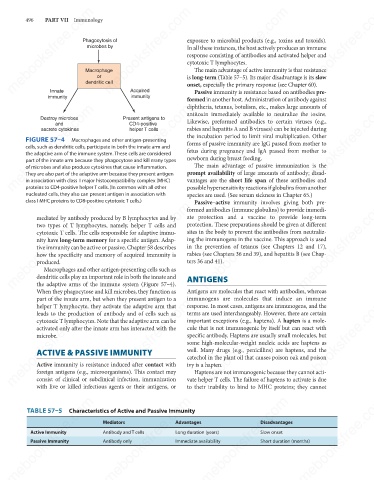
FIGURE 57–4
Macrophages and other antigen-presenting
forms of passive immunity are IgG passed from mother to
cells, such as dendritic cells, participate in both the innate arm and
fetus during pregnancy and IgA passed from mother to
the adaptive arm of the immune system. These cells are considered
newborn during breast feeding.
part of the innate arm because they phagocytose and kill many types
The main advantage of passive immunization is the
of microbes and also produce cytokines that cause inflammation.
They are also part of the adaptive arm because they present antigen
vantages are the short life span of these antibodies and
in association with class II major histocompatibility complex (MHC)
possible hypersensitivity reactions if globulins from another
proteins to CD4-positive helper T cells. (In common with all other
species are used. (See serum sickness in Chapter 65.)
nucleated cells, they also can present antigen in association with prompt availability of large amounts of antibody; disad-
class I MHC proteins to CD8-positive cytotoxic T cells.)
Passive–active immunity involves giving both pre-
mebooksfree.com mebooksfree.com mebooksfree.com protection. These preparations should be given at different mebooksfree.com
mebooksfree.com
mebooksfree.com
formed antibodies (immune globulins) to provide immedi-
ate protection and a vaccine to provide long-term
mediated by antibody produced by B lymphocytes and by
two types of T lymphocytes, namely, helper T cells and
sites in the body to prevent the antibodies from neutraliz-
cytotoxic T cells. The cells responsible for adaptive immu-
ing the immunogens in the vaccine. This approach is used
nity have long-term memory for a specific antigen. Adap-
in the prevention of tetanus (see Chapters 12 and 17),
tive immunity can be active or passive. Chapter 58 describes
rabies (see Chapters 36 and 39), and hepatitis B (see Chap-
how the specificity and memory of acquired immunity is
ters 36 and 41).
produced.
Macrophages and other antigen-presenting cells such as
dendritic cells play an important role in both the innate and
the adaptive arms of the immune system (Figure 57–4).
Antigens are molecules that react with antibodies, whereas
When they phagocytose and kill microbes, they function as ANTIGENS
immunogens are molecules that induce an immune
part of the innate arm, but when they present antigen to a
mebooksfree.com mebooksfree.com mebooksfree.com important exceptions (e.g., haptens). A hapten is a mole- mebooksfree.com
mebooksfree.com
mebooksfree.com
response. In most cases, antigens are immunogens, and the
helper T lymphocyte, they activate the adaptive arm that
terms are used interchangeably. However, there are certain
leads to the production of antibody and of cells such as
cytotoxic T lymphocytes. Note that the adaptive arm can be
cule that is not immunogenic by itself but can react with
activated only after the innate arm has interacted with the
specific antibody. Haptens are usually small molecules, but
microbe.
some high-molecular-weight nucleic acids are haptens as
well. Many drugs (e.g., penicillins) are haptens, and the
ACTIVE & PASSIVE IMMUNITY
catechol in the plant oil that causes poison oak and poison
Active immunity is resistance induced after contact with
ivy is a hapten.
foreign antigens (e.g., microorganisms). This contact may
Haptens are not immunogenic because they cannot acti-
consist of clinical or subclinical infection, immunization
vate helper T cells. The failure of haptens to activate is due
with live or killed infectious agents or their antigens, or
to their inability to bind to MHC proteins; they cannot
mebooksfree.com
mebooksfree.com mebooksfree.com Mediators Advantages mebooksfree.com mebooksfree.com mebooksfree.com
TABLE 57–5 Characteristics of Active and Passive Immunity
Disadvantages
Active Immunity
Antibody and T cells
Long duration (years)
Slow onset
Passive Immunity
Immediate availability
Antibody only
Short duration (months)
mebooksfree.com mebooksfree.com mebooksfree.com mebooksfree.com mebooksfree.com mebooksfree.com

