


Page 508 - Review of Medical Microbiology and Immunology ( PDFDrive )
P. 508
mebooksfree.com
mebooksfree.com
mebooksfree.com
mebooksfree.com
mebooksfree.com
mebooksfree.com
mebooksfree.com
mebooksfree.com mebooksfree.com mebooksfree.com penicillin binds to one of our proteins to cross-link IgE. An 497 mebooksfree.com
mebooksfree.com
CHAPTER 57 Immunity
bind because they are not polypeptides and only polypep-
tides can be presented by MHC proteins. Furthermore,
excellent example of this is penicilloyl polylysine, which is
haptens are univalent and therefore cannot activate B cells
used in skin tests to determine whether a patient is allergic
to penicillin. Each lysine in the polylysine has a penicillin
by themselves. (Compare with the T-independent response
molecule attached to it. These univalent penicillin mole-
of multivalent antigens discussed earlier in this chapter and
in Chapter 58.)
Although haptens cannot stimulate a primary or sec-
cent IgEs on the surface of mast cells. The consequent
release of mediators causes a “wheal and flare” reaction in
ondary response by themselves, they can do so when cova-
lently bound to a “carrier” protein (Figure 57–5). In this cules form a “multivalent” array and can cross-link adja-
the skin of the penicillin-allergic patient.
mebooksfree.com
Another medically important concept that is related to
mebooksfree.com
process, the hapten interacts with an IgM receptor on the B
mebooksfree.com mebooksfree.com mebooksfree.com cines and the vaccine against Haemophilus influenzae. In mebooksfree.com
cell and the hapten–carrier protein complex is internalized.
the hapten–carrier protein model is that of conjugate vac-
cines such as the pneumococcal and meningococcal vac-
A peptide of the carrier protein is presented in association
with class II MHC protein to the helper T cells. The acti-
vated helper T cell then produces interleukins, which
these conjugate vaccines, the capsular polysaccharide is
stimulate the B cells to produce antibody to the hapten (see
conjugated to a carrier protein. The capsular polysaccha-
ride is not a hapten because it can induce IgM via the
Chapter 58, page 512, for additional information).
T-independent response. However, adding a carrier protein
Two additional ideas are needed to understand how
haptens interact with our immune system. The first is that
causes helper T cells to be involved, and large amounts of
many haptens, such as drugs (e.g., penicillin) and poison
The interaction of antigen and antibody is highly spe-
oak oil, bind to our normal proteins, to which we are tol-
erant. The hapten–protein combination now becomes
cific, and this characteristic is frequently used in the diag-
immunogenic (i.e., the hapten modifies the protein suffi- IgG are produced via the T-dependent response.
nostic laboratory to identify microorganisms. Antigen and
antibody bind by weak forces such as hydrogen bonds and
ciently such that when the hapten–peptide combination is
mebooksfree.com
mebooksfree.com
mebooksfree.com mebooksfree.com mebooksfree.com fit of the antigen with its antibody-combining site (i.e., its mebooksfree.com
van der Waals’ forces rather than by covalent bonds. The
presented by the MHC protein, it is recognized as
foreign).
strength of the binding (the affinity) is proportionate to the
The second idea is that although most haptens are uni-
valent, type I hypersensitivity reactions such as anaphylaxis
ability to form more of these bonds). The affinity of anti-
bodies increases with successive exposures to the specific
(see Chapter 65) require cross-linking of adjacent IgEs to
trigger the release of the mediators. By itself, a univalent
antigen (see Chapter 60). Another term, avidity, is also used
hapten cannot cross-link, but when many hapten molecules
to express certain aspects of binding. It need not concern us
are bound to the carrier protein, they are arranged in such
here.
The features of molecules that determine immunoge-
a way that cross-linking can occur. This is how a univalent
nicity are as follows.
hapten, such as penicillin, causes anaphylaxis. Sufficient
mebooksfree.com
Hapten part of mebooksfree.com
mebooksfree.com mebooksfree.com B Hapten carrier protein Helper MHC protein IL-4, IL-5 cell Plasma mebooksfree.com mebooksfree.com
Carrier protein
T cell
TCR
Epitope of
Class II
IgM
B
B
cell
cell
cell
specific
for hapten
interleukins that stimulate the
hapten-carrier B cell presents Activated helper T cell produces Antibodies
epitope of carrier
conjugate interacts
B cell to become a plasma cell
protein to helper
mebooksfree.com mebooksfree.com mebooksfree.com mebooksfree.com mebooksfree.com mebooksfree.com
with hapten–specific
that produces antibodies against
T cell that carries
IgM on the surface
the hapten
a TCR specific
of a B cell
for that epitope
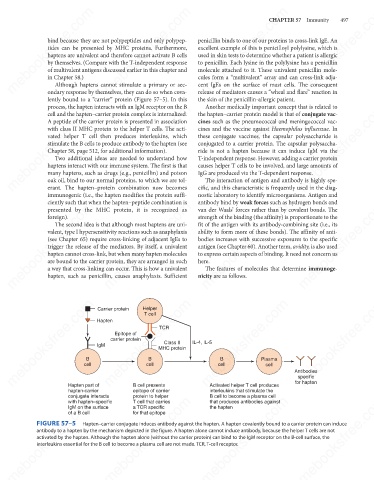
FIGURE 57–5
Hapten–carrier conjugate induces antibody against the hapten. A hapten covalently bound to a carrier protein can induce
antibody to a hapten by the mechanism depicted in the figure. A hapten alone cannot induce antibody, because the helper T cells are not
activated by the hapten. Although the hapten alone (without the carrier protein) can bind to the IgM receptor on the B-cell surface, the
interleukins essential for the B cell to become a plasma cell are not made. TCR, T-cell receptor.
mebooksfree.com mebooksfree.com mebooksfree.com mebooksfree.com mebooksfree.com mebooksfree.com

