


Page 59 - Review of Medical Microbiology and Immunology ( PDFDrive )
P. 59
mebooksfree.com


                                            mebooksfree.com
                                                                            mebooksfree.com
            mebooksfree.com
                                                                                                            mebooksfree.com
 mebooksfree.com  mebooksfree.com           mebooksfree.com                 mebooksfree.com                 mebooksfree.com                mebooksfree.com
                                                                                                                                           mebooksfree.com
                      PART I  Basic Bacteriology
                 48


                                                              Nonpathogenic
                                                              strain of E. coli


                                            mebooksfree.com
 mebooksfree.com  mebooksfree.com   (Enterotoxigenic PAI-A   (Uropathic strain) PAI-B  neonatal meningitis PAI-C mebooksfree.com           mebooksfree.com
                                                                            mebooksfree.com


                                                              E. coli causing
                                     E. coli causing
                                                                                        E. coli causing
                                                               urinary tract
                                    watery diarrhea
                                                                infection
                                                                                        (K-1 capsular
                                                                                          strain)
                                        strain)
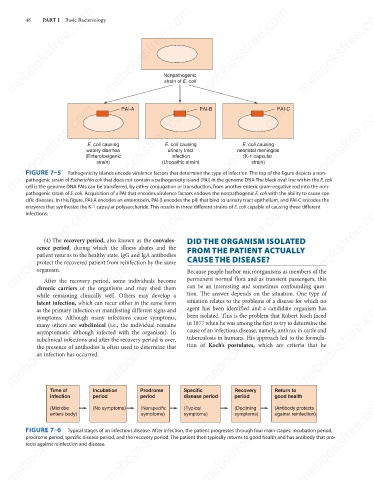
                 FIGURE 7–5
                              Pathogenicity islands encode virulence factors that determine the type of infection. The top of the figure depicts a non-
                 pathogenic strain of Escherichia coli that does not contain a pathogenicity island (PAI) in the genome DNA The black oval line within the E. coli
                 cell is the genome DNA PAIs can be transferred, by either conjugation or transduction, from another enteric gram-negative rod into the non-
                 pathogenic strain of E. coli. Acquisition of a PAI that encodes virulence factors endows the nonpathogenic E. coli with the ability to cause spe-
                 cific diseases. In this figure, PAI-A encodes an enterotoxin, PAI-B encodes the pili that bind to urinary tract epithelium, and PAI-C encodes the
 mebooksfree.com  mebooksfree.com           mebooksfree.com          DID THE ORGANISM ISOLATED                                             mebooksfree.com
                                                                                                            mebooksfree.com
                                                                            mebooksfree.com
                 enzymes that synthesize the K-1 capsular polysaccharide. This results in three different strains of E. coli capable of causing three different
                 infections.
                       (4) The recovery period, also known as the convales-
                    cence period,  during  which  the  illness  abates  and  the
                                                                     FROM THE PATIENT ACTUALLY
                    patient returns to the healthy state. IgG and IgA antibodies
                                                                     CAUSE THE DISEASE?
                    protect the recovered patient from reinfection by the same
                    organism.
                                                                     permanent normal flora and as transient passengers, this
                       After the recovery period, some individuals become
                                                                     can be an interesting and sometimes confounding ques-
                    chronic  carriers  of the  organisms and  may shed them
                                                                     tion. The answer depends on the situation. One type of
                    while remaining clinically well. Others may develop a   Because people harbor microorganisms as members of the
                                                                     situation relates to the problems of a disease for which no
                                                                            mebooksfree.com
                                                                                                            mebooksfree.com
 mebooksfree.com  mebooksfree.com           mebooksfree.com          in 1877 when he was among the first to try to determine the           mebooksfree.com
                    latent infection, which can recur either in the same form
                                                                     agent  has been identified  and a candidate organism has
                    as the primary infection or manifesting different signs and
                                                                     been isolated. This is the problem that Robert Koch faced
                    symptoms. Although many infections cause symptoms,
                    many  others  are  subclinical  (i.e.,  the  individual  remains
                                                                     cause of an infectious disease, namely, anthrax in cattle and
                    asymptomatic although infected with the organism). In
                                                                     tuberculosis in humans. His approach led to the formula-
                    subclinical infections and after the recovery period is over,
                                                                     tion of  Koch’s  postulates, which are criteria that he
                    the presence of antibodies is often used to determine that
                    an infection has occurred.
                         Time of       Incubation     Prodrome      Specific         Recovery     Return to
                                                                                     period
                                                      period
                                       period
                         infection
                                                                                                  good health
                                                                    disease period
 mebooksfree.com  mebooksfree.com           mebooksfree.com                 mebooksfree.com                 mebooksfree.com                mebooksfree.com
                                                                                     (Declining
                                                                                                  (Antibody protects
                                       (No symptoms)
                                                                    (Typical
                         (Microbe
                                                      symptoms)
                         enters body)
                                                                                                  against reinfection)
                                                                                     symptoms)
                                                                    symptoms)
                 FIGURE 7–6
                              Typical stages of an infectious disease. After infection, the patient progresses through four main stages: incubation period,
                 prodrome period, specific disease period, and the recovery period. The patient then typically returns to good health and has antibody that pro-
                 tects against reinfection and disease.
 mebooksfree.com  mebooksfree.com           mebooksfree.com                 mebooksfree.com                 mebooksfree.com                mebooksfree.com

