


Page 56 - Review of Medical Microbiology and Immunology ( PDFDrive )
P. 56
mebooksfree.com
mebooksfree.com
mebooksfree.com
mebooksfree.com
mebooksfree.com
mebooksfree.com
mebooksfree.com
mebooksfree.com
mebooksfree.com mebooksfree.com mebooksfree.com (especially lipid A) CHAPTER 7 Pathogenesis 45 mebooksfree.com
Endotoxin
Activates
Activates
Activates
macrophages
complement
tissue factor
IL-1
C5a
mebooksfree.com
C3a
TNF
Nitric oxide
mebooksfree.com mebooksfree.com v r e mebooksfree.com Hypotension chemotaxis Coagulation mebooksfree.com mebooksfree.com
cascade
y
p
o i s
n
F
e t o
e
n
Neutrophil
H
Fever and
edema
DIC
hypotension
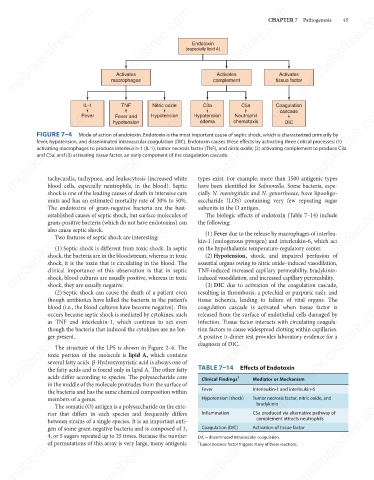
FIGURE 7–4
Mode of action of endotoxin. Endotoxin is the most important cause of septic shock, which is characterized primarily by
fever, hypotension, and disseminated intravascular coagulation (DIC). Endotoxin causes these effects by activating three critical processes: (1)
activating macrophages to produce interleukin-1 (IL-1), tumor necrosis factor (TNF), and nitric oxide; (2) activating complement to produce C3a
and C5a; and (3) activating tissue factor, an early component of the coagulation cascade.
tachycardia, tachypnea, and leukocytosis (increased white
blood cells, especially neutrophils, in the blood). Septic
have been identified for Salmonella. Some bacteria, espe-
shock is one of the leading causes of death in intensive care
cially N. meningitidis and N. gonorrhoeae, have lipooligo-
saccharide (LOS) containing very few repeating sugar
units and has an estimated mortality rate of 30% to 50%. types exist. For example, more than 1500 antigenic types
mebooksfree.com
mebooksfree.com mebooksfree.com mebooksfree.com kin-1 (endogenous pyrogen) and interleukin-6, which act mebooksfree.com
mebooksfree.com
The endotoxins of gram-negative bacteria are the best-
subunits in the O antigen.
established causes of septic shock, but surface molecules of
The biologic effects of endotoxin (Table 7–14) include
the following:
gram-positive bacteria (which do not have endotoxins) can
also cause septic shock.
(1) Fever due to the release by macrophages of interleu-
Two features of septic shock are interesting:
(1) Septic shock is different from toxic shock. In septic
on the hypothalamic temperature-regulatory center.
(2) Hypotension, shock, and impaired perfusion of
shock, the bacteria are in the bloodstream, whereas in toxic
shock, it is the toxin that is circulating in the blood. The
essential organs owing to nitric oxide–induced vasodilation,
clinical importance of this observation is that in septic
induced vasodilation, and increased capillary permeability.
shock, blood cultures are usually positive, whereas in toxic
shock, they are usually negative.
(3) DIC due to activation of the coagulation cascade,
resulting in thrombosis, a petechial or purpuric rash, and
(2) Septic shock can cause the death of a patient even TNF-induced increased capillary permeability, bradykinin-
tissue ischemia, leading to failure of vital organs. The
though antibiotics have killed the bacteria in the patient’s
mebooksfree.com
mebooksfree.com
mebooksfree.com mebooksfree.com mebooksfree.com infection. Tissue factor interacts with circulating coagula- mebooksfree.com
coagulation cascade is activated when tissue factor is
blood (i.e., the blood cultures have become negative). This
occurs because septic shock is mediated by cytokines, such
released from the surface of endothelial cells damaged by
as TNF and interleukin-1, which continue to act even
tion factors to cause widespread clotting within capillaries.
though the bacteria that induced the cytokines are no lon-
A positive d-dimer test provides laboratory evidence for a
ger present.
diagnosis of DIC.
The structure of the LPS is shown in Figure 2–6. The
toxic portion of the molecule is lipid A, which contains
several fatty acids. β-Hydroxymyristic acid is always one of
TABLE 7–14 Effects of Endotoxin
the fatty acids and is found only in lipid A. The other fatty
acids differ according to species. The polysaccharide core
in the middle of the molecule protrudes from the surface of
Interleukin-1 and interleukin-6
Fever
the bacteria and has the same chemical composition within Clinical Findings 1 Mediator or Mechanism
mebooksfree.com mebooksfree.com mebooksfree.com DIC = disseminated intravascular coagulation. mebooksfree.com mebooksfree.com
Tumor necrosis factor, nitric oxide, and
Hypotension (shock)
members of a genus.
mebooksfree.com
bradykinin
The somatic (O) antigen is a polysaccharide on the exte-
C5a produced via alternative pathway of
Inflammation
rior that differs in each species and frequently differs
complement attracts neutrophils
between strains of a single species. It is an important anti-
Coagulation (DIC)
gen of some gram-negative bacteria and is composed of 3,
Activation of tissue factor
4, or 5 sugars repeated up to 25 times. Because the number
of permutations of this array is very large, many antigenic
1
Tumor necrosis factor triggers many of these reactions.
mebooksfree.com mebooksfree.com mebooksfree.com mebooksfree.com mebooksfree.com mebooksfree.com

