


Page 57 - Review of Medical Microbiology and Immunology ( PDFDrive )
P. 57
mebooksfree.com
mebooksfree.com
mebooksfree.com
mebooksfree.com
mebooksfree.com
mebooksfree.com
mebooksfree.com
mebooksfree.com mebooksfree.com mebooksfree.com TABLE 7–15 Beneficial and Harmful Effects of TNF mebooksfree.com
mebooksfree.com
PART I Basic Bacteriology
46
(4) Activation of the alternative pathway of the comple-
ment cascade, resulting in inflammation and tissue dam-
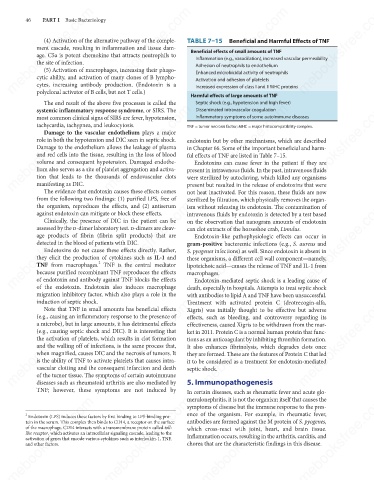
Beneficial effects of small amounts of TNF
age. C5a is potent chemokine that attracts neutrophils to
Inflammation (e.g., vasodilation), increased vascular permeability
the site of infection.
Adhesion of neutrophils to endothelium
(5) Activation of macrophages, increasing their phago-
Enhanced microbicidal activity of neutrophils
cytic ability, and activation of many clones of B lympho-
cytes, increasing antibody production. (Endotoxin is a
Increased expression of class I and II MHC proteins
polyclonal activator of B cells, but not T cells.)
Harmful effects of large amounts of TNF
The end result of the above five processes is called the Activation and adhesion of platelets
Septic shock (e.g., hypotension and high fever)
mebooksfree.com
mebooksfree.com
mebooksfree.com mebooksfree.com mebooksfree.com TNF = tumor necrosis factor; MHC = major histocompatibility complex. mebooksfree.com
systemic inflammatory response syndrome, or SIRS. The
Disseminated intravascular coagulation
most common clinical signs of SIRS are fever, hypotension,
Inflammatory symptoms of some autoimmune diseases
tachycardia, tachypnea, and leukocytosis.
Damage to the vascular endothelium plays a major
role in both the hypotension and DIC seen in septic shock.
endotoxin but by other mechanisms, which are described
Damage to the endothelium allows the leakage of plasma
in Chapter 66. Some of the important beneficial and harm-
and red cells into the tissue, resulting in the loss of blood
ful effects of TNF are listed in Table 7–15.
volume and consequent hypotension. Damaged endothe-
Endotoxins can cause fever in the patient if they are
lium also serves as a site of platelet aggregation and activa-
present in intravenous fluids. In the past, intravenous fluids
tion that leads to the thousands of endovascular clots
manifesting as DIC.
present but resulted in the release of endotoxins that were
The evidence that endotoxin causes these effects comes
not heat inactivated. For this reason, these fluids are now
from the following two findings: (1) purified LPS, free of were sterilized by autoclaving, which killed any organisms
sterilized by filtration, which physically removes the organ-
mebooksfree.com mebooksfree.com 2 mebooksfree.com can clot extracts of the horseshoe crab, Limulus. mebooksfree.com mebooksfree.com
mebooksfree.com
the organism, reproduces the effects, and (2) antiserum
ism without releasing its endotoxin. The contamination of
against endotoxin can mitigate or block these effects.
intravenous fluids by endotoxin is detected by a test based
Clinically, the presence of DIC in the patient can be
on the observation that nanogram amounts of endotoxin
assessed by the d-dimer laboratory test. d-dimers are cleav-
age products of fibrin (fibrin split products) that are
Endotoxin-like pathophysiologic effects can occur in
detected in the blood of patients with DIC.
gram-positive bacteremic infections (e.g., S. aureus and
Endotoxins do not cause these effects directly. Rather,
S. pyogenes infections) as well. Since endotoxin is absent in
they elicit the production of cytokines such as IL-1 and
these organisms, a different cell wall component—namely,
TNF from macrophages. TNF is the central mediator
lipoteichoic acid—causes the release of TNF and IL-1 from
because purified recombinant TNF reproduces the effects
of endotoxin and antibody against TNF blocks the effects
Endotoxin-mediated septic shock is a leading cause of
of the endotoxin. Endotoxin also induces macrophage
death, especially in hospitals. Attempts to treat septic shock
migration inhibitory factor, which also plays a role in the macrophages.
with antibodies to lipid A and TNF have been unsuccessful.
mebooksfree.com
induction of septic shock.
mebooksfree.com mebooksfree.com mebooksfree.com effectiveness, caused Xigris to be withdrawn from the mar- mebooksfree.com
mebooksfree.com
Treatment with activated protein C (drotrecogin-alfa,
Note that TNF in small amounts has beneficial effects
Xigris) was initially thought to be effective but adverse
(e.g., causing an inflammatory response to the presence of
effects, such as bleeding, and controversy regarding its
a microbe), but in large amounts, it has detrimental effects
(e.g., causing septic shock and DIC). It is interesting that
ket in 2011. Protein C is a normal human protein that func-
the activation of platelets, which results in clot formation
tions as an anticoagulant by inhibiting thrombin formation.
and the walling off of infections, is the same process that,
It also enhances fibrinolysis, which degrades clots once
when magnified, causes DIC and the necrosis of tumors. It
they are formed. These are the features of Protein C that led
is the ability of TNF to activate platelets that causes intra-
it to be considered as a treatment for endotoxin-mediated
vascular clotting and the consequent infarction and death
of the tumor tissue. The symptoms of certain autoimmune
5. Immunopathogenesis
diseases such as rheumatoid arthritis are also mediated by
TNF; however, these symptoms are not induced by septic shock.
In certain diseases, such as rheumatic fever and acute glo-
mebooksfree.com
mebooksfree.com
mebooksfree.com mebooksfree.com mebooksfree.com antibodies are formed against the M protein of S. pyogenes, mebooksfree.com
merulonephritis, it is not the organism itself that causes the
symptoms of disease but the immune response to the pres-
ence of the organism. For example, in rheumatic fever,
2
Endotoxin (LPS) induces these factors by first binding to LPS-binding pro-
tein in the serum. This complex then binds to CD14, a receptor on the surface
of the macrophage. CD14 interacts with a transmembrane protein called toll-
which cross-react with joint, heart, and brain tissue.
like receptor, which activates an intracellular signaling cascade, leading to the
Inflammation occurs, resulting in the arthritis, carditis, and
activation of genes that encode various cytokines such as interleukin-1, TNF,
chorea that are the characteristic findings in this disease.
and other factors.
mebooksfree.com mebooksfree.com mebooksfree.com mebooksfree.com mebooksfree.com mebooksfree.com

