


Page 58 - Review of Medical Microbiology and Immunology ( PDFDrive )
P. 58
mebooksfree.com
mebooksfree.com
mebooksfree.com
mebooksfree.com
mebooksfree.com
mebooksfree.com
mebooksfree.com
mebooksfree.com mebooksfree.com mebooksfree.com virulence factors that endow those bacteria with the capa- 47 mebooksfree.com
mebooksfree.com
CHAPTER 7 Pathogenesis
BACTERIAL INFECTIONS
bility to cause different diseases.
ASSOCIATED WITH CANCER
The different virulence factors are encoded on plasmids,
on transposons, on the genome of temperate (lysogenic)
The fact that certain viruses can cause cancer is well estab-
phages, and on pathogenicity islands. These transferable
lished, but the observation that some bacterial infections
are associated with cancers is just emerging. Several docu-
bacterium, which accounts for the ability to cause different
mented examples include (1) the association of Helico-
bacter pylori infection with gastric carcinoma and gastric
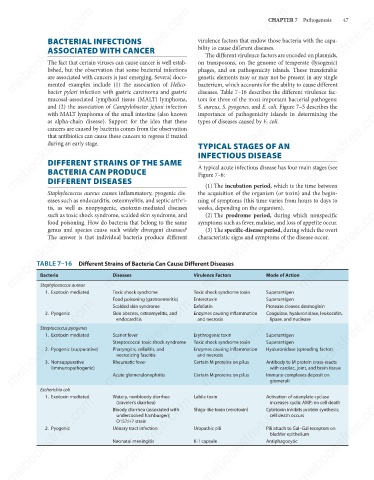
diseases. Table 7–16 describes the different virulence fac-
mucosal-associated lymphoid tissue (MALT) lymphoma, genetic elements may or may not be present in any single
tors for three of the most important bacterial pathogens:
mebooksfree.com mebooksfree.com mebooksfree.com TYPICAL STAGES OF AN mebooksfree.com mebooksfree.com
and (2) the association of Campylobacter jejuni infection
mebooksfree.com
S. aureus, S. pyogenes, and E. coli. Figure 7–5 describes the
with MALT lymphoma of the small intestine (also known
importance of pathogenicity islands in determining the
types of diseases caused by E. coli.
as alpha-chain disease). Support for the idea that these
cancers are caused by bacteria comes from the observation
that antibiotics can cause these cancers to regress if treated
during an early stage.
INFECTIOUS DISEASE
DIFFERENT STRAINS OF THE SAME
A typical acute infectious disease has four main stages (see
BACTERIA CAN PRODUCE
Figure 7–6:
DIFFERENT DISEASES
(1) The incubation period, which is the time between
Staphylococcus aureus causes inflammatory, pyogenic dis-
ning of symptoms (this time varies from hours to days to
eases such as endocarditis, osteomyelitis, and septic arthri- the acquisition of the organism (or toxin) and the begin-
mebooksfree.com
mebooksfree.com
mebooksfree.com mebooksfree.com mebooksfree.com characteristic signs and symptoms of the disease occur. mebooksfree.com
weeks, depending on the organism).
tis, as well as nonpyogenic, exotoxin-mediated diseases
(2) The prodrome period, during which nonspecific
such as toxic shock syndrome, scalded skin syndrome, and
symptoms such as fever, malaise, and loss of appetite occur.
food poisoning. How do bacteria that belong to the same
(3) The specific-disease period, during which the overt
genus and species cause such widely divergent diseases?
The answer is that individual bacteria produce different
TABLE 7–16 Different Strains of Bacteria Can Cause Different Diseases
Bacteria
Staphylococcus aureus
Toxic shock syndrome
Toxic shock syndrome toxin
1. Exotoxin mediated Diseases Virulence Factors Mode of Action
Superantigen
Superantigen
Enterotoxin
Food poisoning (gastroenteritis)
mebooksfree.com
mebooksfree.com mebooksfree.com mebooksfree.com Erythrogenic toxin Superantigen mebooksfree.com mebooksfree.com
Scalded skin syndrome
Protease cleaves desmoglein
Exfoliatin
Skin abscess, osteomyelitis, and
Coagulase, hyaluronidase, leukocidin,
Enzymes causing inflammation
2. Pyogenic
and necrosis
lipase, and nuclease
endocarditis
Streptococcus pyogenes
1. Exotoxin mediated
Scarlet fever
Toxic shock syndrome toxin
Streptococcal toxic shock syndrome
Superantigen
Hyaluronidase (spreading factor)
2. Pyogenic (suppurative)
Pharyngitis, cellulitis, and
Enzymes causing inflammation
and necrosis
necrotizing fasciitis
Rheumatic fever
Antibody to M protein cross-reacts
Certain M proteins on pilus
3. Nonsuppurative
(immunopathogenic)
with cardiac, joint, and brain tissue
glomeruli
Escherichia coli Acute glomerulonephritis Certain M proteins on pilus Immune complexes deposit on
Activation of adenylate cyclase
Labile toxin
Watery, nonbloody diarrhea
1. Exotoxin mediated
mebooksfree.com
mebooksfree.com mebooksfree.com mebooksfree.com Uropathic pili Pili attach to Gal–Gal receptors on mebooksfree.com
mebooksfree.com
increases cyclic AMP; no cell death
(traveler’s diarrhea)
Cytotoxin inhibits protein synthesis;
Shiga-like toxin (verotoxin)
Bloody diarrhea (associated with
undercooked hamburger);
cell death occurs
O157:H7 strain
2. Pyogenic
Urinary tract infection
bladder epithelium
K-1 capsule
Neonatal meningitis
Antiphagocytic
mebooksfree.com mebooksfree.com mebooksfree.com mebooksfree.com mebooksfree.com mebooksfree.com

