


Page 195 - Textbook of Pathology, 6th Edition
P. 195
follicles. Impetigo is yet another staphylococcal skin infection  179
                                                               common in school children in which there are multiple
                                                               pustular lesions on face forming honey-yellow crusts. Breast
                                                               abscess may occur following delivery when staphylococci are
                                                               transmitted from infant having neonatal sepsis or due to
                                                               stasis of milk.                                        CHAPTER 7
                                                               2. Infections of burns and surgical wounds. These are quite
                                                               common due to contamination from the patient’s own nasal
                                                               secretions or from hospital staff. Elderly, malnourished, obese
                                                               patients and neonates have increased susceptibility.

                                                               3. Infections of the upper and lower respiratory tract.
                                                               Small children under 2 years of age get staphylococcal
                                                               infections of the respiratory tract commonly. These include
                                                               pharyngitis, bronchopneumonia, staphylococcal
                                                               pneumonia and its complications.
                                                               4. Bacterial arthritis. Septic arthritis in the elderly is caused
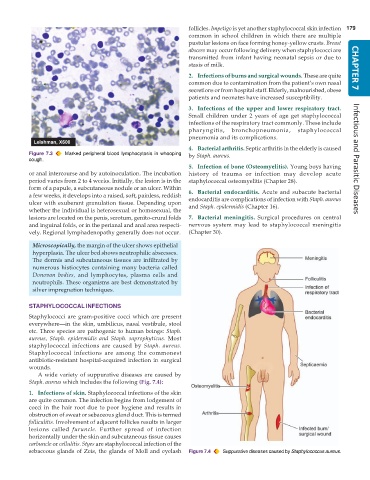
           Figure 7.3  Marked peripheral blood lymphocytosis in whooping  by Staph. aureus.
           cough.                                                                                                     Infectious and Parasitic Diseases
                                                               5. Infection of bone (Osteomyelitis). Young boys having
           or anal intercourse and by autoinoculation. The incubation  history of trauma or infection may develop acute
           period varies from 2 to 4 weeks. Initially, the lesion is in the  staphylococcal osteomyelitis (Chapter 28).
           form of a papule, a subcutaneous nodule or an ulcer. Within
           a few weeks, it develops into a raised, soft, painless, reddish  6. Bacterial endocarditis.  Acute and subacute bacterial
           ulcer with exuberant granulation tissue. Depending upon  endocarditis are complications of infection with Staph. aureus
                                                               and Staph. epidermidis (Chapter 16).
           whether the individual is heterosexual or homosexual, the
           lesions are located on the penis, scrotum, genito-crural folds  7. Bacterial meningitis. Surgical procedures on central
           and inguinal folds, or in the perianal and anal area respecti-  nervous system may lead to staphylococcal meningitis
           vely. Regional lymphadenopathy generally does not occur.  (Chapter 30).

            Microscopically, the margin of the ulcer shows epithelial
            hyperplasia. The ulcer bed shows neutrophilic abscesses.
            The dermis and subcutaneous tissues are infiltrated by
            numerous histiocytes containing many bacteria called
            Donovan bodies,  and lymphocytes, plasma cells and
            neutrophils. These organisms are best demonstrated by
            silver impregnation techniques.

           STAPHYLOCOCCAL INFECTIONS
           Staphylococci are gram-positive cocci which are present
           everywhere—in the skin, umbilicus, nasal vestibule, stool
           etc. Three species are pathogenic to human beings: Staph.
           aureus, Staph. epidermidis and Staph. saprophyticus. Most
           staphylococcal infections are caused by  Staph. aureus.
           Staphylococcal infections are among the commonest
           antibiotic-resistant hospital-acquired infection in surgical
           wounds.
              A wide variety of suppurative diseases are caused by
           Staph. aureus which includes the following (Fig. 7.4):
           1. Infections of skin. Staphylococcal infections of the skin
           are quite common. The infection begins from lodgement of
           cocci in the hair root due to poor hygiene and results in
           obstruction of sweat or sebaceous gland duct. This is termed
           folliculitis. Involvement of adjacent follicles results in larger
           lesions called  furuncle. Further spread of infection
           horizontally under the skin and subcutaneous tissue causes
           carbuncle or cellulitis. Styes are staphylococcal infection of the
           sebaceous glands of Zeis, the glands of Moll and eyelash  Figure 7.4  Suppurative diseases caused by Staphylococcus aureus.

