


Page 193 - Textbook of Pathology, 6th Edition
P. 193
177


                                                                                                                      CHAPTER 7


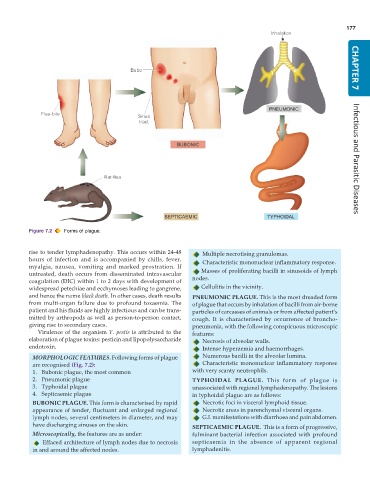
           Figure 7.2  Forms of plague.                                                                               Infectious and Parasitic Diseases


           rise to tender lymphadenopathy. This occurs within 24-48  Multiple necrotising granulomas.
           hours of infection and is accompanied by chills, fever,  Characteristic mononuclear inflammatory response.
           myalgia, nausea, vomiting and marked prostration. If
           untreated, death occurs from disseminated intravascular  Masses of proliferating bacilli in sinusoids of lymph
           coagulation (DIC) within 1 to 2 days with development of  nodes.
           widespread petechiae and ecchymoses leading to gangrene,  Cellulitis in the vicinity.
           and hence the name black death. In other cases, death results  PNEUMONIC PLAGUE. This is the most dreaded form
           from multi-organ failure due to profound toxaemia. The  of plague that occurs by inhalation of bacilli from air-borne
           patient and his fluids are highly infectious and can be trans-  particles of carcasses of animals or from affected patient’s
           mitted by arthropods as well as person-to-person contact,  cough. It is characterised by occurrence of broncho-
           giving rise to secondary cases.                       pneumonia, with the following conspicuous microscopic
              Virulence of the organism Y. pestis is attributed to the  features:
           elaboration of plague toxins: pesticin and lipopolysaccharide  Necrosis of alveolar walls.
           endotoxin.                                               Intense hyperaemia and haemorrhages.
            MORPHOLOGIC FEATURES. Following forms of plague         Numerous bacilli in the alveolar lumina.
            are recognised (Fig. 7.2):                              Characteristic mononuclear inflammatory response
            1. Bubonic plague, the most common                   with very scanty neutrophils.
            2. Pneumonic plague                                  TYPHOIDAL PLAGUE. This form of plague is
            3. Typhoidal plague                                  unassociated with regional lymphadenopathy. The lesions
            4. Septicaemic plague                                in typhoidal plague are as follows:
            BUBONIC PLAGUE. This form is characterised by rapid     Necrotic foci in visceral lymphoid tissue.
            appearance of tender, fluctuant and enlarged regional   Necrotic areas in parenchymal visceral organs.
            lymph nodes, several centimeters in diameter, and may   G.I. manifestations with diarrhoea and pain abdomen.
            have discharging sinuses on the skin.                SEPTICAEMIC PLAGUE.  This is a form of progressive,
            Microscopically, the features are as under:          fulminant bacterial infection associated with profound
               Effaced architecture of lymph nodes due to necrosis  septicaemia in the absence of apparent regional
            in and around the affected nodes.                    lymphadenitis.

