


Page 197 - Textbook of Pathology, 6th Edition
P. 197
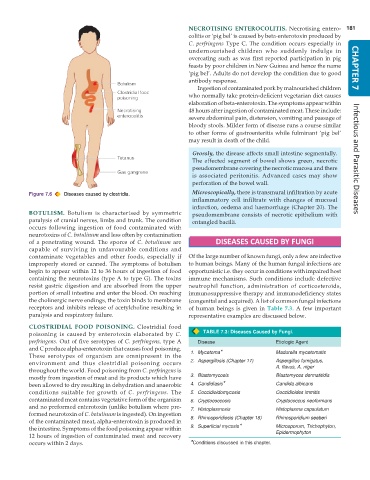
NECROTISING ENTEROCOLITIS. Necrotising entero- 181
colitis or ‘pig bel’ is caused by beta-enterotoxin produced by
C. perfringens Type C. The condition occurs especially in
undernourished children who suddenly indulge in
overeating such as was first reported participation in pig
feasts by poor children in New Guinea and hence the name CHAPTER 7
‘pig bel’. Adults do not develop the condition due to good
antibody response.
Ingestion of contaminated pork by malnourished children
who normally take protein-deficient vegetarian diet causes
elaboration of beta-enterotoxin. The symptoms appear within
48 hours after ingestion of contaminated meat. These include:
severe abdominal pain, distension, vomiting and passage of
bloody stools. Milder form of disease runs a course similar
to other forms of gastroenteritis while fulminant ‘pig bel’
may result in death of the child.
Grossly, the disease affects small intestine segmentally.
The affected segment of bowel shows green, necrotic Infectious and Parasitic Diseases
pseudomembrane covering the necrotic mucosa and there
is associated peritonitis. Advanced cases may show
perforation of the bowel wall.
Microscopically, there is transmural infiltration by acute
Figure 7.6 Diseases caused by clostridia.
inflammatory cell infiltrate with changes of mucosal
infarction, oedema and haemorrhage (Chapter 20). The
BOTULISM. Botulism is characterised by symmetric pseudomembrane consists of necrotic epithelium with
paralysis of cranial nerves, limbs and trunk. The condition entangled bacilli.
occurs following ingestion of food contaminated with
neurotoxins of C. botulinum and less often by contamination
of a penetrating wound. The spores of C. botulinum are DISEASES CAUSED BY FUNGI
capable of surviving in unfavourable conditions and
contaminate vegetables and other foods, especially if Of the large number of known fungi, only a few are infective
improperly stored or canned. The symptoms of botulism to human beings. Many of the human fungal infections are
begin to appear within 12 to 36 hours of ingestion of food opportunistic i.e. they occur in conditions with impaired host
containing the neurotoxins (type A to type G). The toxins immune mechanisms. Such conditions include defective
resist gastric digestion and are absorbed from the upper neutrophil function, administration of corticosteroids,
portion of small intestine and enter the blood. On reaching immunosuppressive therapy and immunodeficiency states
the cholinergic nerve endings, the toxin binds to membrane (congenital and acquired). A list of common fungal infections
receptors and inhibits release of acetylcholine resulting in of human beings is given in Table 7.3. A few important
paralysis and respiratory failure. representative examples are discussed below.
CLOSTRIDIAL FOOD POISONING. Clostridial food
poisoning is caused by enterotoxin elaborated by C. TABLE 7.3: Diseases Caused by Fungi.
perfringens. Out of five serotypes of C. perfringens, type A Disease Etiologic Agent
and C produce alpha-enterotoxin that causes food poisoning. 1. Mycetoma*
These serotypes of organism are omnipresent in the Madurella mycetomatis
environment and thus clostridial poisoning occurs 2. Aspergillosis (Chapter 17) Aspergillus fumigatus,
throughout the world. Food poisoning from C. perfringens is A. flavus, A. niger
mostly from ingestion of meat and its products which have 3. Blastomycosis Blastomyces dermatitidis
been allowed to dry resulting in dehydration and anaerobic 4. Candidiasis* Candida albicans
conditions suitable for growth of C. perfringens. The 5. Coccidioidomycosis Coccidioides immitis
contaminated meat contains vegetative form of the organism 6. Cryptococcosis Cryptococcus neoformans
and no preformed enterotoxin (unlike botulism where pre- 7. Histoplasmosis Histoplasma capsulatum
formed neurotoxin of C. botulinum is ingested). On ingestion
of the contaminated meat, alpha-enterotoxin is produced in 8. Rhinosporidiosis (Chapter 18) Rhinosporidium seeberi
the intestine. Symptoms of the food poisoning appear within 9. Superficial mycosis* Microsporum, Trichophyton,
12 hours of ingestion of contaminated meat and recovery Epidermophyton
occurs within 2 days. *Conditions discussed in this chapter.

