


Page 199 - Textbook of Pathology, 6th Edition
P. 199
SUPERFICIAL MYCOSIS neoplasms are discussed in Chapter 8. A few common and 183
important viral diseases are described below.
Dermatophytes are the most important example of cutaneous
mycosis caused by Microsporum, Trichophyton and VIRAL HAEMORRHAGIC FEVERS
Epidermophyton. These superficial fungi are spread by direct
contact or by fomites and infect tissues such as the skin, hair Viral haemorrhagic fevers are a group of acute viral infections
and nails. Examples of diseases pertaining to these tissues which have common features of causing haemorrhages, CHAPTER 7
are as under: shock and sometimes death. Viruses causing haemorrhagic
Tinea capitis characterised by patchy alopecia affecting fevers were earlier called arthropod-borne (or arbo) viruses
the scalp and eyebrows. since their transmission was considered to be from
Tinea barbae is acute folliculitis of the beard. arthropods to humans. However, now it is known that all
Tinea corporis is dermatitis with formation of such viruses are not transmitted by arthropod vectors alone
erythematous papules. and hence now such haemorrhagic fevers are classified
The diagnosis of dermatophytosis is made by light according to the routes of transmission and other
microscopic examination of skin scrapings after addition of epidemiologic features into 4 groups:
sodium or potassium hydroxide solution. Other methods Mosquito-borne (e.g. yellow fever, dengue fever, Rift
include fungal culture and demonstration of fungus in tissue Valley fever)
sections. Tick-borne (e.g. Crimean haemorrhagic fever, Kyasanur
Forest disease) Infectious and Parasitic Diseases
DISEASES CAUSED BY VIRUSES Zoonotic (e.g. Korean haemorrhagic fever, Lassa fever)
Marburg virus disease and Ebola virus disease by
Viral diseases are the most common cause of human illness. unknown route.
However, many of the viral infections remain asymptomatic Of these, mosquito-borne viral haemorrhagic fevers in
while others produce viral disease. Another peculiar feature which Aedes aegypti mosquitoes are vectors, are the most
of viral infection is that a single etiologic agent may produce common problem the world over, especially in developing
different diseases in the same host depending upon host countries. Two important examples of Aedes mosquito-borne
immune response and age at infection e.g. varicella-zoster viral haemorrhagic fevers are yellow fever and dengue fever,
virus is causative for chickenpox as well as herpes zoster. which are discussed below.
Viruses are essentially intracellular parasites. Depending
upon their nucleic acid genomic composition, they may be Yellow Fever
single-stranded or double-stranded, RNA or DNA viruses.
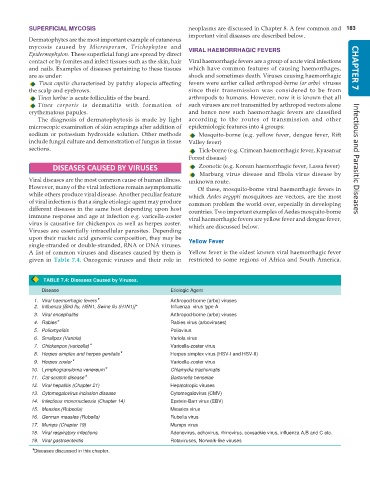
A list of common viruses and diseases caused by them is Yellow fever is the oldest known viral haemorrhagic fever
given in Table 7.4. Oncogenic viruses and their role in restricted to some regions of Africa and South America.
TABLE 7.4: Diseases Caused by Viruses.
Disease Etiologic Agent
1. Viral haemorrhagic fevers* Arthropod-borne (arbo) viruses
2. Influenza [Bird flu, H5N1, Swine flu (H1N1)]* Influenza virus type A
3. Viral encephalitis Arthropod-borne (arbo) viruses
4. Rabies* Rabies virus (arboviruses)
5. Poliomyelitis Poliovirus
6. Smallpox (Variola) Variola virus
7. Chickenpox (varicella)* Varicella-zoster virus
8. Herpes simplex and herpes genitalis* Herpes simplex virus (HSV-I and HSV-II)
9. Herpes zoster* Varicella-zoster virus
10. Lymphogranuloma venereum* Chlamydia trachomatis
11. Cat-scratch disease* Bartonella henselae
12. Viral hepatitis (Chapter 21) Hepatotropic viruses
13. Cytomegalovirus inclusion disease Cytomegalovirus (CMV)
14. Infectious mononucleosis (Chapter 14) Epstein-Barr virus (EBV)
15. Measles (Rubeola) Measles virus
16. German measles (Rubella) Rubella virus
17. Mumps (Chapter 19) Mumps virus
18. Viral respiratory infections Adenovirus, echovirus, rhinovirus, coxsackie virus, influenza A,B and C etc.
19. Viral gastroenteritis Rotaviruses, Norwalk-like viruses
*Diseases discussed in this chapter.

