


Page 224 - Textbook of Pathology, 6th Edition
P. 224
208 2. CONTRACEPTIVE HORMONES. The sequential types      C. Physical carcinogens and radiation carcinogenesis
           of oral contraceptives increase the risk of developing breast  D. Biologic carcinogens and viral oncogenesis.
           cancer. Other tumours showing a slightly increased
           frequency in women receiving contraceptive pills for long  A. MOLECULAR PATHOGENESIS OF CANCER
           durations are benign tumours of the liver, and a few patients  (GENETIC MECHANISMS OF CANCER)
           have been reported to have developed hepatocellular
           carcinoma.                                          Basic Concept of Molecular Pathogenesis
           3. ANABOLIC STEROIDS.  Consumption of anabolic      The mechanism as to how a normal cell is transformed to a
           steroids by athletes to increase the muscle mass is not only  cancer cell is complex. At different times, attempts have been
     SECTION I
           unethical athletic practice but also increases the risk of  made to unravel this mystery by various mechanisms.
           developing benign and malignant tumours of the liver.  Currently, a lot of literature has accumulated to explain the
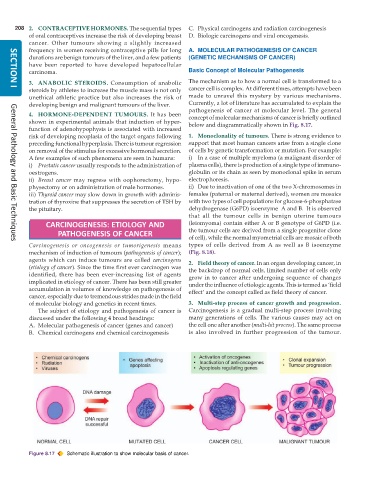
                                                               pathogenesis of cancer at molecular level. The general
           4. HORMONE-DEPENDENT TUMOURS.  It has been          concept of molecular mechanisms of cancer is briefly outlined
           shown in experimental animals that induction of hyper-  below and diagrammatically shown in Fig. 8.17.
           function of adenohypophysis is associated with increased
           risk of developing neoplasia of the target organs following  1. Monoclonality of tumours. There is strong evidence to
           preceding functional hyperplasia. There is tumour regression  support that most human cancers arise from a single clone
           on removal of the stimulus for excessive hormonal secretion.  of cells by genetic transformation or mutation. For example:
           A few examples of such phenomena are seen in humans:  i) In a case of multiple myeloma (a malignant disorder of
           i) Prostatic cancer usually responds to the administration of  plasma cells), there is production of a single type of immuno-
           oestrogens.                                         globulin or its chain as seen by monoclonal spike in serum
           ii) Breast cancer may regress with oophorectomy, hypo-  electrophoresis.
           physectomy or on administration of male hormones.   ii) Due to inactivation of one of the two X-chromosomes in
           iii) Thyroid cancer may slow down in growth with adminis-  females (paternal or maternal derived), women are mosaics
           tration of thyroxine that suppresses the secretion of TSH by  with two types of cell populations for glucose-6-phosphatase
           the pituitary.                                      dehydrogenase (G6PD) isoenzyme  A and B.  It is observed
                                                               that all the tumour cells in benign uterine tumours
                CARCINOGENESIS: ETIOLOGY AND                   (leiomyoma) contain either A or B genotype of G6PD (i.e.
                    PATHOGENESIS OF CANCER                     the tumour cells are derived from a single progenitor clone
                                                               of cell), while the normal myometrial cells are mosaic of both
     General Pathology and Basic Techniques
           Carcinogenesis or oncogenesis or tumorigenesis  means  types of cells derived from A as well as B isoenzyme
           mechanism of induction of tumours (pathogenesis of cancer);  (Fig. 8.18).
           agents which can induce tumours are called  carcinogens  2. Field theory of cancer. In an organ developing cancer, in
           (etiology of cancer). Since the time first ever carcinogen was  the backdrop of normal cells, limited number of cells only
           identified, there has been ever-increasing list of agents  grow in to cancer after undergoing sequence of changes
           implicated in etiology of cancer. There has been still greater  under the influence of etiologic agents. This is termed as ‘field
           accumulation in volumes of knowledge on pathogenesis of  effect’ and the concept called as field theory of cancer.
           cancer, especially due to tremendous strides made in the field
           of molecular biology and genetics in recent times.  3. Multi-step process of cancer growth and progression.
              The subject of etiology and pathogenesis of cancer is  Carcinogenesis is a gradual multi-step process involving
           discussed under the following 4 broad headings:     many generations of cells. The various causes may act on
           A. Molecular pathogenesis of cancer (genes and cancer)  the cell one after another (multi-hit process). The same process
           B. Chemical carcinogens and chemical carcinogenesis  is also involved in further progression of the tumour.


           Figure 8.17  Schematic illustration to show molecular basis of cancer.

