


Page 236 - Textbook of Pathology, 6th Edition
P. 236
220
TABLE 8.8: Contrasting Features of Initiator and Promoter Carcinogens.
Feature Initiator Carcinogens Promoter Carcinogens
1. Mechanism Induction of mutation Not mutagenic
2. Dose Single for a short time Repeated dose exposure, for a long time
3. Response Sudden response Slow response
4. Change Permanent, irreversible Change may be reversible
5. Sequence Applied first, then followed by promoter Applied after prior exposure to initiator
6. Effectivity Effective alone if exposed in large dose Not effective alone
SECTION I
7. Molecular changes Most common mutation of Clonal expansion of mutated cells
RAS oncogene, p53 anti-oncogene
8. Examples Most chemical carcinogens, radiation Hormones, phorbol esters
i) Phorbol esters. The best known promoter in experimental C. PHYSICAL CARCINOGENESIS
animals is TPA (tetradecanoyl phorbol acetate) which acts Physical agents in carcinogenesis are divided into 2 groups:
by signal induction protein activation pathway.
ii) Hormones. Endogenous or exogenous oestrogen excess in 1. Radiation, both ultraviolet light and ionising radiation, is
promotion of cancers of endometrium and breast, prolonged the most important physical agent. The role of radiation as
administration of diethylstilbestrol in the etiology of carcinogenic agent is discussed below while its non-
postmenopausal endometrial carcinoma and in vaginal neoplastic complications are described in Chapter 3.
cancer in adolescent girls born to mothers exposed to this 2. Non-radiation physical agents are the various forms of
hormone during their pregnancy. injury and are less important.
iii) Miscellaneous e.g. dietary fat in cancer of colon, cigarette
smoke and viral infections etc. 1. Radiation Carcinogenesis
The feature of initiators and promoters are contrasted in
Table 8.8. Ultraviolet (UV) light and ionising radiation are the two
main forms of radiation carcinogens which can induce
cancer in experimental animals and are implicated in
Tests for Chemical Carcinogenicity
causation of some forms of human cancers. A property
General Pathology and Basic Techniques
There are 2 main methods of testing chemical compound for common between the two forms of radiation carcinogens is
its carcinogenicity: the appearance of mutations followed by a long period of
latency after initial exposure, often 10-20 years or even later.
1. EXPERIMENTAL INDUCTION. The traditional method Also, radiation carcinogens may act to enhance the effect
is to administer the chemical compound under test to a batch of another carcinogen (co-carcinogens) and, like chemical
of experimental animals like mice or other rodents by an carcinogens, may have sequential stages of initiation,
appropriate route e.g. painting on the skin, giving orally or promotion and progression in their evolution. Ultraviolet
parenterally, or by inhalation. The chemical is administered light and ionising radiation differ in their mode of action
repeatedly, the dose varied, and promoting agents are as described below:
administered subsequently. After many months, the animal
is autopsied and results obtained. However, all positive or i) ULTRAVIOLET LIGHT. The main source of UV
negative tests cannot be applied to humans since there is radiation is the sunlight; others are UV lamps and welder’s
sufficient species variation in susceptibility to particular arcs. UV light penetrates the skin for a few millimetres only
carcinogen. Besides, the test is rather prolonged and so that its effect is limited to epidermis. The efficiency of UV
expensive. light as carcinogen depends upon the extent of light-
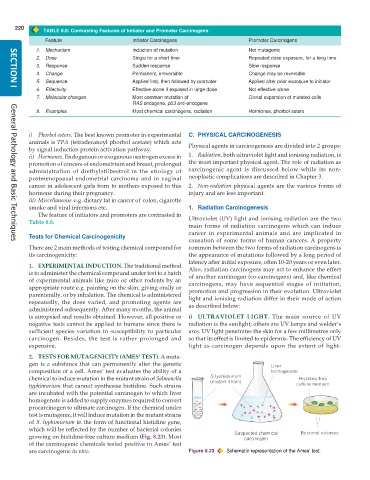
2. TESTS FOR MUTAGENICITY (AMES’ TEST). A muta-
gen is a substance that can permanently alter the genetic
composition of a cell. Ames’ test evaluates the ability of a
chemical to induce mutation in the mutant strain of Salmonella
typhimurium that cannot synthesise histidine. Such strains
are incubated with the potential carcinogen to which liver
homogenate is added to supply enzymes required to convert
procarcinogen to ultimate carcinogen. If the chemical under
test is mutagenic, it will induce mutation in the mutant strains
of S. typhimurium in the form of functional histidine gene,
which will be reflected by the number of bacterial colonies
growing on histidine-free culture medium (Fig. 8.23). Most
of the carcinogenic chemicals tested positive in Ames’ test
are carcinogenic in vivo. Figure 8.23 Schematic representation of the Ames’ test.

