


Page 232 - Textbook of Pathology, 6th Edition
P. 232
216


     SECTION I


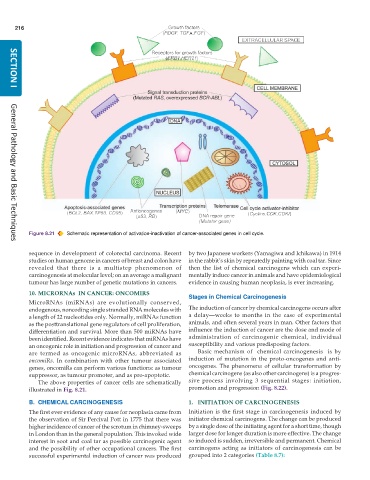
           Figure 8.21  Schematic representation of activation-inactivation of cancer-associated genes in cell cycle.
     General Pathology and Basic Techniques
           sequence in development of colorectal carcinoma. Recent  by two Japanese workers (Yamagiwa and Ichikawa) in 1914
           studies on human genome in cancers of breast and colon have  in the rabbit’s skin by repeatedly painting with coal tar. Since
           revealed that there is a multistep phenomenon of    then the list of chemical carcinogens which can experi-
           carcinogenesis at molecular level; on an average a malignant  mentally induce cancer in animals and have epidemiological
           tumour has large number of genetic mutations in cancers.  evidence in causing human neoplasia, is ever increasing.
           10. MICRORNAs  IN CANCER: ONCOMIRS
                                                               Stages in Chemical Carcinogenesis
           MicroRNAs (miRNAs) are evolutionally conserved,
           endogenous, noncoding single stranded RNA molecules with  The induction of cancer by chemical carcinogens occurs after
           a length of 22 nucleotides only. Normally, miRNAs function  a delay—weeks to months in the case of experimental
           as the posttranslational gene regulators of cell proliferation,  animals, and often several years in man. Other factors that
           differentiation and survival. More than 500 miRNAs have  influence the induction of cancer are the dose and mode of
           been identified. Recent evidence indicates that miRNAs have  administration of carcinogenic chemical, individual
           an oncogenic role in initiation and progression of cancer and  susceptibility and various predisposing factors.
           are termed as oncogenic microRNAs, abbreviated as      Basic mechanism of  chemical carcinogenesis  is by
           oncomiRs. In combination with other tumour associated  induction of mutation in the proto-oncogenes and anti-
           genes, oncomiRs can perform various functions: as tumour  oncogenes. The phenomena of cellular transformation by
           suppressor, as tumour promoter, and as pro-apoptotic.  chemical carcinogens (as also other carcinogens) is a progres-
              The above properties of cancer cells are schematically  sive process involving 3 sequential stages: initiation,
           illustrated in Fig. 8.21.                           promotion and progression (Fig. 8.22).
           B. CHEMICAL CARCINOGENESIS                          1. INITIATION OF CARCINOGENESIS
           The first ever evidence of any cause for neoplasia came from  Initiation is the first stage in carcinogenesis induced by
           the observation of Sir Percival Pott in 1775 that there was  initiator chemical carcinogens. The change can be produced
           higher incidence of cancer of the scrotum in chimney-sweeps  by a single dose of the initiating agent for a short time, though
           in London than in the general population. This invoked wide  larger dose for longer duration is more effective. The change
           interest in soot and coal tar as possible carcinogenic agent  so induced is sudden, irreversible and permanent. Chemical
           and the possibility of other occupational cancers. The first  carcinogens acting as initiators of carcinogenesis can be
           successful experimental induction of cancer was produced  grouped into 2 categories (Table 8.7):

