


Page 237 - Textbook of Pathology, 6th Edition
P. 237
absorbing protective melanin pigmentation of the skin. In                                                221
           humans, excessive exposure to UV rays can cause various
           forms of skin cancers—squamous cell carcinoma, basal cell
           carcinoma and malignant melanoma. In support of this is
           the epidemiological evidence of high incidence of these skin
           cancers in fair-skinned Europeans, albinos who do not tan
           readily, in inhabitants of Australia and New Zealand living                                                CHAPTER 8
           close to the equator who receive more sunlight, and in
           farmers and outdoor workers due to the effect of actinic light
           radiation.
           Mechanism. UV radiation may have various effects on the
           cells. The most important is induction of mutation; others
           are inhibition of cell division, inactivation of enzymes and                                               Neoplasia
           sometimes causing cell death. The most important
           biochemical effect of UV radiation is the formation of
           pyrimidine dimers in DNA. Such UV-induced DNA damage
           in normal individuals is repaired, while in the predisposed
           persons who are excessively exposed to sunlight such
           damage remain unrepaired. The proof in favour of mutagenic
           effect of UV radiation comes from following recessive
           hereditary diseases characterised by a defect in DNA repair
           mechanism and associated with high incidence of cancers:
           a) Xeroderma pigmentosum is predisposed to skin cancers
           at younger age (under 20 years of age).
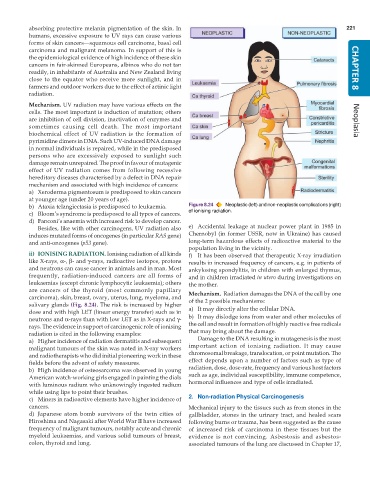
           b) Ataxia telangiectasia is predisposed to leukaemia.  Figure 8.24  Neoplastic (left) and non-neoplastic complications (right)
           c) Bloom’s syndrome is predisposed to all types of cancers.  of ionising radiation.
           d) Fanconi’s anaemia with increased risk to develop cancer.
              Besides, like with other carcinogens, UV radiation also  e) Accidental leakage at nuclear power plant in 1985 in
           induces mutated forms of oncogenes (in particular RAS gene)  Chernobyl (in former USSR, now in Ukraine) has caused
           and anti-oncogenes (p53 gene).                      long-term hazardous effects of radioactive material to the
                                                               population living in the vicinity.
           ii) IONISING RADIATION. Ionising radiation of all kinds  f) It has been observed that therapeutic X-ray irradiation
           like X-rays, α-, β- and γ-rays, radioactive isotopes, protons  results in increased frequency of cancers, e.g. in patients of
           and neutrons can cause cancer in animals and in man. Most  ankylosing spondylitis, in children with enlarged thymus,
           frequently, radiation-induced cancers are all forms of  and in children irradiated in utero during investigations on
           leukaemias (except chronic lymphocytic leukaemia); others  the mother.
           are cancers of the thyroid (most commonly papillary  Mechanism.  Radiation damages the DNA of the cell by one
           carcinoma), skin, breast, ovary, uterus, lung, myeloma, and  of the 2 possible mechanisms:
           salivary glands (Fig. 8.24). The risk is increased by higher
           dose and with high LET (linear energy transfer) such as in  a) It may directly alter the cellular DNA.
           neutrons and α-rays than with low LET as in X-rays and γ-  b) It may dislodge ions from water and other molecules of
           rays. The evidence in support of carcinogenic role of ionising  the cell and result in formation of highly reactive free radicals
           radiation is cited in the following examples:       that may bring about the damage.
           a) Higher incidence of radiation dermatitis and subsequent  Damage to the DNA resulting in mutagenesis is the most
           malignant tumours of the skin was noted in X-ray workers  important action of ionising radiation. It may cause
           and radiotherapists who did initial pioneering work in these  chromosomal breakage, translocation, or point mutation. The
           fields before the advent of safety measures.        effect depends upon a number of factors such as type of
           b) High incidence of osteosarcoma was observed in young  radiation, dose, dose-rate, frequency and various host factors
           American watch-working girls engaged in painting the dials  such as age, individual susceptibility, immune competence,
           with luminous radium who unknowingly ingested radium  hormonal influences and type of cells irradiated.
           while using lips to point their brushes.
           c) Miners in radioactive elements have higher incidence of  2. Non-radiation Physical Carcinogenesis
           cancers.                                            Mechanical injury to the tissues such as from stones in the
           d) Japanese atom bomb survivors of the twin cities of  gallbladder, stones in the urinary tract, and healed scars
           Hiroshima and Nagasaki after World War II have increased  following burns or trauma, has been suggested as the cause
           frequency of malignant tumours, notably acute and chronic  of increased risk of carcinoma in these tissues but the
           myeloid leukaemias, and various solid tumours of breast,  evidence is not convincing. Asbestosis and asbestos-
           colon, thyroid and lung.                            associated tumours of the lung are discussed in Chapter 17,

