


Page 233 - Textbook of Pathology, 6th Edition
P. 233
217  Neoplasia


                                                                                                                      CHAPTER 8


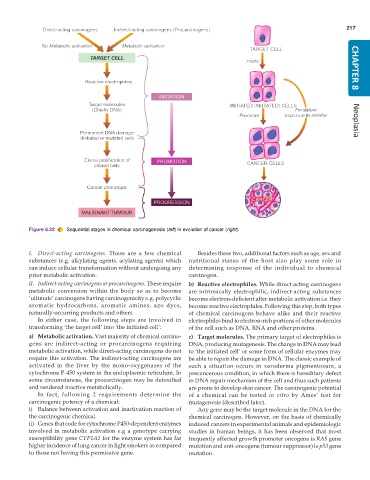
           Figure 8.22  Sequential stages in chemical carcinogenesis (left) in evolution of cancer (right).


           I. Direct-acting carcinogens. These are a few chemical  Besides these two, additional factors such as age, sex and
           substances (e.g. alkylating agents, acylating agents) which  nutritional status of the host also play some role in
           can induce cellular transformation without undergoing any  determining response of the individual to chemical
           prior metabolic activation.                         carcinogen.
           II. Indirect-acting carcinogens or procarcinogens. These require  b) Reactive electrophiles. While direct-acting carcinogens
           metabolic conversion within the body so as to become  are intrinsically electrophilic, indirect-acting substances
           ‘ultimate’ carcinogens having carcinogenicity e.g. polycyclic  become electron-deficient after metabolic activation i.e. they
           aromatic hydrocarbons, aromatic amines, azo dyes,   become reactive electrophiles. Following this step, both types
           naturally-occurring products and others.            of chemical carcinogens behave alike and their reactive
              In either case, the following steps are involved in  electrophiles bind to electron-rich portions of other molecules
           transforming ‘the target cell’ into ‘the initiated cell’:  of the cell such as DNA, RNA and other proteins.
           a) Metabolic activation. Vast majority of chemical carcino-  c) Target molecules. The primary target of electrophiles is
           gens are indirect-acting or procarcinogens requiring  DNA, producing mutagenesis. The change in DNA may lead
           metabolic activation, while direct-acting carcinogens do not  to ‘the initiated cell’ or some form of cellular enzymes may
           require this activation. The indirect-acting carcinogens are  be able to repair the damage in DNA. The classic example of
           activated in the liver by the mono-oxygenases of the  such a situation occurs in xeroderma pigmentosum, a
           cytochrome P-450 system in the endoplasmic reticulum. In  precancerous condition, in which there is hereditary defect
           some circumstances, the procarcinogen may be detoxified  in DNA repair mechanism of the cell and thus such patients
           and rendered inactive metabolically.                are prone to develop skin cancer. The carcinogenic potential
              In fact, following 2 requirements determine the  of a chemical can be tested  in vitro  by Ames’ test for
           carcinogenic potency of a chemical:                 mutagenesis (described later).
           i) Balance between activation and inactivation reaction of  Any gene may be the target molecule in the DNA for the
           the carcinogenic chemical.                          chemical carcinogen. However, on the basis of chemically
           ii) Genes that code for cytochrome P450-dependent enzymes  induced cancers in experimental animals and epidemiologic
           involved in metabolic activation e.g a genotype carrying  studies in human beings, it has been observed that most
           susceptibility gene CYP1A1 for the enzyme system has far  frequently affected growth promoter oncogene is RAS gene
           higher incidence of lung cancer in light smokers as compared  mutation and anti-oncogene (tumour suppressor) is p53 gene
           to those not having this permissive gene.           mutation.

