


Page 253 - Textbook of Pathology, 6th Edition
P. 253
Pneumoconiosis—the group of lung diseases due to TABLE 9.1: Major Constituents of Tobacco Smoke with 237
occupational over-exposure to pollutants is discussed in Adverse Effects.
Chapter 17.
Adverse Effect Constituents
TOBACCO SMOKING 1. Carcinogenesis • Tar
• Polycyclic aromatic
Habits hydrocarbons CHAPTER 9
• Nitrosamines
Tobacco smoking is the most prevalent and preventable cause 2. Tumour promoters • Nicotine
of disease and death. The harmful effects of smoking pipe • Phenol
and cigar are somewhat less. Long-term smokers of filter-
tipped cigarettes appear to have 30-50% lower risk of 3. Irritation and toxicity • Formaldehyde
Nitrogen oxide
to respiratory mucosa
development of cancer due to reduced inhalation of tobacco 4. Reduced oxygen transport • Carbon monoxide
smoke constituents.
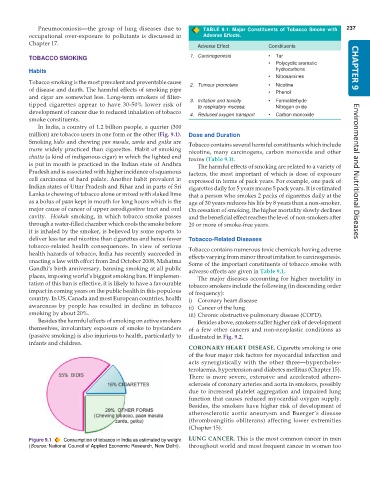
In India, a country of 1.2 billion people, a quarter (300
million) are tobacco users in one form or the other (Fig. 9.1). Dose and Duration
Smoking bidis and chewing pan masala, zarda and gutka are Tobacco contains several harmful constituents which include
more widely practiced than cigarettes. Habit of smoking nicotine, many carcinogens, carbon monoxide and other
chutta (a kind of indigenous cigar) in which the lighted end toxins (Table 9.1).
is put in mouth is practiced in the Indian state of Andhra The harmful effects of smoking are related to a variety of
Pradesh and is associated with higher incidence of squamous factors, the most important of which is dose of exposure Environmental and Nutritional Diseases
cell carcinoma of hard palate. Another habit prevalent in expressed in terms of pack years. For example, one pack of
Indian states of Uttar Pradesh and Bihar and in parts of Sri cigarettes daily for 5 years means 5 pack years. It is estimated
Lanka is chewing of tabacco alone or mixed with slaked lime that a person who smokes 2 packs of cigarettes daily at the
as a bolus of paan kept in mouth for long hours which is the age of 30 years reduces his life by 8 years than a non-smoker.
major cause of cancer of upper aerodigestive tract and oral On cessation of smoking, the higher mortality slowly declines
cavity. Hookah smoking, in which tobacco smoke passes and the beneficial effect reaches the level of non-smokers after
through a water-filled chamber which cools the smoke before 20 or more of smoke-free years.
it is inhaled by the smoker, is believed by some reports to
deliver less tar and nicotine than cigarettes and hence fewer Tobacco-Related Diseases
tobacco-related health consequences. In view of serious Tobacco contains numerous toxic chemicals having adverse
health hazards of tobacco, India has recently succeeded in effects varying from minor throat irritation to carcinogenesis.
enacting a law with effect from 2nd October 2008, Mahatma Some of the important constituents of tobacco smoke with
Gandhi’s birth anniversary, banning smoking at all public adverse effects are given in Table 9.1.
places, imposing world’s biggest smoking ban. If implemen- The major diseases accounting for higher mortality in
tation of this ban is effective, it is likely to have a favourable tobacco smokers include the following (in descending order
impact in coming years on the public health in this populous of frequency):
country. In US, Canada and most European countries, health i) Coronary heart disease
awareness by people has resulted in decline in tobacco ii) Cancer of the lung
smoking by about 20%. iii) Chronic obstructive pulmonary disease (COPD).
Besides the harmful effects of smoking on active smokers Besides above, smokers suffer higher risk of development
themselves, involuntary exposure of smoke to bystanders of a few other cancers and non-neoplastic conditions as
(passive smoking) is also injurious to health, particularly to illustrated in Fig. 9.2.
infants and children.
CORONARY HEART DISEASE. Cigarette smoking is one
of the four major risk factors for myocardial infarction and
acts synergistically with the other three—hypercholes-
terolaemia, hypertension and diabetes mellitus (Chapter 15).
There is more severe, extensive and accelerated athero-
sclerosis of coronary arteries and aorta in smokers, possibly
due to increased platelet aggregation and impaired lung
function that causes reduced myocardial oxygen supply.
Besides, the smokers have higher risk of development of
atherosclerotic aortic aneurysm and Buerger’s disease
(thromboangiitis obliterans) affecting lower extremities
(Chapter 15).
LUNG CANCER. This is the most common cancer in men
Figure 9.1 Consumption of tobacco in India as estimated by weight
(Source: National Council of Applied Economic Research, New Delhi). throughout world and most frequent cancer in women too

