


Page 267 - Textbook of Pathology, 6th Edition
P. 267
1. Haemorrhagic disease of newborn. The newborn infants                                                  251
           are deficient in vitamin K because of minimal stores of
           vitamin K at birth, lack of established intestinal flora for
           endogenous synthesis and limited dietary intake since breast
           milk is a poor source of vitamin K. Hence the clinical practice
           is to routinely administer vitamin K at birth.                                                            CHAPTER 9
           2. Biliary obstruction. Bile is prevented from entering the
           bowel due to biliary obstruction which prevents the
           absorption of this fat-soluble vitamin. Surgery in patients of
           obstructive jaundice, therefore, leads to marked tendency to
           bleeding.
           3. Due to malabsorption syndrome. Patients suffering from
           malabsorption of fat develop vitamin K deficiency e.g. coeliac
           disease, sprue, pancreatic disease, hypermotility of bowel
           etc.
           4. Due to anticoagulant therapy. Patients on warfarin group
           of anticoagulants have impaired biosynthesis of vitamin K-
           dependent coagulation factors.
           5. Due to antibiotic therapy. The use of broad-spectrum
           antibiotics and sulfa drugs reduces the normal intestinal flora.                                           Environmental and Nutritional Diseases
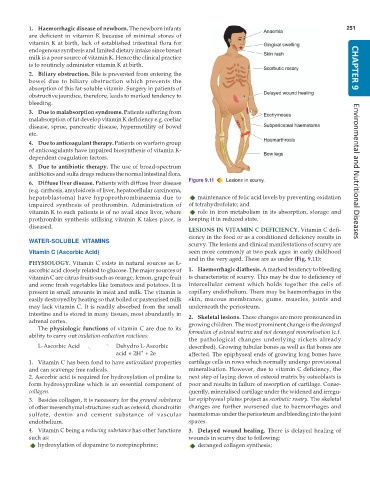
           6. Diffuse liver disease. Patients with diffuse liver disease  Figure 9.11  Lesions in scurvy.
           (e.g. cirrhosis, amyloidosis of liver, hepatocellular carcinoma,
           hepatoblastoma) have hypoprothrombinaemia due to       maintenance of folic acid levels by preventing oxidation
           impaired synthesis of prothrombin. Administration of  of tetrahydrofolate; and
           vitamin K to such patients is of no avail since liver, where  role in iron metabolism in its absorption, storage and
           prothrombin synthesis utilising vitamin K takes place, is  keeping it in reduced state.
           diseased.
                                                               LESIONS IN VITAMIN C DEFICIENCY. Vitamin C defi-
                                                               ciency in the food or as a conditioned deficiency results in
           WATER-SOLUBLE  VITAMINS
                                                               scurvy. The lesions and clinical manifestations of scurvy are
           Vitamin C (Ascorbic Acid)                           seen more commonly at two peak ages: in early childhood
                                                               and in the very aged. These are as under (Fig. 9.11):
           PHYSIOLOGY. Vitamin C exists in natural sources as L-
           ascorbic acid closely related to glucose. The major sources of  1. Haemorrhagic diathesis. A marked tendency to bleeding
           vitamin C are citrus fruits such as orange, lemon, grape fruit  is characteristic of scurvy. This may be due to deficiency of
           and some fresh vegetables like tomatoes and potatoes. It is  intercellular cement which holds together the cells of
           present in small amounts in meat and milk. The vitamin is  capillary endothelium. There may be haemorrhages in the
           easily destroyed by heating so that boiled or pasteurised milk  skin, mucous membranes, gums, muscles, joints and
           may lack vitamin C. It is readily absorbed from the small  underneath the periosteum.
           intestine and is stored in many tissues, most abundantly in  2. Skeletal lesions. These changes are more pronounced in
           adrenal cortex.
              The physiologic functions of vitamin C are due to its  growing children. The most prominent change is the deranged
                                                               formation of osteoid matrix and not deranged mineralisation (c.f.
           ability to carry out oxidation-reduction reactions:
                                                               the pathological changes underlying rickets already
              L-Ascorbic Acid          Dehydro L-Ascorbic      described). Growing tubular bones as well as flat bones are
                                                +
                                       acid + 2H  + 2e         affected. The epiphyseal ends of growing long bones have
           1. Vitamin C has been fond to have antioxidant properties  cartilage cells in rows which normally undergo provisional
           and can scavenge free radicals.                     mineralisation. However, due to vitamin C deficiency, the
           2. Ascorbic acid is required for hydroxylation of proline to  next step of laying down of osteoid matrix by osteoblasts is
           form hydroxyproline which is an essential component of  poor and results in failure of resorption of cartilage. Conse-
           collagen.                                           quently, mineralised cartilage under the widened and irregu-
           3. Besides collagen, it is necessary for the ground substance  lar epiphyseal plates project as scorbutic rosary. The skeletal
           of other mesenchymal structures such as osteoid, chondroitin  changes are further worsened due to haemorrhages and
           sulfate, dentin and cement substance of vascular    haematomas under the periosteum and bleeding into the joint
           endothelium.                                        spaces.
           4. Vitamin C being a reducing substance has other functions  3. Delayed wound healing. There is delayed healing of
           such as:                                            wounds in scurvy due to following:
              hydroxylation of dopamine to norepinephrine;        deranged collagen synthesis;

