


Page 268 - Textbook of Pathology, 6th Edition
P. 268
252     poor preservation and maturation of fibroblasts; and  dry beriberi (peripheral neuritis);
              localisation of infections in the wounds.           wet beriberi (cardiac manifestations), and
           4. Anaemia. Anaemia is common in scurvy. It may be the  cerebral beriberi (Wernicke-Korsakoff’s syndrome).
           result of haemorrhage, interference with formation of folic  It is worth-noting that lesions in beriberi are mainly
           acid or deranged iron metabolism. Accordingly, anaemia is  located in the nervous system and heart. This is because the
           most often normocytic normochromic type; occasionally it  energy requirement of the brain and nerves is solely derived
           may be megaloblastic or even iron deficiency type.  from oxidation of carbohydrates which is deranged in
                                                               beriberi, while lesions in the heart appear to arise due to
           5. Lesions in teeth and gums. Scurvy may interfere with  reduced ATP synthesis in beriberi which is required for
           development of dentin. The gums are soft and swollen, may  cardiac functions.
     SECTION I
           bleed readily and get infected commonly.
                                                                  The features of 3 forms of beriberi are as under:
           6. Skin rash. Hyperkeratotic and follicular rash may occur
           in scurvy.                                          1. Dry beriberi (peripheral neuritis). This is marked by
                                                               neuromuscular symptoms such as weakness, paraesthesia
                                                               and sensory loss. The nerves show polyneuritis, myelin
           VITAMIN B COMPLEX
                                                               degeneration and fragmentation of axons.
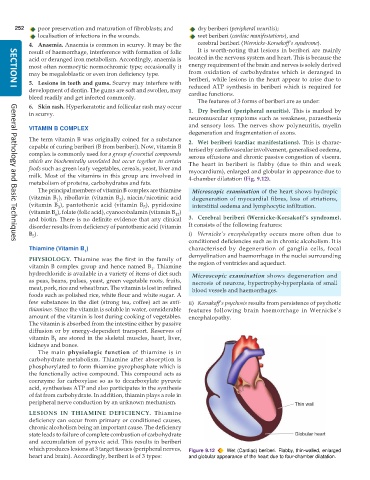
           The term vitamin B was originally coined for a substance  2. Wet beriberi (cardiac manifestations). This is charac-
           capable of curing beriberi (B from beriberi). Now, vitamin B  terised by cardiovascular involvement, generalised oedema,
           complex is commonly used for a group of essential compounds  serous effusions and chronic passive congestion of viscera.
           which are biochemically unrelated but occur together in certain  The heart in beriberi is flabby (due to thin and weak
           foods such as green leafy vegetables, cereals, yeast, liver and  myocardium), enlarged and globular in appearance due to
           milk. Most of the vitamins in this group are involved in  4-chamber dilatation (Fig. 9.12).
           metabolism of proteins, carbohydrates and fats.
              The principal members of vitamin B complex are thiamine  Microscopic examination of the heart shows hydropic
           (vitamin B ), riboflavin (vitamin B ), niacin/nicotinic acid  degeneration of myocardial fibres, loss of striations,
                    1
                                         2
           (vitamin B ), pantothenic acid (vitamin B ), pyridoxine  interstitial oedema and lymphocytic infiltration.
                                                5
                    3
           (vitamin B ), folate (folic acid), cyanocobalamin (vitamin B )
                                                           12
                   6
           and biotin. There is no definite evidence that any clinical  3. Cerebral beriberi (Wernicke-Korsakoff’s syndrome).
           disorder results from deficiency of pantothenic acid (vitamin  It consists of the following features:
           B ).                                                i) Wernicke’s encephalopathy occurs more often due to
            5
                                                               conditioned deficiencies such as in chronic alcoholism. It is
     General Pathology and Basic Techniques
           Thiamine (Vitamin B )                               characterised by degeneration of ganglia cells, focal
                             1
                                                               demyelination and haemorrhage in the nuclei surrounding
           PHYSIOLOGY.  Thiamine was the first in the family of  the region of ventricles and aqueduct.
           vitamin B complex group and hence named B . Thiamine
                                                   1
           hydrochloride is available in a variety of items of diet such  Microscopic examination shows degeneration and
           as peas, beans, pulses, yeast, green vegetable roots, fruits,  necrosis of neurons, hypertrophy-hyperplasia of small
           meat, pork, rice and wheat bran. The vitamin is lost in refined  blood vessels and haemorrhages.
           foods such as polished rice, white flour and white sugar. A
           few substances in the diet (strong tea, coffee) act as anti-  ii) Korsakoff’s psychosis results from persistence of psychotic
           thiamines. Since the vitamin is soluble in water, considerable  features following brain haemorrhage in Wernicke’s
           amount of the vitamin is lost during cooking of vegetables.  encephalopathy.
           The vitamin is absorbed from the intestine either by passive
           diffusion or by energy-dependent transport. Reserves of
           vitamin B  are stored in the skeletal muscles, heart, liver,
                   1
           kidneys and bones.
              The main  physiologic function of thiamine is in
           carbohydrate metabolism. Thiamine after absorption is
           phosphorylated to form thiamine pyrophosphate which is
           the functionally active compound. This compound acts as
           coenzyme for carboxylase so as to decarboxylate pyruvic
           acid, synthesises ATP and also participates in the synthesis
           of fat from carbohydrate. In addition, thiamin plays a role in
           peripheral nerve conduction by an unknown mechanism.
           LESIONS IN THIAMINE DEFICIENCY.  Thiamine
           deficiency can occur from primary or conditioned causes,
           chronic alcoholism being an important cause. The deficiency
           state leads to failure of complete combustion of carbohydrate
           and accumulation of pyruvic acid. This results in beriberi
           which produces lesions at 3 target tissues (peripheral nerves,  Figure 9.12  Wet (Cardiac) beriberi. Flabby, thin-walled, enlarged
           heart and brain). Accordingly, beriberi is of 3 types:  and globular appearance of the heart due to four-chamber dilatation.

