


Page 470 - Textbook of Pathology, 6th Edition
P. 470
454 known etiologies. However, the term cardiomyopathy has
TABLE 16.10: Classification of Primary Cardiomyopathies.
been loosely used by various workers for myocardial diseases
1. Idiopathic dilated (or congestive) cardiomyopathy of known etiology as well e.g. alcoholic cardiomyopathy,
2. Idiopathic hypertrophic cardiomyopathy amyloid cardiomyopathy, ischaemic cardiomyopathy etc.
i) Obstructive type This controversy is resolved by classifying all cardiomyo-
ii) Non-obstructive type
3. Idiopathic restrictive (or obliterative or infiltrative) cardio- pathies into two broad groups:
myopathy a) primary cardiomyopathy; and
i) Cardiac amyloidosis b) secondary cardiomyopathy i.e. myocardial disease with
ii) Endocardial fibroelastosis known underlying cause.
iii) Endomyocardial fibrosis Based on these principles, a classification of primary
iv) Löeffler’s endocarditis (fibroplastic parietal endocarditis cardiomyopathy and its subtypes is presented in Table 16.10.
with peripheral blood eosinophilia)
v) Other forms
A. PRIMARY CARDIOMYOPATHY
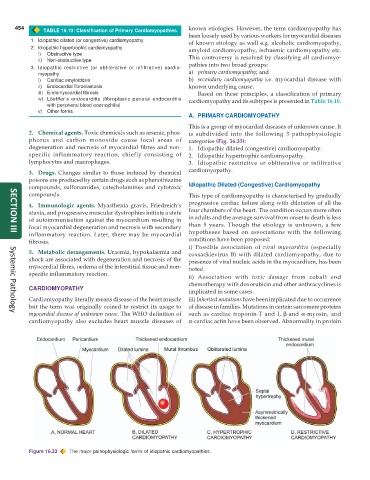
This is a group of myocardial diseases of unknown cause. It
2. Chemical agents. Toxic chemicals such as arsenic, phos- is subdivided into the following 3 pathophysiologic
phorus and carbon monoxide cause focal areas of categories (Fig. 16.33):
degeneration and necrosis of myocardial fibres and non- 1. Idiopathic dilated (congestive) cardiomyopathy.
specific inflammatory reaction, chiefly consisting of 2. Idiopathic hypertrophic cardiomyopathy.
lymphocytes and macrophages. 3. Idiopathic restrictive or obliterative or infiltrative
3. Drugs. Changes similar to those induced by chemical cardiomyopathy.
poisons are produced by certain drugs such as phenothiazine
compounds, sulfonamides, catecholamines and cytotoxic Idiopathic Dilated (Congestive) Cardiomyopathy
compounds. This type of cardiomyopathy is characterised by gradually
4. Immunologic agents. Myasthenia gravis, Friedreich’s progressive cardiac failure along with dilatation of all the
ataxia, and progressive muscular dystrophies initiate a state four chambers of the heart. The condition occurs more often
of autoimmunisation against the myocardium resulting in in adults and the average survival from onset to death is less
focal myocardial degeneration and necrosis with secondary than 5 years. Though the etiology is unknown, a few
inflammatory reaction. Later, there may be myocardial hypotheses based on associations with the following
SECTION III
fibrosis. conditions have been proposed:
i) Possible association of viral myocarditis (especially
5. Metabolic derangements. Uraemia, hypokalaemia and coxsackievirus B) with dilated cardiomyopathy, due to
shock are associated with degeneration and necrosis of the presence of viral nucleic acids in the myocardium, has been
myocardial fibres, oedema of the interstitial tissue and non- noted.
specific inflammatory reaction.
ii) Association with toxic damage from cobalt and
chemotherapy with doxorubicin and other anthracyclines is
CARDIOMYOPATHY
implicated in some cases.
Cardiomyopathy literally means disease of the heart muscle iii) Inherited mutations have been implicated due to occurrence
but the term was originally coined to restrict its usage to of disease in families. Mutations in certain sarcomere proteins
myocardial disease of unknown cause. The WHO definition of such as cardiac troponin-T and I, β-and α-myosin, and
Systemic Pathology
cardiomyopathy also excludes heart muscle diseases of α-cardiac actin have been observed. Abnormality in protein
Figure 16.33 The major pathophysiologic forms of idiopathic cardiomyopathies.

