


Page 666 - Textbook of Pathology, 6th Edition
P. 666
650                                                      capillaries is high. Therefore, renal cortex is more prone to
                                                               the effects of hypertension.
                                                               ii) The renal medulla, on the other hand, is poorly perfused
                                                               and any interference in blood supply to it results in medullary
                                                               necrosis.
                                                               iii) The divisions and subdivisions of the renal artery up to
                                                               arterioles are end-arteries and have no anastomoses. Thus,
                                                               occlusion of any of the branches results in infarction of the
                                                               renal parenchyma supplied by it.
                                                               iv) Since the tubular capillary beds are derived from the
                                                               efferent arterioles leaving the glomeruli, diseases affecting
                                                               the blood flow through glomerular tuft have significant
                                                               effects on the tubules as well.
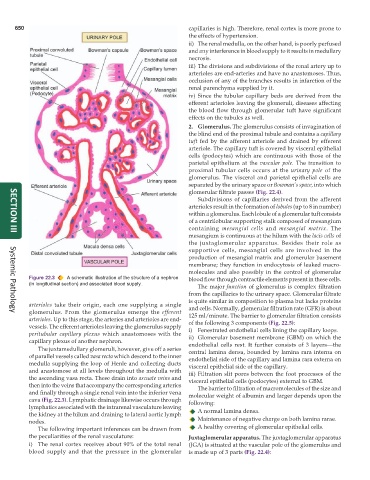
                                                               2. Glomerulus. The glomerulus consists of invagination of
                                                               the blind end of the proximal tubule and contains a capillary
                                                               tuft fed by the afferent arteriole and drained by efferent
                                                               arteriole. The capillary tuft is covered by visceral epithelial
                                                               cells (podocytes) which are continuous with those of the
                                                               parietal epithelium at the  vascular pole. The transition to
                                                               proximal tubular cells occurs at the  urinary pole  of the
                                                               glomerulus. The visceral and parietal epithelial cells are
                                                               separated by the urinary space or Bowman’s space, into which
                                                               glomerular filtrate passes (Fig. 22.4).
                                                                  Subdivisions of capillaries derived from the afferent
                                                               arterioles result in the formation of lobules (up to 8 in number)
                                                               within a glomerulus. Each lobule of a glomerular tuft consists
                                                               of a centrilobular supporting stalk composed of mesangium
                                                               containing  mesangial cells  and mesangial matrix.  The
                                                               mesangium is continuous at the hilum with the lacis cells of
     SECTION III
                                                               the juxtaglomerular apparatus. Besides their role as
                                                               supportive cells, mesangial cells are involved in the
                                                               production of mesangial matrix and glomerular basement
                                                               membrane; they function in endocytosis of leaked macro-
                                                               molecules and also possibly in the control of glomerular
           Figure 22.3  A schematic illustration of the structure of a nephron  blood flow through contractile elements present in these cells.
           (in longitudinal section) and associated blood supply.
                                                                  The major function of glomerulus is complex filtration
                                                               from the capillaries to the urinary space. Glomerular filtrate
                                                               is quite similar in composition to plasma but lacks proteins
           arterioles  take their origin, each one supplying a single  and cells. Normally, glomerular filtration rate (GFR) is about
           glomerulus. From the glomerulus emerge the  efferent  125 ml/minute. The barrier to glomerular filtration consists
     Systemic Pathology
           arterioles. Up to this stage, the arteries and arterioles are end-  of the following 3 components (Fig. 22.5):
           vessels. The efferent arterioles leaving the glomerulus supply  i) Fenestrated endothelial cells lining the capillary loops.
           peritubular capillary plexus which anastomoses with the  ii) Glomerular basement membrane (GBM) on which the
           capillary plexus of another nephron.                endothelial cells rest. It further consists of 3 layers—the
              The juxtamedullary glomeruli, however, give off a series  central lamina densa, bounded by lamina rara interna on
           of parallel vessels called vasa recta which descend to the inner  endothelial side of the capillary and lamina rara externa on
           medulla supplying the loop of Henle and collecting ducts  visceral epithelial side of the capillary.
           and anastomose at all levels throughout the medulla with  iii) Filtration slit pores between the foot processes of the
           the ascending vasa recta. These drain into arcuate veins and  visceral epithelial cells (podocytes) external to GBM.
           then into the veins that accompany the corresponding arteries  The barrier to filtration of macromolecules of the size and
           and finally through a single renal vein into the inferior vena  molecular weight of albumin and larger depends upon the
           cava (Fig. 22.3). Lymphatic drainage likewise occurs through  following:
           lymphatics associated with the intrarenal vasculature leaving  A normal lamina densa.
           the kidney at the hilum and draining to lateral aortic lymph
           nodes.                                                 Maintenance of negative charge on both lamina rarae.
              The following important inferences can be drawn from  A healthy covering of glomerular epithelial cells.
           the peculiarities of the renal vasculature:         Juxtaglomerular apparatus. The juxtaglomerular apparatus
           i) The renal cortex receives about 90% of the total renal  (JGA) is situated at the vascular pole of the glomerulus and
           blood supply and that the pressure in the glomerular  is made up of 3 parts (Fig. 22.4):

