


Page 667 - Textbook of Pathology, 6th Edition
P. 667
651


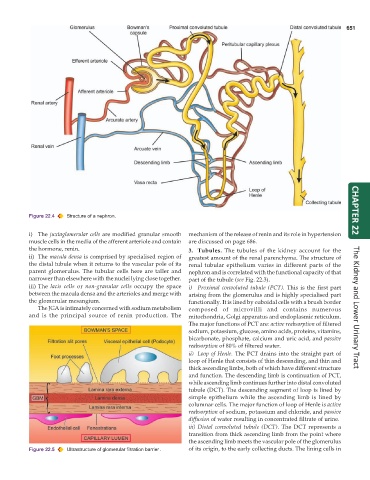
           Figure 22.4  Structure of a nephron.                                                                       CHAPTER 22


           i) The juxtaglomerular cells are modified granular smooth  mechanism of the release of renin and its role in hypertension
           muscle cells in the media of the afferent arteriole and contain  are discussed on page 686.
           the hormone, renin.                                 3. Tubules. The tubules of the kidney account for the
           ii) The macula densa is comprised by specialised region of  greatest amount of the renal parenchyma. The structure of
           the distal tubule when it returns to the vascular pole of its  renal tubular epithelium varies in different parts of the
           parent glomerulus. The tubular cells here are taller and  nephron and is correlated with the functional capacity of that
           narrower than elsewhere with the nuclei lying close together.  part of the tubule (see Fig. 22.3).
           iii) The  lacis cells or  non-granular cells  occupy the space  i) Proximal convoluted tubule (PCT). This is the first part
           between the macula densa and the arterioles and merge with  arising from the glomerulus and is highly specialised part
           the glomerular mesangium.                           functionally. It is lined by cuboidal cells with a brush border
              The JGA is intimately concerned with sodium metabolism  composed of microvilli and contains numerous    The Kidney and Lower Urinary Tract
           and is the principal source of renin production. The  mitochondria, Golgi apparatus and endoplasmic reticulum.
                                                               The major functions of PCT are: active reabsorption of filtered
                                                               sodium, potassium, glucose, amino acids, proteins, vitamins,
                                                               bicarbonate, phosphate, calcium and uric acid, and passive
                                                               reabsorption of 80% of filtered water.
                                                               ii) Loop of Henle. The PCT drains into the straight part of
                                                               loop of Henle that consists of thin descending, and thin and
                                                               thick ascending limbs, both of which have different structure
                                                               and function. The descending limb is continuation of PCT,
                                                               while ascending limb continues further into distal convoluted
                                                               tubule (DCT). The descending segment of loop is lined by
                                                               simple epithelium while the ascending limb is lined by
                                                               columnar cells. The major function of loop of Henle is active
                                                               reabsorption of sodium, potassium and chloride, and passive
                                                               diffusion of water resulting in concentrated filtrate of urine.
                                                               iii) Distal convoluted tubule (DCT). The DCT represents a
                                                               transition from thick ascending limb from the point where
                                                               the ascending limb meets the vascular pole of the glomerulus
           Figure 22.5  Ultrastructure of glomerular filtration barrier.  of its origin, to the early collecting ducts. The lining cells in

