


Page 664 - Textbook of Pathology, 6th Edition
P. 664
648 African Americans and accounts for 5% of all cancer deaths
           in that country. It is commoner in males than in females and
           the incidence increases progressively after the age of 50 years.

           ETIOLOGY.   A significant increase in the incidence of
           pancreatic cancer has been observed in the UK and US during
           the last 50 years. Little is known about etiology of pancreatic
           cancer.  However, following factors have been implicated in
           its etiology:
           1. Smoking: Heavy cigarette smokers have higher incidence
           than the non-smokers. However, it is not known whether
           tobacco metabolites have a direct carcinogenic effect on the
           pancreas or by some other unknown mechanism.
           2. Diet and obesity: Diet with high total caloric value and
           high consumption of animal proteins and fats is related to
           higher incidence of pancreatic cancer. Obesity is a risk factor
           for pancreatic cancer.
           3. Chemical carcinogens: Individuals exposed to  β-naph-
           thylamine, benzidine and nitrosamines have higher incidence
           of cancer of the pancreas.
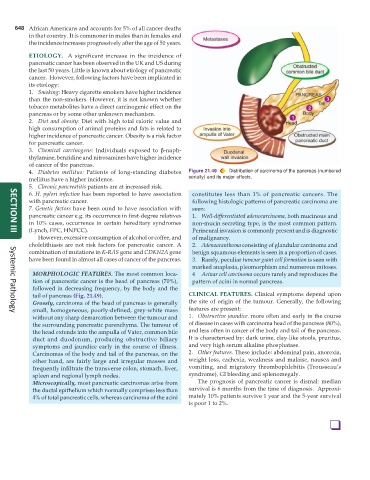
           4. Diabetes mellitus: Patients of long-standing diabetes  Figure 21.49  Distribution of carcinoma of the pancreas (numbered
           mellitus have a higher incidence.                   serially) and its major effects.
           5. Chronic pancreatitis patients are at increased risk.
           6. H. pylori infection has been reported to have association  constitutes less than 1% of pancreatic cancers. The
           with pancreatic cancer.                               following histologic patterns of pancreatic carcinoma are
           7. Genetic factors have been ound to have association with  seen:
           pancreatic cancer e.g. its occurrence in first-degree relatives  1. Well-differentiated adenocarcinoma, both mucinous and
           in 10% cases, occurrence in certain hereditary syndromes  non-mucin secreting type, is the most common pattern.
           (Lynch, FPC, HNPCC).                                  Perineural invasion is commonly present and is diagnostic
     SECTION III
              However, excessive consumption of alcohol or coffee, and  of malignancy.
           cholelithiasis are not risk factors for pancreatic cancer. A  2. Adenoacanthoma consisting of glandular carcinoma and
           combination of mutations in K-RAS gene and CDKN2A gene  benign squamous elements is seen in a proportion of cases.
           have been found in almost all cases of cancer of the pancreas.  3. Rarely, peculiar tumour giant cell formation is seen with
                                                                 marked anaplasia, pleomorphism and numerous mitoses.
            MORPHOLOGIC FEATURES. The most common loca-          4  Acinar cell carcinoma occurs rarely and reproduces the
            tion of pancreatic cancer is the head of pancreas (70%),  pattern of acini in normal pancreas.
            followed in decreasing frequency, by the body and the
            tail of pancreas (Fig. 21.49).                     CLINICAL FEATURES. Clinical symptoms depend upon
            Grossly, carcinoma of the head of pancreas is generally  the site of origin of the tumour. Generally, the following
            small, homogeneous, poorly-defined, grey-white mass  features are present:
     Systemic Pathology
            without any sharp demarcation between the tumour and  1. Obstructive jaundice. more often and early in the course
            the surrounding pancreatic parenchyma. The tumour of  of disease in cases with carcinoma head of the pancreas (80%),
            the head extends into the ampulla of Vater, common bile  and less often in cancer of the body and tail of the pancreas.
            duct and duodenum, producing obstructive biliary   It is characterised by: dark urine, clay-like stools, pruritus,
            symptoms and jaundice early in the course of illness.  and very high serum alkaline phosphatase.
            Carcinomas of the body and tail of the pancreas, on the  2. Other features. These include: abdominal pain, anorexia,
            other hand, are fairly large and irregular masses and  weight loss, cachexia, weakness and malaise, nausea and
            frequently infiltrate the transverse colon, stomach, liver,  vomiting, and migratory thrombophlebitis (Trousseau’s
            spleen and regional lymph nodes.                   syndrome), GI bleeding and splenomegaly.
            Microscopically, most pancreatic carcinomas arise from  The prognosis of pancreatic cancer is dismal: median
            the ductal epithelium which normally comprises less than  survival is 6 months from the time of diagnosis.  Approxi-
            4% of total pancreatic cells, whereas carcinoma of the acini  mately 10% patients survive 1 year and the 5-year survival
                                                               is poor 1 to 2%.


                                                                                                              ❑

