


Page 663 - Textbook of Pathology, 6th Edition
P. 663
COMPLICATIONS. Late stage of chronic pancreatitis may  647
                                                               be complicated by diabetes mellitus, pancreatic insufficiency
                                                               with steatorrhoea and malabsorption and formation of
                                                               pancreatic pseudocysts (Fig. 21.48).

                                                               TUMOURS AND TUMOUR-LIKE LESIONS
                                                               Tumour-like masses of the exocrine pancreas include
                                                               congenital cystic disease (involving the pancreas, liver and
                                                               kidney) and pancreatic pseudocysts. True pancreatic tumours
                                                               are classified into benign (e.g. serous cystadenoma, fibroma,
                                                               lipoma and adenoma) and malignant (i.e. carcinoma of the
                                                               pancreas). Out of all these, only two pancreatic lesions—
                                                               pseudocyst and carcinoma of the pancreas, are common and
                                                               are discussed below.

                                                               Pancreatic Pseudocyst

                                                               Pancreatic pseudocyst is a localised collection of pancreatic
                                                               juice, necrotic debris and haemorrhages. It develops
                                                               following either acute pancreatitis or trauma. The patients
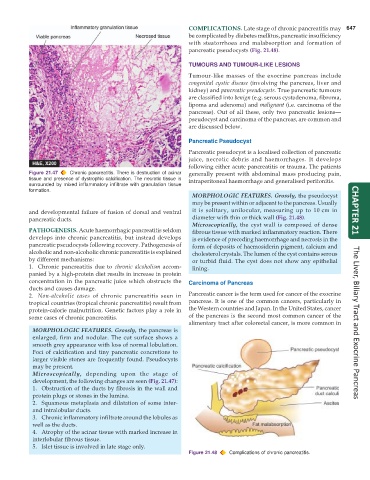
           Figure 21.47  Chronic pancreatitis. There is destruction of acinar  generally present with abdominal mass producing pain,
           tissue and presence of dystrophic calcification. The necrotic tissue is  intraperitoneal haemorrhage and generalised peritonitis.
           surrounded by mixed inflammatory infiltrate with granulation tissue
           formation.
                                                                 MORPHOLOGIC FEATURES. Grossly, the pseudocyst
                                                                 may be present within or adjacent to the pancreas. Usually
           and developmental failure of fusion of dorsal and ventral  it is solitary, unilocular, measuring up to 10 cm in  CHAPTER 21
           pancreatic ducts.                                     diameter with thin or thick wall (Fig. 21.48).
                                                                 Microscopically, the cyst wall is composed of dense
           PATHOGENESIS. Acute haemorrhagic pancreatitis seldom  fibrous tissue with marked inflammatory reaction. There
           develops into chronic pancreatitis, but instead develops  is evidence of preceding haemorrhage and necrosis in the
           pancreatic pseudocysts following recovery. Pathogenesis of  form of deposits of haemosiderin pigment, calcium and
           alcoholic and non-alcoholic chronic pancreatitis is explained  cholesterol crystals. The lumen of the cyst contains serous
           by different mechanisms:                              or turbid fluid. The cyst does not show any epithelial
           1. Chronic pancreatitis due to  chronic alcoholism accom-  lining.
           panied by a high-protein diet results in increase in protein
           concentration in the pancreatic juice which obstructs the  Carcinoma of Pancreas
           ducts and causes damage.
           2. Non-alcoholic cases of chronic pancreatitis seen in  Pancreatic cancer is the term used for cancer of the exocrine
           tropical countries (tropical chronic pancreatitis) result from  pancreas. It is one of the common cancers, particularly in
           protein-calorie malnutrition. Genetic factors play a role in  the Western countries and Japan. In the United States, cancer
           some cases of chronic pancreatitis.                 of the pancreas is the second most common cancer of the
                                                               alimentary tract after colorectal cancer, is more common in  The Liver, Biliary Tract and Exocrine Pancreas
            MORPHOLOGIC FEATURES. Grossly, the pancreas is
            enlarged, firm and nodular. The cut surface shows a
            smooth grey appearance with loss of normal lobulation.
            Foci of calcification and tiny pancreatic concretions to
            larger visible stones are frequently found. Pseudocysts
            may be present.
            Microscopically, depending upon the stage of
            development, the following changes are seen (Fig. 21.47):
            1. Obstruction of the ducts by fibrosis in the wall and
            protein plugs or stones in the lumina.
            2. Squamous metaplasia and dilatation of some inter-
            and intralobular ducts.
            3. Chronic inflammatory infiltrate around the lobules as
            well as the ducts.
            4. Atrophy of the acinar tissue with marked increase in
            interlobular fibrous tissue.
            5. Islet tissue is involved in late stage only.
                                                               Figure 21.48  Complications of chronic pancreatitis.

