


Page 665 - Textbook of Pathology, 6th Edition
P. 665
649

                                                        The Kidney and
            Chapter 22
            Chapter 22
                                                   Lower Urinary Tract


                               KIDNEY


           NORMAL STRUCTURE
           ANATOMY. The kidneys are bean-shaped paired organs,
           each weighing about 150 gm in the adult male and about
           135 gm in the adult female. The hilum of the kidney is
           situated at the midpoint on the medial aspect where the
           artery, vein, lymphatics and ureter are located. The kidney
           is surrounded by a thin fibrous capsule which is adherent at
           the hilum.
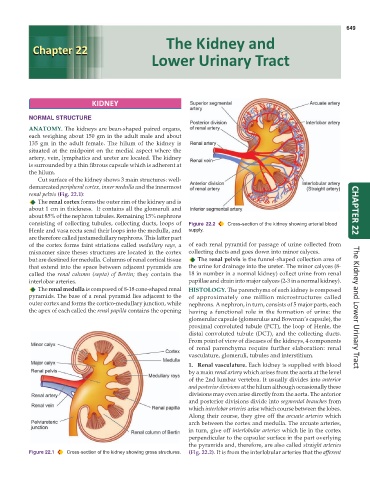
              Cut surface of the kidney shows 3 main structures: well-
           demarcated peripheral cortex, inner medulla and the innermost
           renal pelvis (Fig. 22.1):
              The renal cortex forms the outer rim of the kidney and is
           about 1 cm in thickness.  It contains all the glomeruli and                                                CHAPTER 22
           about 85% of the nephron tubules. Remaining 15% nephrons
           consisting of collecting tubules, collecting ducts, loops of  Figure 22.2  Cross-section of the kidney showing arterial blood
           Henle and vasa recta send their loops into the medulla, and  supply.
           are therefore called juxtamedullary nephrons. This latter part
           of the cortex forms faint striations called medullary rays, a  of each renal pyramid for passage of urine collected from
           misnomer since theses structures are located in the cortex  collecting ducts and goes down into minor calyces.
           but are destined for medulla. Columns of renal cortical tissue  The renal pelvis is the funnel-shaped collection area of
           that extend into the space between adjacent pyramids are  the urine for drainage into the ureter. The minor calyces (8-
           called the  renal column (septa) of Bertin; they contain the  18 in number in a normal kidney) collect urine from renal
           interlobar arteries.                                papillae and drain into major calyces (2-3 in a normal kidney).
              The renal medulla is composed of 8-18 cone-shaped renal  HISTOLOGY. The parenchyma of each kidney is composed
           pyramids. The base of a renal pyramid lies adjacent to the  of approximately one million microstructures called
           outer cortex and forms the cortico-medullary junction, while  nephrons. A nephron, in turn, consists of 5 major parts, each
           the apex of each called the renal papilla contains the opening  having a functional role in the formation of urine: the  The Kidney and Lower Urinary Tract
                                                               glomerular capsule (glomerulus and Bowman’s capsule), the
                                                               proximal convoluted tubule (PCT), the loop of Henle, the
                                                               distal convoluted tubule (DCT), and the collecting ducts.
                                                               From point of view of diseases of the kidneys, 4 components
                                                               of renal parenchyma require further elaboration: renal
                                                               vasculature, glomeruli, tubules and interstitium.
                                                               1. Renal vasculature. Each kidney is supplied with blood
                                                               by a main renal artery which arises from the aorta at the level
                                                               of the 2nd lumbar vertebra. It usually divides into anterior
                                                               and posterior divisions at the hilum although occasionally these
                                                               divisions may even arise directly from the aorta. The anterior
                                                               and posterior divisions divide into segmental branches from
                                                               which interlobar arteries arise which course between the lobes.
                                                               Along their course, they give off the arcuate arteries which
                                                               arch between the cortex and medulla. The arcuate arteries,
                                                               in turn, give off interlobular arteries which lie in the cortex
                                                               perpendicular to the capsular surface in the part overlying
                                                               the pyramids and, therefore, are also called straight arteries
           Figure 22.1  Cross-section of the kidney showing gross structures.  (Fig. 22.2). It is from the interlobular arteries that the afferent

