


Page 816 - Textbook of Pathology, 6th Edition
P. 816
800 neuromas and von Recklinghausen’s neurofibromatosis in    About 10% of pheochromcytomas may be malignant
           varying combinations.                               having tendency for osseous metastases.
              The  clinical features  of pheochromocytoma are
           predominantly due to secretion of catecholamines, both  Myelolipoma
           epinephrine and norepinephrine. The most common feature
           is hypertension. Other manifestations due to sudden release  Myelolipoma is an uncommon benign adrenal medullary
           of catecholamines are congestive heart failure, myocardial  tumour found incidentally at autopsy. Less often, it may
           infarction, pulmonary oedema, cerebral haemorrhage, and  produce symptoms due to excessive hormone elaboration.
           even death. The diagnosis is established by measuring 24-  MORPHOLOGIC FEATURES. Grossly, a myelolipoma
           hour urinary catecholamines or their metabolites such as  is usually a small tumour, measuring 0.2-2 cm in diameter.
           metanephrine and VMA.                                 Microscopically, it consists of well-differentiated adipose
                                                                 tissue in which is scattered clumps of haematopoietic cells
            MORPHOLOGIC FEATURES. Grossly, the tumour is         are seen.
            soft, spherical, may be quite variable in size and weight,
            and well-demarcated from the adjacent adrenal gland. On  Neuroblastoma
            cut section, the tumour is grey to dusky brown with areas
            of haemorrhages, necrosis, calcification and cystic change  Neuroblastoma, also called as sympathicoblastoma, is a
            (Fig. 27.3). On immersing the tumour in dichromate  common malignant tumour of embryonic nerve cells,
            fixative, it turns brown-black due to oxidation of  occurring most commonly in children under 5 years of age.
            catecholamines in the tumour and hence the name    Vast majority of cases occur within the abdomen (in the
            chromaffin tumour.                                 adrenal medulla and paravertebral autonomic ganglia) and
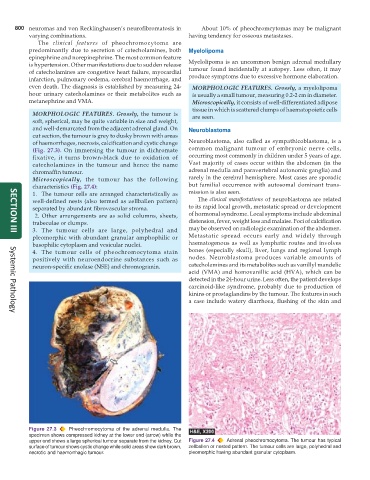
            Microscopically, the tumour has the following      rarely in the cerebral hemisphere. Most cases are sporadic
            characteristics (Fig. 27.4):                       but familial occurrence with autosomal dominant trans-
            1. The tumour cells are arranged characteristically as  mission is also seen.
            well-defined nests (also termed as zellballen pattern)  The clinical manifestations of neuroblastoma are related
            separated by abundant fibrovascular stroma.        to its rapid local growth, metastatic spread or development
             2. Other arrangements are as solid columns, sheets,  of hormonal syndrome. Local symptoms include abdominal
            trabeculae or clumps.                              distension, fever, weight loss and malaise. Foci of calcification
            3. The tumour cells are large, polyhedral and      may be observed on radiologic examination of the abdomen.
     SECTION III
            pleomorphic with abundant granular amphophilic or  Metastatic spread occurs early and widely through
            basophilic cytoplasm and vesicular nuclei.         haematogenous as well as lymphatic routes and involves
            4. The tumour cells of pheochromocytoma stain      bones (especially skull), liver, lungs and regional lymph
            positively with neuroendocrine substances such as  nodes. Neuroblastoma produces variable amounts of
            neuron-specific enolase (NSE) and chromogranin.    catecholamines and its metabolites such as vanillyl mandelic
                                                               acid (VMA) and homovanillic acid (HVA), which can be
                                                               detected in the 24-hour urine. Less often, the patient develops
                                                               carcinoid-like syndrome, probably due to production of
                                                               kinins or prostaglandins by the tumour. The features in such
                                                               a case include watery diarrhoea, flushing of the skin and

     Systemic Pathology


           Figure 27.3  Pheochromocytoma of the adrenal medulla. The
           specimen shows compressed kidney at the lower end (arrow) while the
           upper end shows a large spherical tumour separate from the kidney. Cut  Figure 27.4  Adrenal pheochromocytoma. The tumour has typical
           surface of tumour shows cystic change while solid areas show dark brown,  zellballen or nested pattern. The tumour cells are large, polyhedral and
           necrotic and haemorrhagic tumour.                   pleomorphic having abundant granular cytoplasm.

