


Page 819 - Textbook of Pathology, 6th Edition
P. 819
nervousness, palpitation, fatigue, weight loss in spite of good  1. Developmental anomalies e.g. thyroid agenesis and ectopic  803
           appetite, heat intolerance, perspiration, menstrual  thyroid.
           disturbances and fine tremors of the outstretched hands.  2. Genetic defect in thyroid hormone synthesis e.g. defect in
           Cardiac manifestations in the form of tachycardia,  iodine trapping, oxidation, iodination, coupling and
           palpitations and cardiomegaly are invariably present in  thyroglobulin synthesis.
           hyperthyroidism. The skin of these patients is warm, moist  3. Foetal exposure to iodides and antithyroid drugs.
           and flushed. Weakness of skeletal muscles and osteoporosis  4. Endemic cretinism in regions with endemic goitre due to
           are common. Typical eye changes in the form of exoph-  dietary lack of iodine (sporadic cretinism, on the other hand,
           thalmos are a common feature in Graves’ disease. Serum  is due to developmental anomalies and genetic defects in
           levels of T  and T  are elevated but TSH secretion is usually  thyroid hormone synthesis described above).
                   3
                         4
           inhibited.                                          CLINICAL FEATURES. The clinical manifestations usually
              A sudden spurt in the severity of hyperthyroidism termed  become evident within a few weeks to months of birth. The
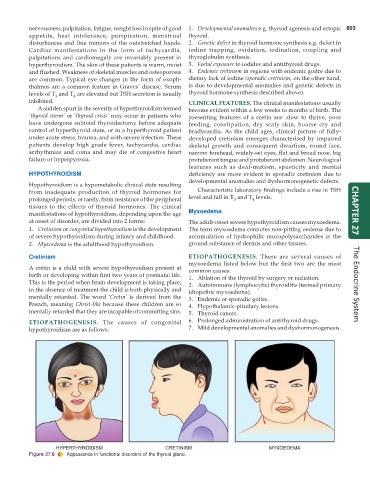
           ‘thyroid storm’ or ‘thyroid crisis’ may occur in patients who  presenting features of a cretin are: slow to thrive, poor
           have undergone subtotal thyroidectomy before adequate  feeding, constipation, dry scaly skin, hoarse cry and
           control of hyperthyroid state, or in a hyperthyroid patient  bradycardia. As the child ages, clinical picture of fully-
           under acute stress, trauma, and with severe infection. These  developed cretinism emerges characterised by impaired
           patients develop high grade fever, tachycardia, cardiac  skeletal growth and consequent dwarfism, round face,
           arrhythmias and coma and may die of congestive heart  narrow forehead, widely-set eyes, flat and broad nose, big
           failure or hyperpyrexia.                            protuberant tongue and protuberant abdomen. Neurological
                                                               features such as deaf-mutism, spasticity and mental
           HYPOTHYROIDISM                                      deficiency are more evident in sporadic cretinism due to
                                                               developmental anomalies and dyshormonogenetic defects.
           Hypothyroidism is a hypometabolic clinical state resulting
           from inadequate production of thyroid hormones for     Characteristic laboratory findings include a rise in TSH
           prolonged periods, or rarely, from resistance of the peripheral  level and fall in T  and T  levels.
                                                                                    4
                                                                              3
           tissues to the effects of thyroid hormones. The clinical
           manifestations of hypothyroidism, depending upon the age  Myxoedema                                        CHAPTER 27
           at onset of disorder, are divided into 2 forms:     The adult-onset severe hypothyroidism causes myxoedema.
           1. Cretinism or congenital hypothyroidism is the development  The term myxoedema connotes non-pitting oedema due to
           of severe hypothyroidism during infancy and childhood.  accumulation of hydrophilic mucopolysaccharides in the
           2. Myxoedema is the adulthood hypothyroidism.       ground substance of dermis and other tissues.
           Cretinism                                           ETIOPATHOGENESIS.  There are several causes of
                                                               myxoedema listed below but the first two are the most
           A cretin is a child with severe hypothyroidism present at  common causes:
           birth or developing within first two years of postnatal life.  1. Ablation of the thyroid by surgery or radiation.
           This is the period when brain development is taking place;  2. Autoimmune (lymphocytic) thyroiditis (termed primary  The Endocrine System
           in the absence of treatment the child is both physically and  idiopathic myxoedema).
           mentally retarded. The word  ‘Cretin’ is derived from the  3. Endemic or sporadic goitre.
           French, meaning  Christ-like  because these children are so  4. Hypothalamic-pituitary lesions.
           mentally retarded that they are incapable of committing sins.  5. Thyroid cancer.
           ETIOPATHOGENESIS.  The causes of congenital         6. Prolonged administration of antithyroid drugs.
           hypothyroidism are as follows:                      7. Mild developmental anomalies and dyshormonogenesis.


           Figure 27.6  Appearance in functional disorders of the thyroid gland.

