


Page 817 - Textbook of Pathology, 6th Edition
P. 817
801


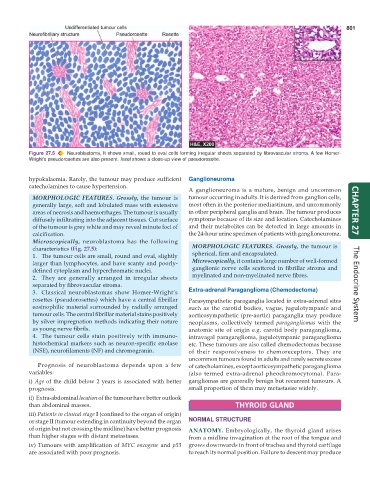
           Figure 27.5  Neuroblastoma, It shows small, round to oval cells forming irregular sheets separated by fibrovascular stroma. A few Homer-
           Wright’s pseudorosettes are also present. Inset shows a close-up view of pseudorosette.


           hypokalaemia. Rarely, the tumour may produce sufficient  Ganglioneuroma
           catecholamines to cause hypertension.
                                                               A ganglioneuroma is a mature, benign and uncommon
            MORPHOLOGIC FEATURES. Grossly, the tumour is       tumour occurring in adults. It is derived from ganglion cells,
            generally large, soft and lobulated mass with extensive  most often in the posterior mediastinum, and uncommonly
            areas of necrosis and haemorrhages. The tumour is usually  in other peripheral ganglia and brain. The tumour produces  CHAPTER 27
            diffusely infiltrating into the adjacent tissues. Cut surface  symptoms because of its size and location. Catecholamines
            of the tumour is grey white and may reveal minute foci of  and their metabolites can be detected in large amounts in
            calcification.                                     the 24-hour urine specimen of patients with ganglioneuroma.
            Microscopically, neuroblastoma has the following
            characteristics (Fig. 27.5):                         MORPHOLOGIC FEATURES. Grossly, the tumour is
            1. The tumour cells are small, round and oval, slightly  spherical, firm and encapsulated.
            larger than lymphocytes, and have scanty and poorly-  Microscopically, it contains large number of well-formed
            defined cytoplasm and hyperchromatic nuclei.         ganglionic nerve cells scattered in fibrillar stroma and
            2. They are generally arranged in irregular sheets   myelinated and non-myelinated nerve fibres.
            separated by fibrovascular stroma.                                                                        The Endocrine System
            3. Classical neuroblastomas show Homer-Wright’s    Extra-adrenal Paraganglioma (Chemodectoma)
            rosettes (pseudorosettes) which have a central fibrillar  Parasympathetic paraganglia located in extra-adrenal sites
            eosinophilic material surrounded by radially arranged  such as the carotid bodies, vagus, jugulotympanic and
            tumour cells. The central fibrillar material stains positively  aorticosympathetic (pre-aortic) paraganglia may produce
            by silver impregnation methods indicating their nature  neoplasms, collectively termed paragangliomas with the
            as young nerve fibrils.                            anatomic site of origin e.g. carotid body paraganglioma,
            4. The tumour cells stain positively with immuno-  intravagal paraganglioma, jugulotympanic paraganglioma
            histochemical markers such as neuron-specific enolase  etc. These tumours are also called chemodectomas because
            (NSE), neurofilaments (NF) and chromogranin.       of their responsiveness to chemoreceptors. They are
                                                               uncommon tumours found in adults and rarely secrete excess
              Prognosis of neuroblastoma depends upon a few    of catecholamines, except aorticosympathetic paraganglioma
           variables:                                          (also termed extra-adrenal pheochromocytoma). Para-
           i) Age of the child below 2 years is associated with better  gangliomas are generally benign but recurrent tumours. A
           prognosis.                                          small proportion of them may metastasise widely.
           ii)  Extra-abdominal location of the tumour have better outlook
           than abdominal masses.                                              THYROID GLAND
           iii) Patients in clinical stage I (confined to the organ of origin)
           or stage II (tumour extending in continuity beyond the organ  NORMAL STRUCTURE
           of origin but not crossing the midline) have better prognosis  ANATOMY.  Embryologically, the thyroid gland arises
           than higher stages with distant metastases.         from a midline invagination at the root of the tongue and
           iv) Tumours with amplification of MYC oncogene and p53  grows downwards in front of trachea and thyroid cartilage
           are associated with poor prognosis.                 to reach its normal position. Failure to descent may produce

