


Page 821 - Textbook of Pathology, 6th Edition
P. 821
805


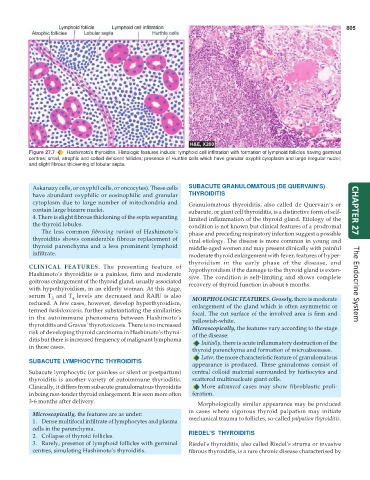
           Figure 27.7  Hashimoto’s thyroiditis. Histologic features include: lymphoid cell infiltration with formation of lymphoid follicles having germinal
           centres; small, atrophic and colloid-deficient follicles; presence of Hurthle cells which have granular oxyphil cytoplasm and large irregular nuclei;
           and slight fibrous thickening of lobular septa.


            Askanazy cells, or oxyphil cells, or oncocytes). These cells  SUBACUTE GRANULOMATOUS (DE QUERVAIN’S)
            have abundant oxyphilic or eosinophilic and granular  THYROIDITIS
            cytoplasm due to large number of mitochondria and  Granulomatous thyroiditis, also called de Quervain’s or
            contain large bizarre nuclei.                      subacute, or giant cell thyroiditis, is a distinctive form of self-  CHAPTER 27
            4. There is slight fibrous thickening of the septa separating  limited inflammation of the thyroid gland. Etiology of the
            the thyroid lobules.                               condition is not known but clinical features of a prodromal
               The less common  fibrosing variant of Hashimoto’s  phase and preceding respiratory infection suggest a possible
            thyroiditis shows considerable fibrous replacement of  viral etiology. The disease is more common in young and
            thyroid parenchyma and a less prominent lymphoid   middle-aged women and may present clinically with painful
            infiltrate.                                        moderate thyroid enlargement with fever, features of hyper-
                                                               thyroidism in the early phase of the disease, and
           CLINICAL FEATURES. The presenting feature of        hypothyroidism if the damage to the thyroid gland is exten-
           Hashimoto’s thyroiditis is a painless, firm and moderate  sive. The condition is self-limiting and shows complete
           goitrous enlargement of the thyroid gland, usually associated  recovery of thyroid function in about 6 months.
           with hypothyroidism, in an elderly woman. At this stage,                                                   The Endocrine System
           serum T  and T  levels are decreased and RAIU is also  MORPHOLOGIC FEATURES. Grossly, there is moderate
                  3
                         4
           reduced. A few cases, however, develop hyperthyroidism,  enlargement of the gland which is often asymmetric or
           termed hashitoxicosis, further substantiating the similarities  focal. The cut surface of the involved area is firm and
           in the autoimmune phenomena between Hashimoto’s       yellowish-white.
           thyroiditis and Graves’ thyrotoxicosis. There is no increased  Microscopically, the features vary according to the stage
           risk of developing thyroid carcinoma in Hashimoto’s thyroi-  of the disease:
           ditis but there is increased frequency of malignant lymphoma  Initially, there is acute inflammatory destruction of the
           in these cases.
                                                                 thyroid parenchyma and formation of microabscesses.
                                                                    Later, the more characteristic feature of granulomatous
           SUBACUTE LYMPHOCYTIC THYROIDITIS
                                                                 appearance is produced. These granulomas consist of
           Subacute lymphocytic (or painless or silent or postpartum)  central colloid material surrounded by histiocytes and
           thyroiditis is another variety of autoimmune thyrioditis.  scattered multinucleate giant cells.
           Clinically, it differs from subacute granulomatous thyroiditis  More advanced cases may show fibroblastic proli-
           in being non-tender thyroid enlargement. It is seen more often  feration.
           3-6 months after delivery.
                                                                  Morphologically similar appearance may be produced
            Microscopically, the features are as under:        in cases where vigorous thyroid palpation may initiate
            1. Dense multifocal infiltrate of lymphocytes and plasma  mechanical trauma to follicles, so-called palpation thyroiditis.
            cells in the parenchyma.
            2. Collapse of thyroid follicles.                  RIEDEL’S  THYROIDITIS
            3. Rarely, presence of lymphoid follicles with germinal  Riedel’s thyroiditis, also called Riedel’s struma or invasive
            centres, simulating Hashimoto’s thyroiditis.       fibrous thyroiditis, is a rare chronic disease characterised by

