


Page 822 - Textbook of Pathology, 6th Edition
P. 822
806 stony-hard thyroid that is densely adherent to the adjacent  i) Thyroid-stimulating immunoglobulin (TSI): It binds to TSH
           structures in the neck. The condition is clinically significant  receptor and stimulates increased release of thyroid hormone.
           due to compressive clinical features (e.g. dysphagia,  ii) Thyroid growth-stimulating immunoglobulins (TGI): It
           dyspnoea, recurrent laryngeal nerve paralysis and stridor)  stimulates proliferation of follicular epithelium.
           and resemblance with thyroid cancer. Riedel’s struma is seen  iii) TSH-binding inhibitor immunoglobulins (TBII): It is
           more commonly in females in 4th to 7th decades of life. The  inhibitory to binding of TSH to its own receptor. Depending
           etiology is unknown but possibly Riedel’s thyroiditis is a part  upon its action as inhibitory or stimulatory to follicular
           of multifocal idiopathic fibrosclerosis (page 591). This group of  epithelium, it may result in alternate episodes of hypo- and
           disorders includes: idiopathic retroperitoneal, mediastinal  hyperthyroidism.
           and retro-orbital fibrosis, and sclerosing cholangitis, all of  However, it is not quite clear what stimulates B cells to
           which may occur simultaneously with Riedel’s thyroiditis.  form these autoantibodies in Graves’ disease. Possibly,
                                                               intrathyroidal CD4+ helper T cells are responsible for
            MORPHOLOGIC FEATURES. Grossly, the thyroid gland   stimulating B cells to secrete autoantibodies.
            is usually contracted, stony-hard, asymmetric and firmly
            adherent to the adjacent structures. Cut section is hard  The pathogenesis of Graves’ infiltrative ophthalmopathy
            and devoid of lobulations.                         is also of autoimmune origin. The evidence in support is the
            Microscopically, there is extensive fibrocollagenous  intense lymphocytic infiltrate around the ocular muscles and
            replacement, marked atrophy of the thyroid parenchyma,  detection of circulating autoantibodies against muscle
            focally scattered lymphocytic infiltration and invasion of  antigen that cross-react with thyroid microsomes.
            the adjacent muscle tissue by the process.           MORPHOLOGIC FEATURES. Grossly, the thyroid is
                                                                 moderately, diffusely and symmetrically enlarged and
           GRAVES’ DISEASE (DIFFUSE TOXIC GOITRE)                may weigh up to 70-90 gm. On cut section, the thyroid
           Graves’ disease, also known as Basedow’s disease, primary  parenchyma is typically homogeneous, red-brown and
           hyperplasia, exophthalmic goitre, and diffuse toxic goitre, is  meaty and lacks the normal translucency.
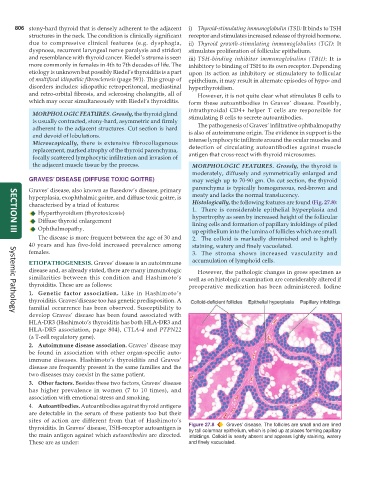
           characterised by a triad of features:                 Histologically, the following features are found (Fig. 27.8):
              Hyperthyroidism (thyrotoxicosis)                   1. There is considerable epithelial hyperplasia and
              Diffuse thyroid enlargement                        hypertrophy as seen by increased height of the follicular
                                                                 lining cells and formation of papillary infoldings of piled
              Ophthalmopathy.
                                                                 up epithelium into the lumina of follicles which are small.
     SECTION III
              The disease is more frequent between the age of 30 and  2. The colloid is markedly diminished and is lightly
           40 years and has five-fold increased prevalence among  staining, watery and finely vacuolated.
           females.                                              3. The stroma shows increased vascularity and
           ETIOPATHOGENESIS. Graves’ disease is an autoimmune    accumulation of lymphoid cells.
           disease and, as already stated, there are many immunologic  However, the pathologic changes in gross specimen as
           similarities between this condition and Hashimoto’s  well as on histologic examination are considerably altered if
           thyroiditis. These are as follows:                  preoperative medication has been administered. Iodine
           1. Genetic factor association. Like in Hashimoto’s
           thyroiditis. Graves’disease too has genetic predisposition. A
           familial occurrence has been observed. Susceptibility to
           develop Graves’ disease has been found associated with
     Systemic Pathology
           HLA-DR3 (Hashimoto’s thyroiditis has both HLA-DR3 and
           HLA-DR5 association, page 804),  CTLA-4 and  PTPN22
           (a T-cell regulatory gene).
           2. Autoimmune disease association. Graves’ disease may
           be found in association with other organ-specific auto-
           immune diseases. Hashimoto’s thyroiditis and Graves’
           disease are frequently present in the same families and the
           two diseases may coexist in the same patient.
           3. Other factors. Besides these two factors, Graves’ disease
           has higher prevalence in women (7 to 10 times), and
           association with emotional stress and smoking.
           4. Autoantibodies. Autoantibodies against thyroid antigens
           are detectable in the serum of these patients too but their
           sites of action are different from that of Hashimoto’s
           thyroiditis. In Graves’ disease, TSH-receptor autoantigen is  Figure 27.8  Graves’ disease. The follicles are small and are lined
                                                               by tall columnar epithelium, which is piled up at places forming papillary
           the main antigen against which autoantibodies are directed.  infoldings. Colloid is nearly absent and appears lightly staining, watery
           These are as under:                                 and finely vacuolated.

