


Page 841 - Textbook of Pathology, 6th Edition
P. 841
90 to 120 days which is lifespan of red cells (page 288) . are the usual precipitating causes. Severe lack of insulin 825
Similarly, there is accumulation of labile and reversible glyco- causes lipolysis in the adipose tissues, resulting in release of
sylation products on collagen and other tissues of the blood free fatty acids into the plasma. These free fatty acids are
vessel wall which subsequently become stable and taken up by the liver where they are oxidised through acetyl
irreversible by chemical changes and form advanced glyco- coenzyme-A to ketone bodies, principally acetoacetic acid
sylation end-products (AGE). The AGEs bind to receptors and β-hydroxybutyric acid. Such free fatty acid oxidation to
on different cells and produce a variety of biologic and ketone bodies is accelerated in the presence of elevated level
chemical changes e.g. thickening of vascular basement of glucagon. Once the rate of ketogenesis exceeds the rate at
membrane in diabetes. which the ketone bodies can be utilised by the muscles and
other tissues, ketonaemia and ketonuria occur. If urinary
2. Polyol pathway mechanism. This mechanism is excretion of ketone bodies is prevented due to dehydration,
responsible for producing lesions in the aorta, lens of the systemic metabolic ketoacidosis occurs. Clinically, the
eye, kidney and peripheral nerves. These tissues have an condition is characterised by anorexia, nausea, vomitings,
enzyme, aldose reductase, that reacts with glucose to form deep and fast breathing, mental confusion and coma. Most
sorbitol and fructose in the cells of the hyperglycaemic patient patients of ketoacidosis recover.
as under:
2. Hyperosmolar hyperglycaemic nonketotic coma (HHS).
aldose reductase
Glucose + NADH + H + > Sorbitol + NAD + Hyperosmolar hyperglycaemic nonketotic coma is usually a
complication of type 2 DM. It is caused by severe dehydration
sorbitol resulting from sustained hyperglycaemic diuresis. The loss
dehydrogenase of glucose in urine is so intense that the patient is unable to
Sorbitol + NAD > Fructose + NADH + H +
drink sufficient water to maintain urinary fluid loss. The
usual clinical features of ketoacidosis are absent but
Intracellular accumulation of sorbitol and fructose so
produced results in entry of water inside the cell and prominent central nervous signs are present. Blood sugar is
consequent cellular swelling and cell damage. Also, intra- extremely high and plasma osmolality is high. Thrombotic
cellular accumulation of sorbitol causes intracellular and bleeding complications are frequent due to high viscosity CHAPTER 27
deficiency of myoinositol which promotes injury to Schwann of blood. The mortality rate in hyperosmolar nonketotic coma
cells and retinal pericytes. These polyols result in disturbed is high.
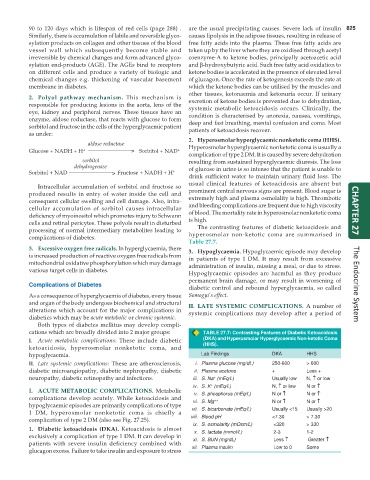
processing of normal intermediary metabolites leading to The contrasting features of diabetic ketoacidosis and
complications of diabetes. hyperosmolar non-ketotic coma are summarised in
Table 27.7.
3. Excessive oxygen free radicals. In hyperglycaemia, there 3. Hypoglycaemia. Hypoglycaemic episode may develop
is increased production of reactive oxygen free radicals from in patients of type 1 DM. It may result from excessive
mitochondrial oxidative phosphorylation which may damage administration of insulin, missing a meal, or due to stress.
various target cells in diabetes.
Hypoglycaemic episodes are harmful as they produce
permanent brain damage, or may result in worsening of
Complications of Diabetes The Endocrine System
diabetic control and rebound hyperglycaemia, so called
As a consequence of hyperglycaemia of diabetes, every tissue Somogyi’s effect.
and organ of the body undergoes biochemical and structural II. LATE SYSTEMIC COMPLICATIONS. A number of
alterations which account for the major complications in systemic complications may develop after a period of
diabetics which may be acute metabolic or chronic systemic.
Both types of diabetes mellitus may develop compli-
cations which are broadly divided into 2 major groups: TABLE 27.7: Contrasting Features of Diabetic Ketoacidosis
I. Acute metabolic complications: These include diabetic (DKA) and Hyperosmolar Hyperglycaemic Non-ketotic Coma
ketoacidosis, hyperosmolar nonketotic coma, and (HHS).
hypoglycaemia. Lab Findings DKA HHS
II. Late systemic complications: These are atherosclerosis, i. Plasma glucose (mg/dL) 250-600 > 600
diabetic microangiopathy, diabetic nephropathy, diabetic ii. Plasma acetone + Less +
neuropathy, diabetic retinopathy and infections. iii. S. Na (mEq/L) Usually low N, ↑↑ ↑↑ ↑ or low
+
iv. S. K (mEq/L) N, ↑↑ ↑↑ ↑ or low N or ↑↑ ↑↑ ↑
+
I. ACUTE METABOLIC COMPLICATIONS. Metabolic v. S. phosphorus (mEq/L) N or ↑↑ ↑↑ ↑ N or ↑↑ ↑↑ ↑
complications develop acutely. While ketoacidosis and ++ N or ↑↑ ↑↑ ↑ N or ↑↑ ↑↑ ↑
hypoglycaemic episodes are primarily complications of type vi. S. Mg
1 DM, hyperosmolar nonketotic coma is chiefly a vii. S. bicarbonate (mEq/L) Usually <15 Usually >20
complication of type 2 DM (also see Fig. 27.25). viii. Blood pH <7.30 > 7.30
ix. S. osmolarity (mOsm/L) <320 > 330
1. Diabetic ketoacidosis (DKA). Ketoacidosis is almost x. S. lactate (mmol/L) 2-3 1-2
exclusively a complication of type 1 DM. It can develop in Less ↑↑ ↑↑ ↑ Greater ↑↑ ↑↑ ↑
patients with severe insulin deficiency combined with xi. S. BUN (mg/dL)
glucagon excess. Failure to take insulin and exposure to stress xii. Plasma insulin Low to 0 Some

