


Page 842 - Textbook of Pathology, 6th Edition
P. 842
826 15-20 years in either type of diabetes. Late complications are 6. Infections. Diabetics have enhanced susceptibility to
largely responsible for morbidity and premature mortality various infections such as tuberculosis, pneumonias,
in diabetes mellitus. These complications are briefly outlined pyelonephritis, otitis, carbuncles and diabetic ulcers. This
below as they are discussed in detail in relevant chapters could be due to various factors such as impaired leucocyte
(Fig. 27.26,B). functions, reduced cellular immunity, poor blood supply due
1. Atherosclerosis. Diabetes mellitus of both type 1 and to vascular involvement and hyperglycaemia per se.
type 2 accelerates the development of atherosclerosis.
Consequently, atherosclerotic lesions appear earlier than in Diagnosis of Diabetes
the general population, are more extensive, and are more
often associated with complicated plaques such as ulceration, Hyperglycaemia remains the fundamental basis for the
calcification and thrombosis (page 398). The cause for this diagnosis of diabetes mellitus. In symptomatic cases, the
accelerated atherosclerotic process is not known but possible diagnosis is not a problem and can be confirmed by finding
contributory factors are hyperlipidaemia, reduced HDL glucosuria and a random plasma glucose concentration
levels, nonenzymatic glycosylation, increased platelet above 200 mg/dl.
adhesiveness, obesity and associated hypertension in The severity of clinical symptoms of polyuria and
diabetes. polydipsia is directly related to the degree of hyperglycaemia.
The possible ill-effects of accelerated atherosclerosis in In asymptomatic cases, when there is persistently elevated
diabetes are early onset of coronary artery disease, silent fasting plasma glucose level, diagnosis again poses no
myocardial infarction, cerebral stroke and gangrene of the difficulty.
toes and feet. Gangrene of the lower extremities is 100 times The problem arises in asymptomatic patients who have
more common in diabetics than in non-diabetics. normal fasting glucose level in the plasma but are suspected
2. Diabetic microangiopathy. Microangiopathy of diabetes to have diabetes on other grounds and are thus subjected to
is characterised by basement membrane thickening of small oral glucose tolerance test (GTT). If abnormal GTT values
blood vessels and capillaries of different organs and tissues are found, these subjects are said to have ‘chemical diabetes’
such as the skin, skeletal muscle, eye and kidney. Similar (Fig. 27.27). The American Diabetes Association (2007) has
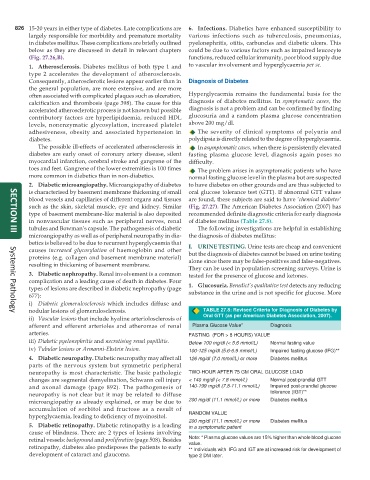
type of basement membrane-like material is also deposited recommended definite diagnostic criteria for early diagnosis
in nonvascular tissues such as peripheral nerves, renal of diabetes mellitus (Table 27.8).
tubules and Bowman’s capsule. The pathogenesis of diabetic The following investigations are helpful in establishing
microangiopathy as well as of peripheral neuropathy in dia- the diagnosis of diabetes mellitus:
SECTION III
betics is believed to be due to recurrent hyperglycaemia that I. URINE TESTING. Urine tests are cheap and convenient
causes increased glycosylation of haemoglobin and other but the diagnosis of diabetes cannot be based on urine testing
proteins (e.g. collagen and basement membrane material) alone since there may be false-positives and false-negatives.
resulting in thickening of basement membrane.
They can be used in population screening surveys. Urine is
3. Diabetic nephropathy. Renal involvement is a common tested for the presence of glucose and ketones.
complication and a leading cause of death in diabetes. Four
types of lesions are described in diabetic nephropathy (page 1. Glucosuria. Benedict’s qualitative test detects any reducing
677): substance in the urine and is not specific for glucose. More
i) Diabetic glomerulosclerosis which includes diffuse and
nodular lesions of glomerulosclerosis. TABLE 27.8: Revised Criteria for Diagnosis of Diabetes by
Systemic Pathology
ii) Vascular lesions that include hyaline arteriolosclerosis of Oral GTT (as per American Diabetes Association, 2007).
afferent and efferent arterioles and atheromas of renal Plasma Glucose Value* Diagnosis
arteries. FASTING (FOR > 8 HOURS) VALUE
iii) Diabetic pyelonephritis and necrotising renal papillitis. Below 100 mg/dl (< 5.6 mmol/L) Normal fasting value
iv) Tubular lesions or Armanni-Ebstein lesion. 100-125 mg/dl (5.6-6.9 mmol/L) Impaired fasting glucose (IFG)**
4. Diabetic neuropathy. Diabetic neuropathy may affect all 126 mg/dl (7.0 mmol/L) or more Diabetes mellitus
parts of the nervous system but symmetric peripheral
neuropathy is most characteristic. The basic pathologic TWO-HOUR AFTER 75 GM ORAL GLUCOSE LOAD
changes are segmental demyelination, Schwann cell injury < 140 mg/dl (< 7.8 mmol/L) Normal post-prandial GTT
and axonal damage (page 892). The pathogenesis of 140-199 mg/dl (7.8-11.1 mmol/L) Impaired post-prandial glucose
neuropathy is not clear but it may be related to diffuse tolerance (IGT)**
microangiopathy as already explained, or may be due to 200 mg/dl (11.1 mmol/L) or more Diabetes mellitus
accumulation of sorbitol and fructose as a result of
hyperglycaemia, leading to deficiency of myoinositol. RANDOM VALUE
200 mg/dl (11.1 mmol/L) or more Diabetes mellitus
5. Diabetic retinopathy. Diabetic retinopathy is a leading in a symptomatic patient
cause of blindness. There are 2 types of lesions involving
retinal vessels: background and proliferative (page 508). Besides Note: * Plasma glucose values are 15% higher than whole blood glucose
retinopathy, diabetes also predisposes the patients to early value.
** Individuals with IFG and IGT are at increased risk for development of
development of cataract and glaucoma. type 2 DM later.

