


Page 891 - Textbook of Pathology, 6th Edition
P. 891
Leptomeningitis, commonly called meningitis, is usually                                               875
           the result of infection but infrequently chemical meningitis
           and carcinomatous meningitis by infiltration of the
           subarachnoid space by cancer cells may occur. Infectious
           meningitis is broadly classified into 3 types: acute pyogenic,
           acute lymphocytic (viral, aseptic) and chronic (bacterial or
           fungal).


           Acute Pyogenic Meningitis
           Acute pyogenic or acute purulent meningitis is acute infec-
           tion of the pia-arachnoid and of the CSF enclosed in the
           subarachnoid space. Since the subarachnoid space is
           continuous around the brain, spinal cord and the optic
           nerves, infection spreads immediately to whole of the
           cerebrospinal meninges as well as to the ventricles.

           ETIOPATHOGENESIS. The causative organisms vary with
           age of the patient:
           1. Escherichia coli infection is common in neonates with
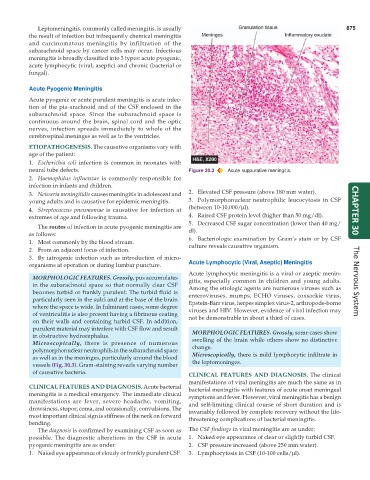
           neural tube defects.                                Figure 30.3   Acute suppurative meningitis.
           2. Haemophilus influenzae is commonly responsible for
           infection in infants and children.
           3. Neisseria meningitidis causes meningitis in adolescent and  2. Elevated CSF pressure (above 180 mm water).
           young adults and is causative for epidemic meningitis.  3. Polymorphonuclear neutrophilic leucocytosis in CSF
           4. Streptococcus pneumoniae  is causative for infection at  (between 10-10,000/μl).                        CHAPTER 30
           extremes of age and following trauma.               4. Raised CSF protein level (higher than 50 mg/dl).
                                                               5. Decreased CSF sugar concentration (lower than 40 mg/
              The routes of infection in acute pyogenic meningitis are
           as follows:                                         dl).
           1. Most commonly by the blood stream.               6. Bacteriologic examination by Gram’s stain or by CSF
           2. From an adjacent focus of infection.             culture reveals causative organism.
           3. By iatrogenic infection such as introduction of micro-
           organisms at operation or during lumbar puncture.   Acute Lymphocytic (Viral, Aseptic) Meningitis
                                                               Acute lymphocytic meningitis is a viral or aseptic menin-
            MORPHOLOGIC FEATURES. Grossly, pus accumulates     gitis, especially common in children and young adults.
            in the subarachnoid space so that normally clear CSF  Among the etiologic agents are numerous viruses such as  The Nervous System
            becomes turbid or frankly purulent. The turbid fluid is  enteroviruses, mumps, ECHO viruses, coxsackie virus,
            particularly seen in the sulci and at the base of the brain  Epstein-Barr virus, herpes simplex virus-2, arthropode-borne
            where the space is wide. In fulminant cases, some degree  viruses and HIV. However, evidence of viral infection may
            of ventriculitis is also present having a fibrinous coating  not be demonstrable in about a third of cases.
            on their walls and containing turbid CSF. In addition,
            purulent material may interfere with CSF flow and result
            in obstructive hydrocephalus.                        MORPHOLOGIC FEATURES. Grossly, some cases show
            Microscopically, there is presence of numerous       swelling of the brain while others show no distinctive
            polymorphonuclear neutrophils in the subarachnoid space  change.
            as well as in the meninges, particularly around the blood  Microscopically, there is mild lymphocytic infiltrate in
            vessels (Fig. 30.3). Gram-staining reveals varying number  the leptomeninges.
            of causative bacteria.
                                                               CLINICAL FEATURES AND DIAGNOSIS. The clinical
                                                               manifestations of viral meningitis are much the same as in
           CLINICAL FEATURES AND DIAGNOSIS. Acute bacterial    bacterial meningitis with features of acute onset meningeal
           meningitis is a medical emergency. The immediate clinical  symptoms and fever. However, viral meningitis has a benign
           manifestations are fever, severe headache, vomiting,  and self-limiting clinical course of short duration and is
           drowsiness, stupor, coma, and occasionally, convulsions. The  invariably followed by complete recovery without the life-
           most important clinical sign is stiffness of the neck on forward  threatening complications of bacterial meningitis.
           bending.
              The diagnosis is confirmed by examining CSF as soon as  The CSF findings in viral meningitis are as under:
           possible. The diagnostic alterations in the CSF in acute  1. Naked eye appearance of clear or slightly turbid CSF.
           pyogenic meningitis are as under:                   2. CSF pressure increased (above 250 mm water).
           1. Naked eye appearance of cloudy or frankly purulent CSF.  3. Lymphocytosis in CSF (10-100 cells/μl).

